


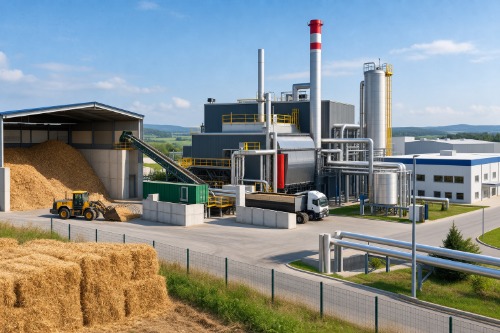
Bulgarian pet food producer Furajny Hrany Ltd. has commissioned a second KARA biomass boiler house at its production facility in Lovech, expanding its installed biomass capacity to 5.7 MW and replacing natural gas for the associated process heat demand.
The new biomass combustion system has a capacity of 3.4 MW and builds on a 2.3 MW KARA installation commissioned at the site in 2017. The company uses straw generated from its own agricultural activities as fuel, creating an integrated biomass energy system linked directly to its agricultural and manufacturing operations.
According to the company, the transition from natural gas to biomass heat is expected to reduce CO₂ emissions by more than 10,000 tonnes annually.
Second biomass boiler expands renewable heat capacity
The new 3.4 MW installation brings Furajny Hrany’s total KARA biomass combustion capacity to 5.7 MW.
The investment is designed to supply renewable thermal energy for the company’s pet food manufacturing operations while reducing its reliance on fossil fuel for process heat.
The project represents the second stage of a biomass transition that began with the commissioning of the first 2.3 MW boiler house nearly a decade ago.
Rather than introducing biomass as an externally sourced fuel alone, Furajny Hrany has connected the energy system to its own agricultural activities, using residual straw from crop production.
Agricultural residue becomes industrial fuel
Furajny Hrany grows agricultural crops that provide ingredients for its dog and cat food production. Straw left over from these agricultural operations is subsequently used as fuel in the biomass installations.
The arrangement links three stages of the company’s operations: crop cultivation, pet food manufacturing and renewable heat generation.
The agricultural residue that would otherwise remain outside the main food-production stream is therefore used to generate process heat at the same broader production operation.
The company says this approach has enabled it to eliminate natural gas use for the relevant heat production and achieve an estimated annual CO₂ reduction of more than 10,000 tonnes.
Project marks continuation of KARA partnership
The new boiler house was officially opened on September 3, 2026, by Furajny Hrany owner Desislava Hristova-Stankova, Dutch Ambassador to Bulgaria Arthur den Hartog and KARA Future Energy Systems CEO Robert Reinders.
The commissioning extends a partnership between Furajny Hrany and KARA that began with the first biomass installation in 2017.
Hristova-Stankova said the second boiler house represented an important milestone for the company and highlighted the use of straw from its own agricultural activities to produce energy for manufacturing.
KARA CEO Reinders said the additional capacity demonstrates how an industrial biomass project can expand alongside a customer’s changing energy requirements. He also highlighted the company’s use of biomass generated within its own agricultural value chain.
Biomass integrated into pet food production
Furajny Hrany manufactures dog and cat food at its Lovech facility and operates under ISO 9001 and ISO 22000-certified quality management and food safety systems.
The biomass project adds renewable thermal energy to that production model, using an agricultural residue originating from the company’s own operations.
With 5.7 MW of combined biomass combustion capacity, the facility now has a larger renewable heat system supporting its manufacturing activities.
The project demonstrates how industrial companies with access to agricultural residues can connect feedstock generation and energy demand within the same production chain, potentially reducing both fossil fuel consumption and the need to transport biomass over longer distances.
Bioenergy Business Analysis
The Furajny Hrany project illustrates the potential of vertically integrated biomass systems in industries that generate agricultural residues while also requiring substantial process heat. In this case, straw produced through the company’s agricultural activities is connected directly to the thermal requirements of its pet food manufacturing operation.
The expansion from 2.3 MW to 5.7 MW also shows how biomass infrastructure can develop incrementally as industrial energy requirements evolve. The reported reduction of more than 10,000 tonnes of CO₂ per year is a company estimate associated with replacing natural gas for the relevant heat demand.
For other agricultural and food-processing businesses, the model highlights the value of assessing internally generated residues as potential energy resources. Its applicability will depend on factors including residue availability, competing uses for biomass, boiler requirements, logistics and the facility’s heat demand.
Furajny Hrany’s second biomass boiler therefore links renewable heat generation with an existing agricultural supply chain, making energy production part of the wider manufacturing model rather than a separate operation.
Read also: Seras expands UK waste wood operations with Enva acquisition