

VERDE Hydrogen’s large-scale alkaline water electrolysis system at China’s Yongli Hydrogen Plant has moved from demonstration operation into sustained commercial production after more than 760 days of safe and stable operation.
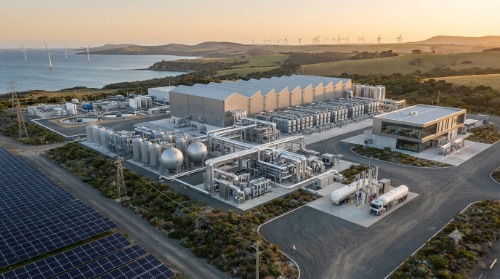
The facility, located at the Ningdong Energy and Chemical Industry Base, reached full-load hydrogen production of 5,000 Nm³/h on September 9, 2026, with the hydrogen produced at full load supplied to external customers, according to a company announcement. The milestone represents the commercial operation of a five-electrolyser configuration in which five 1,000 Nm³/h-class alkaline electrolyzers share a central balance-of-plant system.
VERDE describes the configuration as the world’s first large-scale asymmetric “Five-to-One” water electrolysis system, although that designation is a company claim. The system has a designed annual hydrogen output of approximately 1,428.6 tonnes of high-purity hydrogen.
The company says hydrogen purity has remained above 99.999% during operation.
Five Electrolyzers Share One Centralised System
The Yongli project uses five alkaline electrolyzers, each in the 1,000 Nm³/h class, to provide a combined hydrogen production capacity of 5,000 Nm³/h.
Rather than providing each electrolyzer with an individual auxiliary system, VERDE’s architecture connects the five units to a shared central balance of plant.
The company’s scope covered the system architecture, alkaline electrolyzers, gas-liquid separation, hydrogen purification, balance-of-plant integration and multi-electrolyzer control.
This configuration is intended to reduce duplication of auxiliary equipment and associated infrastructure while allowing multiple electrolyzers to operate as a coordinated production system.
VERDE says the approach can reduce equipment redundancy, plant footprint, infrastructure investment and long-term operations and maintenance requirements compared with conventional configurations in which each electrolyzer has its own auxiliary system.
Full-Load Operation Follows More Than 760 Days of Testing
The latest milestone is notable because the system has operated for more than two years rather than being limited to a short-duration demonstration.
VERDE said the complete hydrogen production system had accumulated more than 760 days of safe and stable operation before reaching full-load production and commercial sales.
An industry report from Shanghai Metals Market also reported the Yongli plant’s 5,000 Nm³/h full-load operation, approximately 1,428.6 tonnes of annual capacity and more than 760 days of stable operation.
The plant’s move to full production means the electrolyzer system is now linked to an operating commercial customer base rather than being evaluated solely through technical demonstration.
VERDE said the plant set a new record for daily hydrogen sales when the full-load production was supplied to external customers.
Production Capacity Increased While Energy Consumption Fell
According to VERDE, optimisation and full-capacity operation increased the project’s overall production capacity by approximately 70%, while overall energy consumption declined by approximately 16%.
These figures are company-reported performance results and should therefore be distinguished from independently verified benchmarks for alkaline electrolysis technology. The system has also maintained hydrogen purity above 99.999%, according to VERDE.
The combination of higher utilisation and lower reported energy consumption is particularly relevant to the economics of renewable hydrogen, where electricity consumption represents a major component of operating cost.
System Designed for Renewable Power Flexibility
The five-to-one architecture is designed for operation with renewable electricity, including variable wind and solar generation.
This operating model is relevant to renewable hydrogen projects because electrolyzers connected to variable renewable generation may need to operate across a range of loads rather than at constant output.
A centralised control system can coordinate multiple electrolyzers according to available power and production requirements, although the economic value of that flexibility depends on electricity prices, renewable-resource profiles, utilisation rates and hydrogen offtake arrangements.
Yongli Project Points to Larger Multi-Electrolyzer Configurations
The commercial operation of the Yongli system provides a field example of using multiple large alkaline electrolyzers within a shared auxiliary infrastructure.
VERDE says the experience demonstrates the potential for centralised multi-electrolyzer systems to be scaled towards hundreds-of-megawatts and gigawatt-scale hydrogen projects.
That conclusion remains forward-looking. The Yongli installation has a production capacity of 5,000 Nm³/h and a designed annual output of about 1,428.6 tonnes, while projects at hundreds-of-megawatts or gigawatt scale would involve substantially larger numbers of electrolyzers, power systems, hydrogen handling equipment and supporting infrastructure.
The operational data from Yongli could nevertheless provide useful experience in coordinating multiple alkaline electrolyzers and their common balance-of-plant systems.
Commercial Hydrogen Sales Mark Shift Beyond Demonstration
The transition to regular external sales is an important part of the project’s latest development.
Hydrogen projects can demonstrate electrolyzer performance under controlled conditions without necessarily establishing that the technology can operate continuously within a commercial supply chain. At Yongli, VERDE says the system has accumulated more than 760 days of operation and is now producing hydrogen at full load for external customers.
That does not by itself establish the broader commercial viability of all large-scale alkaline electrolysis projects. Project economics remain dependent on electricity costs, electrolyzer utilisation, capital expenditure, hydrogen prices, infrastructure and the availability of suitable renewable power.
However, the Yongli operating record adds a longer-duration industrial reference point for VERDE’s multi-electrolyzer architecture.
VERDE Hydrogen Targets Wider Deployment
Following the Yongli milestone, VERDE says it will continue developing large-scale water electrolysis, intelligent multi-electrolyzer integration and renewable hydrogen systems.
The company’s stated objective is to support a shift from demonstration projects towards larger commercial deployments.
The key question for future projects will be whether the operating and infrastructure efficiencies reported at Yongli can be reproduced as system size increases and as projects integrate larger quantities of variable renewable electricity.