

Voestalpine and VERBUND have launched the expanded H2FUTURE hydrogen pilot plant in Linz, Austria, moving the research facility beyond green hydrogen production to cover its compression, purification, storage, loading and supply for industrial applications.
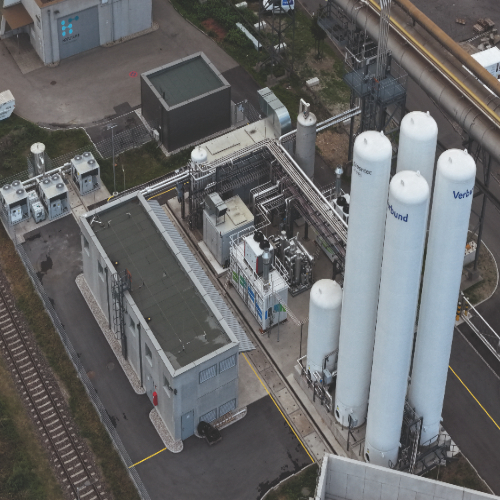
The expansion, costing €16.4 million, adds a hydrogen compression and purification unit and five storage tanks to the plant at voestalpine’s Linz site. The partners said the expanded facility will allow them to investigate hydrogen quality parameters, particularly purity and pressure, as well as the handling and provision of hydrogen for industrial applications.
The development represents the next phase of the H2FUTURE project, which has operated at the Linz site since 2019 and was commissioned at the time as the world’s largest hydrogen pilot plant.
Under the expanded H2FUTURE-Follow-Up project, hydrogen produced through electrolysis will be compressed, purified and temporarily stored before being supplied for further use.
Four of the five new storage tanks will be used to manage fluctuations between hydrogen production and consumption. This storage function is intended to help maintain a more consistent hydrogen supply despite variations in electrolysis output and demand.
The fifth tank will serve as a shipping and supply tank. From the end of 2027, it is planned to supply hydrogen directly to the HY4SMELT industrial-scale demonstration plant through a pipeline of approximately 1 kilometre.
HY4SMELT is being developed at the voestalpine Linz site to investigate hydrogen-based direct reduction of ultra-fine iron ores combined with electric smelting.
The original H2FUTURE facility was primarily focused on the production and operational characteristics of green hydrogen. The follow-up project broadens that work to include the treatment and delivery of hydrogen at specifications required by industrial applications.
Hydrogen generated by the existing electrolysis system will be compressed and purified before entering the new storage infrastructure.
The facility will also be capable of compressing hydrogen to up to 500 bar and loading it into trailers for road transportation. This creates a route for the hydrogen to be supplied to external customers and research or industrial projects.
One example is the SuSteel research project at voestalpine’s Donawitz site, which can receive hydrogen transported by trailer from the Linz facility.
The expanded infrastructure therefore connects hydrogen production with several downstream use cases rather than treating electrolysis as an isolated production process.
Existing six-megawatt PEM plant remains central to project
H2FUTURE has been operating since 2019 and is one of the world’s longest-running proton exchange membrane (PEM) electrolysis plants.
The existing installation consists of 12 stacks, each containing 50 electrolysis cells, with a connected load of 6 MW. It can produce up to 1,200 cubic metres of green hydrogen per hour.
According to voestalpine, the plant has produced almost 2,000 tonnes of green hydrogen since commissioning and has been used for multiple research and testing programmes.
A previous stress test demonstrated the plant’s ability to operate continuously and respond rapidly to significant changes in electrical load. The facility has also been used to help balance fluctuations in the electricity grid associated with changing renewable power availability and electricity demand.
The new infrastructure adds hydrogen handling and storage capabilities around this established electrolysis platform.
Hydrogen to support voestalpine’s steel decarbonisation programme
The expanded H2FUTURE project is closely linked to voestalpine’s greentec steel transformation programme.
The company plans to commission a green-electricity-powered electric arc furnace at both its Linz and Donawitz sites in the first half of 2027. The initial transition is expected to reduce the group’s CO₂ emissions by up to 30% by 2029, compared with 2019 levels.
Voestalpine has set a longer-term objective of achieving net-zero CO₂ emissions in steel production by 2050.
Hydrogen is expected to play a role in technologies being researched for the later stages of that transition, particularly processes involving hydrogen-based reduction of iron ore.
The connection between H2FUTURE and HY4SMELT provides a direct test environment for integrating renewable hydrogen production with an industrial steelmaking research application.
HY4SMELT creates a direct hydrogen demand pathway
HY4SMELT is being developed as an industrial-scale demonstration project combining hydrogen-based direct reduction of ultra-fine iron ores with an electric smelting process.
Construction of the project is progressing at the Linz site, with first production targeted for the end of 2027. The hydrogen required for the direct-reduction process will come from H2FUTURE through the dedicated pipeline connection.
This arrangement gives the expanded H2FUTURE facility a defined industrial application for its hydrogen output while allowing researchers to examine the requirements associated with supplying hydrogen to a larger-scale process.
H2FUTURE expansion supports voestalpine’s green steel strategy
The expanded H2FUTURE facility is intended to provide practical insights into how hydrogen can be conditioned and supplied for industrial applications. The new compression and purification systems will allow hydrogen produced through electrolysis to be processed to the required purity and pressure before being temporarily stored or supplied to downstream users.
The infrastructure is closely linked to voestalpine’s broader strategy to reduce emissions from steel production. The company plans to bring one green-electricity-powered electric arc furnace into operation at each of its Linz and Donawitz sites in the first half of 2027.
“With greentec steel we have a clear strategy to transform our steel production. In the first half of 2027, one green electricity-powered electric arc furnace at each of the Linz and Donawitz sites will go into operation, enabling us to save up to 30% of our CO2 emissions by 2029 as a first step. In the long term, we aim to achieve net-zero CO2 emissions in steel production by 2050. Hydrogen will play an important role in this process. Together with our partner VERBUND, we will gain further crucial insights thanks to this research infrastructure, the only one of its kind in Europe.”
Herbert Eibensteiner, CEO, voestalpine AG
The expanded hydrogen infrastructure will also support the company’s work on hydrogen-based steelmaking. From the end of 2027, the fifth storage tank, designed as a “shipping” tank, is expected to supply hydrogen directly to the HY4SMELT demonstration plant through an approximately 1-km pipeline.
Functional testing begins as project runs through 2030
The first functional tests of the expanded H2FUTURE-Follow-Up project have already started, with initial research results expected by the end of 2026.
The research programme is scheduled to continue until December 2030 and is being supported by funding from Austria’s Federal Ministry of Economy, Energy and Tourism.
For voestalpine and VERBUND, the project is intended to generate practical data on how renewable electricity can be converted into hydrogen and subsequently compressed, purified, stored and delivered at specifications required by industrial users.