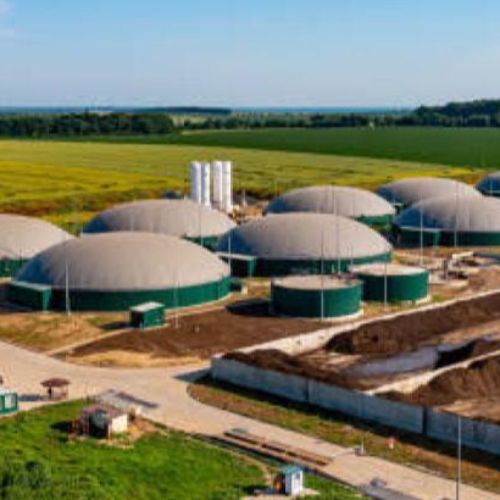
The UK’s Anaerobic Digestion and Bioresources Association (ADBA) has urged the government to release funding for new biomethane projects after the 28 October 2026 Budget allocated £27 million from general taxation to the first Hydrogen Allocation Round (HAR1), while the Green Gas Support Scheme (GGSS) application cap remains a concern for developers.
ADBA says more than a dozen projects are ready to proceed but are awaiting approval under the scheme. The industry association has warned that continued restrictions could delay investment and lead to project cancellations, and is calling for ministers to unlock additional support for biomethane production.
Biomethane developers face funding uncertainty
The GGSS supports new anaerobic digestion (AD) facilities that upgrade biogas into biomethane for injection into the gas grid. Funded through the Green Gas Levy on licensed fossil gas suppliers, the scheme provides tariff payments linked to eligible biomethane injected into the network.
The application budget for the 2026-27 financial year was set at £124.9 million. ADBA says the cap has remained frozen for more than four months and could remain so until the 2027 spending review.
The association argues that uncertainty over the availability of tariff support could make it harder for developers to progress projects requiring substantial upfront capital. It warns that prolonged delays could undermine investment decisions across the UK biomethane sector.
ADBA challenges the funding balance between hydrogen and biomethane
ADBA has questioned why the Budget provides £27 million in Exchequer funding for HAR1 while new biomethane projects continue to face uncertainty over the GGSS budget cap.
The association argues that biomethane is an established renewable gas option that can contribute to domestic energy supply using agricultural residues and organic waste. It also contends that biomethane offers better value for money than hydrogen, although that comparison is ADBA’s position rather than an independently established conclusion across all applications.
Chris Huhne, chair of ADBA, said the Budget had missed an opportunity to support domestically produced green gas. He called on the government to lift the GGSS cap so projects awaiting approval could move towards construction and supply gas to UK homes.
Security of supply at the centre of the argument
ADBA is also urging ministers to use the Budget’s provision for new policy costs considered essential to security of supply as a basis for releasing additional biomethane support.
The association argues that domestic biomethane production could displace imported liquefied natural gas (LNG) and reduce exposure to international gas-price volatility. It has proposed three possible routes to funding: applying the security-of-supply provision, using Green Gas Levy funds already collected but not spent, or providing direct Exchequer support.
Industry welcomes changes to gas levies
Despite its criticism of biomethane funding, ADBA welcomed two other measures announced in the Budget.
The first is the move to shift gas standing charges onto the unit rate. ADBA said this would distribute Green Gas Levy costs more closely in line with fossil gas consumption, placing a greater share of the cost on heavier users.
The association also welcomed the decision to scrap the proposed Gas Shipper Obligation, which was intended to help fund hydrogen production subsidies. ADBA had opposed the proposed arrangement because biomethane could also have faced the charge, increasing the cost of one low-carbon gas to support another.
ADBA further welcomed the government’s continued commitment to net zero emissions by 2050 and its focus on household energy affordability ahead of winter.
Bioenergy Business Analysis
The dispute highlights a policy challenge for the UK’s low-carbon gas market: how to allocate public support between technologies at different stages of development while maintaining affordability, energy security and investment certainty.
Biomethane can use organic waste and agricultural residues as feedstock, providing a route to renewable gas production alongside potential waste-management and agricultural benefits. Where it meets the necessary technical and commercial requirements, grid-injected biomethane can contribute to gas supplies without requiring consumers to switch to a different gaseous fuel.
Hydrogen and biomethane also have different production pathways, infrastructure requirements and potential applications. ADBA’s assertion that biomethane provides better value for money should be assessed against comparable project costs, emissions reductions, end uses and system requirements rather than treated as a universal conclusion.
The immediate issue for developers is policy certainty. If the GGSS application cap remains constrained, projects awaiting tariff guarantees may face delays while developers reassess financing and construction plans. Conversely, additional support would need to be evaluated against the scheme’s budget, levy costs and expected benefits to consumers.
The next important indicators are whether the government changes the GGSS budget arrangements, how it responds to ADBA’s proposed funding options, and whether projects awaiting approval can secure the support needed to proceed. Those decisions will help determine the pace at which the UK can expand domestic biomethane production.