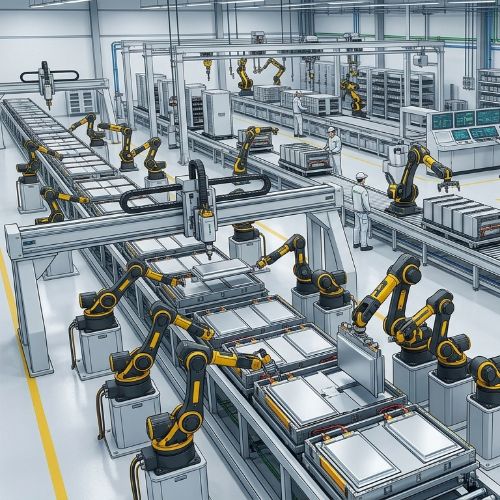
Mecpower Solutions and Navitas Solar have partnered to establish a battery energy storage system (BESS) manufacturing facility with a planned annual capacity of 5 gigawatt-hours (GWh) in Karjan, Gujarat, with operations targeted for the first quarter of the 2027-28 financial year. The project aims to expand India’s domestic battery storage assembly and integration capabilities as renewable energy deployment increases demand for grid-scale storage.
The proposed facility will combine Mecpower Solutions’ expertise in renewable energy project development, engineering and execution with Navitas Solar’s manufacturing capabilities. According to the companies’ announcement, its output is expected to support utility-scale renewable energy projects, engineering, procurement and construction (EPC) deployments, and commercial and industrial (C&I) applications.
Facility to focus on battery storage assembly and integration
The Karjan project is intended to integrate manufacturing, system engineering and project deployment within a single operating platform. The companies aim to develop storage systems suited to different project sizes and electricity-use requirements.
A report by Mercom India, based on an interview with Mecpower Solutions Director Setul Shah, indicates that the facility will focus on assembling battery storage systems and integrating their key components rather than manufacturing every element of the battery supply chain locally. These components include battery packs, racks, battery management systems (BMS), power conversion systems (PCS) and energy management systems (EMS).
Battery cells are expected to be sourced externally during the initial phase, according to Shah, reflecting the need to supplement domestic cell manufacturing capacity. The facility’s initial focus will therefore be on system assembly, engineering and integration rather than complete upstream battery production.
Domestic storage capacity to support renewable energy projects
Battery energy storage systems can store electricity when generation is high and release it when demand rises or renewable output declines. This capability is increasingly relevant to power systems with growing shares of solar and wind generation, whose output varies with weather and time of day.
For project developers, storage can support the delivery of electricity during specified periods, improve flexibility in managing power supply and help integrate renewable generation into the grid. The commercial value of each installation depends on factors including its duration, efficiency, operating costs and the electricity market or contract in which it participates.
The planned Karjan facility is expected to supply systems for both companies’ projects, including utility-scale deployments and EPC contracts. Its planned 5 GWh annual capacity is intended to position the collaboration to serve a range of storage requirements across India’s renewable energy market.
Mecpower and Navitas outline their expansion plans
Setul Shah, Director of Mecpower Solutions, said the planned facility would extend the company’s capabilities across the energy storage value chain and complement its engineering, procurement and construction and independent power producer (IPP) businesses.
He said battery storage would be important for managing variability in solar and wind generation, improving grid flexibility and enabling more predictable electricity delivery as India’s renewable energy capacity expands.
Ankit Singhania, Director of Navitas Solar, said the collaboration would extend the company’s manufacturing activities into energy storage. He highlighted the importance of developing domestic manufacturing capabilities to support utility-scale storage requirements and strengthen India’s clean-energy supply chain.
The statements reflect the companies’ rationale for the partnership; the facility’s ultimate contribution will depend on its commissioning, production ramp-up and ability to secure orders.
Bioenergy Business Analysis
The proposed 5 GWh facility reflects a broader shift in India’s renewable energy industry towards combining power generation with storage infrastructure. As solar and wind capacity grows, battery storage can help address differences between when electricity is generated and when it is needed.
For Mecpower Solutions and Navitas Solar, the collaboration offers a route to link storage-system assembly with renewable energy project development and manufacturing. A facility serving both companies’ project requirements could help coordinate equipment supply and deployment, although its commercial impact will depend on actual production volumes, procurement costs and customer demand.
The next milestones to watch are progress towards commissioning, the availability of battery cells and other components, production ramp-up, and orders from utility-scale and commercial customers. These factors will help establish whether the planned capacity translates into sustained domestic supply of integrated battery storage systems.