


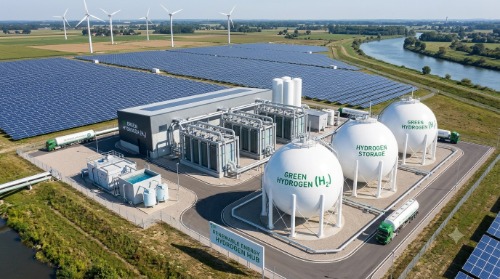
India is targeting annual green hydrogen production capacity of 5 million metric tonnes (MMT) by 2030 under the National Green Hydrogen Mission, with the government projecting more than ₹8 lakh crore in investment, over six lakh jobs and annual carbon dioxide emissions avoidance of nearly 50 MMT. The programme is also expected to reduce cumulative fossil fuel imports by approximately ₹1 lakh crore by 2030.
The targets form part of India’s strategy to reduce dependence on imported fossil fuels, decarbonise emissions-intensive industries and develop domestic capabilities in hydrogen production and associated technologies. The Ministry of New and Renewable Energy (MNRE) is implementing the mission, which was approved by the Union Cabinet in January 2023 with an initial outlay of ₹19,744 crore.
However, reaching the 2030 ambition will require significant expansion from the capacity commissioned so far, alongside further investment in renewable electricity, electrolysers, hydrogen infrastructure and industrial demand.
National Green Hydrogen Mission targets production and industrial growth
The mission aims to establish India as a hub for green hydrogen production, utilisation and exports. Green hydrogen is produced by splitting water into hydrogen and oxygen using electrolysis powered by renewable electricity.
The fuel is being developed for applications in sectors where reducing emissions can be particularly challenging, including steelmaking, fertiliser production, shipping and selected energy applications. Its potential contribution to decarbonisation depends on the electricity source, production costs, infrastructure availability and the ability of industrial users to adopt hydrogen-based processes.
According to the government’s mission estimates, achieving the 2030 production target could mobilise more than ₹8 lakh crore in total investment and create over six lakh jobs across manufacturing, infrastructure, research and project development. The programme also anticipates nearly 50 MMT of CO₂ emissions being avoided annually through its green hydrogen initiatives.
The government expects the expansion to strengthen domestic manufacturing and create opportunities across the hydrogen value chain, including electrolyser production, hydrogen generation, storage, transport and industrial equipment.
Production incentives and electrolyser manufacturing expand
The Strategic Interventions for Green Hydrogen Transition (SIGHT) programme is a central component of the mission. It provides financial incentives for domestic electrolyser manufacturing and green hydrogen production.
The programme has an allocated outlay of ₹17,490 crore through the 2029-30 financial year. The wider mission budget also includes ₹1,466 crore for pilot projects, ₹400 crore for research and development, and ₹388 crore for other mission components.
These figures represent different stages of development. Awarded capacity does not necessarily mean a facility has been constructed or is producing at full output. The commissioned capacity figure provides a more direct measure of operating progress, although it does not establish actual annual production volumes.
The gap between commissioned capacity and the 5 MMT target highlights the scale of deployment required over the remainder of the decade.
Six states notify dedicated green hydrogen policies
State-level policy support is another part of the government’s strategy to accelerate project development and attract investment.
Gujarat, Andhra Pradesh, Maharashtra, Uttar Pradesh, Rajasthan and West Bengal have notified dedicated green hydrogen policies, according to the government. Haryana, Punjab, Bihar and Kerala are preparing draft policies, while several other states have incorporated hydrogen provisions into their existing industrial or renewable energy frameworks.
These policies can help establish state-specific investment incentives and facilitate project development. Their effectiveness will depend on implementation, land and infrastructure availability, access to renewable electricity, water requirements and the ability to attract hydrogen-consuming industries.
The central government is also facilitating renewable power access and grid connectivity for hydrogen projects. Green hydrogen and green ammonia plants commissioned by 31 December 2030 are eligible for a 25-year exemption from inter-state transmission system charges under the applicable provisions, a measure intended to lower electricity costs.
International partnerships and certification support market development
India is pursuing international cooperation to support technology development, investment and potential export markets. MNRE, directly or through the National Institute of Solar Energy, has signed memoranda of understanding, letters of intent or joint declarations with Australia, Finland, France, Germany, Saudi Arabia, the United Arab Emirates and Uzbekistan. An India–US Hydrogen Task Force has also been established under the Strategic Clean Energy Partnership.
Certification is another element of the emerging market framework. In April 2025, MNRE launched the Green Hydrogen Certification Scheme of India, intended to establish a framework for verifying green hydrogen production and emissions-related requirements.
In June 2026, the ministry launched the Green Hydrogen Certification Portal of India to support certification and regulatory compliance. The Bureau of Energy Efficiency has a role in accrediting agencies for monitoring, verification and certification under the scheme.
A transparent certification framework could help buyers distinguish hydrogen produced under qualifying emissions criteria and support confidence in domestic and international transactions. Its commercial value will depend on implementation, verification standards and alignment with the requirements of prospective export markets.
Bioenergy Business Analysis
India’s 5 MMT green hydrogen ambition represents a substantial industrial development programme, but the distinction between announced targets, awarded capacity and operating production will be critical in assessing progress.
The economics of green hydrogen will depend heavily on the cost and availability of renewable electricity, electrolyser utilisation, financing, water supply and the infrastructure required to store and transport hydrogen. Industrial buyers will also need confidence in long-term supply and pricing before committing to major fuel-switching investments.
The projected investment of more than ₹8 lakh crore and the anticipated employment and emissions benefits should therefore be understood as mission-level estimates, not realised outcomes. Future assessments should track commissioned facilities, actual production, offtake agreements, renewable electricity deployment and verified emissions reductions.
For India’s energy transition, the key test will be whether the policy framework can translate project awards and investment commitments into reliable production and commercially viable industrial use by 2030.


