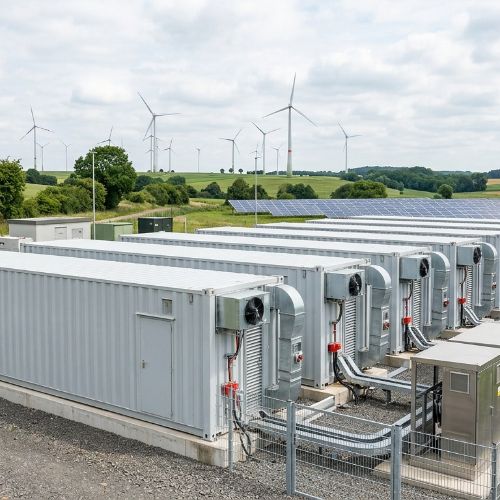
Jinko ESS, a subsidiary of JinkoSolar Co., Ltd., is advancing a portfolio of three stand-alone battery energy storage system (BESS) projects in Germany with a combined capacity of 20 megawatt-hours (MWh).
The portfolio consists of two 5 MWh projects and one 10 MWh project. The merchant-focused installations are intended to participate in Germany’s electricity markets, providing flexibility to the power system while creating opportunities to generate revenue through energy trading and grid services.
Unlike storage systems directly coupled to a specific renewable energy plant, stand-alone BESS installations can operate independently and respond to electricity market signals and grid requirements. Their ability to shift electricity consumption and supply across different periods can help manage fluctuations associated with variable renewable energy generation.
Jinko ESS Deploys Liquid-Cooled Tera Storage Technology
The three projects will use Jinko ESS’s Tera liquid-cooled energy storage system, which has a stated capacity of 5.01 MWh.
According to the company, the system is designed for merchant trading applications, including capturing price differences between peak and off-peak electricity periods. Jinko ESS reports a tested conversion efficiency of 94.1% and low-power standby modes intended to improve system performance.
The technology also incorporates grid-forming capabilities and fast-response functionality. These features are designed to support grid balancing and regulation requirements, alongside participation in spot electricity and ancillary-services markets.
The portfolio combines different project sizes with a common technology platform, allowing the installations to address varying merchant applications and market conditions.
German Projects Target Electricity Trading and Grid Services
Merchant battery storage projects typically operate by responding to electricity market prices and service requirements. They can charge when electricity prices are relatively low and discharge when prices rise, while also offering services that help maintain grid stability.
The business case depends on factors including price spreads, market access, operating costs, system efficiency and the availability of ancillary-services opportunities.
As renewable electricity generation expands, battery storage can help manage periods of surplus generation and changing demand. Stand-alone systems can also provide flexibility independently of the operating schedules of individual wind or solar farms.
However, the commercial performance of the German portfolio will depend on market conditions and the projects’ ability to access and optimise multiple revenue streams.
Jinko ESS Highlights Long-Term Project Partnership
Commenting on the portfolio, Roberto Murgioni, General Manager of Jinko ESS Europe, said:
“We are very pleased to build on our collaboration through this three-project portfolio. This portfolio shows how stand-alone BESS can provide targeted flexibility across projects of different sizes. We look forward to supporting their long-term success with reliable technology, operational expertise and close partnership.”
The announcement adds to Jinko ESS’s activity in the European energy storage market, with the German portfolio illustrating the role of merchant battery systems in supporting electricity trading and grid flexibility.
Bioenergy Business Analysis
The German portfolio reflects a broader shift in energy storage towards merchant business models, in which battery operators seek to earn revenue from electricity price fluctuations and grid-support services rather than relying exclusively on storage linked to a renewable generation asset.
The 20 MWh portfolio is relatively modest in scale compared with utility-scale storage developments, but its three-project structure demonstrates how different installation sizes can be deployed under a shared technology and commercial approach.
The projects’ longer-term significance will depend on commissioning, market participation and demonstrated operating performance. Jinko ESS’s reported 94.1% conversion efficiency is a technology specification; it should not be interpreted as the overall round-trip efficiency or realised commercial performance of the German portfolio without further technical details.