


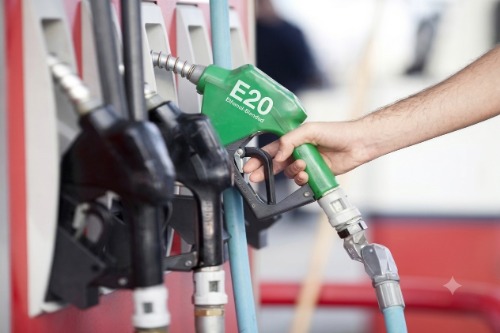
India’s Ministry of Petroleum and Natural Gas has rejected claims that petrol sold at certain retail outlets in Karnataka contains ethanol above the prescribed 20% blending level, stating that 893 samples tested across 27 States and Union Territories complied with the Bureau of Indian Standards (BIS) specifications.
In a clarification issued on 7 November 2026, the Ministry said all 56 samples tested in Karnataka also met the requirements of IS 17021, the standard for ethanol-blended motor gasoline. Their ethanol content ranged from 19% to 20%, with an average of 19.30%.
The clarification follows allegations by Karnataka’s Department of Food, Civil Supplies, Consumer Affairs and Legal Metrology that petrol at certain retail outlets in the state contained between 26% and 31% ethanol.
The three public sector oil marketing companies (OMCs) – Indian Oil Corporation (IOCL), Bharat Petroleum Corporation (BPCL) and Hindustan Petroleum Corporation (HPCL) – have disputed the reported findings, citing concerns over the sampling process and testing methodology. They have requested the Karnataka Government to share the complete sampling records and laboratory reports and have sought joint testing with state representatives.
893 E20 samples reported within prescribed ethanol range
According to the Petroleum Ministry, the Centre for High Technology (CHT) and the OMC Quality Coordination Cell (QCC) conducted testing of 893 E20 petrol samples collected from company depots and retail outlets across 27 States and Union Territories.
The samples included 330 from IOCL, 280 from BPCL and 283 from HPCL. Testing was carried out at refinery and OMC quality-control laboratories using the water-extraction method under Annex C of IS 17021.
All 893 samples recorded ethanol content within the prescribed range of 19% to 21%, the Ministry said.
In Karnataka, the 56 samples tested covered different locations and all three OMCs. Their ethanol content ranged from 19% to 20%, according to the Ministry.
The findings contrast with the Karnataka Government’s October 2026 sampling exercise, which reportedly identified ethanol levels of 26% to 31% at certain fuel outlets.
OMCs question Karnataka sampling and testing procedures
The OMCs have raised concerns about the methodology used in Karnataka’s October exercise, stating that the reported results were not obtained through the procedures prescribed under the Motor Spirit and High Speed Diesel (Regulation of Supply, Distribution and Prevention of Malpractices) Order, 2005, read with the Marketing Discipline Guidelines (MDG) 2024.
Under the prescribed procedure, six one-litre samples must be collected. Two are handed to the dealer against acknowledgement, two are retained by the oil company or the department, and two are sent to a designated laboratory for testing. Sample labels must be jointly signed, and results must be communicated to the dealer and the oil company within the specified timeframe.
The OMCs said samples collected during Karnataka’s September 2026 exercise were routed through the State Level Coordinator to designated company laboratories. However, they alleged that the October exercise took place without the participation of OMC representatives.
They also stated that they had not received the corresponding retained samples, complete outlet-wise information or laboratory reports despite requesting the documentation through the State Level Coordinator.
According to the companies, the findings relied on certificates from a third-party laboratory rather than a laboratory specified under the relevant Control Order. They said the certificates did not contain sufficient technical information to independently verify the reported ethanol levels.
Ministry cites BIS testing requirements
The OMCs have also questioned whether the testing methods cited in the Karnataka certificates complied with IS 17021:2018, including Amendment No. 3 issued in August 2025.
The standard provides for determining ethanol content through specified methods, including Fourier Transform Infrared Spectroscopy (FTIR), water extraction and Gas Chromatography.
The Ministry said the Karnataka certificates referred to ethanol measurement by Gas Chromatography but did not specify the applicable test standard, sample dilution procedure or reference material used for correction.
For Gas Chromatography under the specified ASTM methods, the sample must be diluted in a 1:1 ratio with oxygenate-free petrol, with the result corrected against an E10 certified reference material.
The Ministry said the absence of these details meant the reported ethanol levels of 26–31% could not be independently validated against the prescribed BIS methodology.
The OMCs also pointed to differences in the density readings recorded in the Karnataka certificates and those measured in their own E20 surveys, stating that the discrepancy warranted further examination.
OMCs seek joint testing and independent verification
Following the dispute, IOCL, BPCL and HPCL have asked the Karnataka Government to provide the complete sampling documentation, outlet-wise laboratory reports and details of the testing methods used.
The companies have also sought access to the retained counterpart samples for independent testing at an authorised laboratory using the prescribed referee method. They proposed that representatives of both the state government and the OMCs participate in the exercise.
The companies said they were willing to cooperate with the state authorities in conducting joint sampling and testing in accordance with the Control Order and MDG 2024. Any deviation established through the prescribed process would be addressed under the applicable guidelines.
Bioenergy Business Analysis
The dispute highlights the importance of transparent fuel-quality monitoring as India advances its Ethanol Blended Petrol (EBP) Programme and seeks to maintain the national 20% blending target. While the Petroleum Ministry’s testing results indicate compliance across the 893 samples examined, Karnataka’s separate findings have raised questions about ethanol content at individual retail outlets.
The competing results cannot be conclusively reconciled without access to the underlying samples, laboratory records and testing procedures. Joint sampling and independent verification under the prescribed BIS methods will be important to establish whether the reported higher ethanol concentrations reflect actual deviations or differences in testing methodology.



