


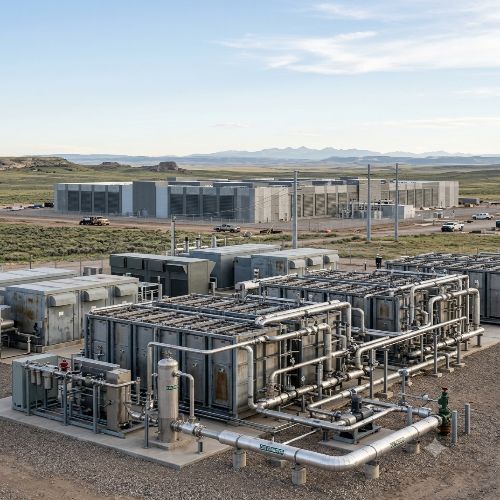
Google plans to invest US$17 billion in its first data centre in Wyoming, United States, with the development incorporating a 702-megawatt (MW) natural gas fuel-cell installation equipped with carbon capture and storage (CCS).
Announced on 5 November 2026, the project will be developed in Laramie County in partnership with Tallgrass Energy, Black Hills Energy, American Electric Power (AEP) and Related Digital. The energy infrastructure will combine fuel-cell generation, additional natural gas-fired power and carbon management technology to support the data centre’s electricity requirements.
The 702 MW fuel-cell project is contracted through AEP, with Bloom Energy manufacturing the fuel cells. The system will generate electricity from natural gas through an electrochemical process rather than conventional combustion.
Google said the installation would incorporate CCS technology to capture a large majority of its associated carbon emissions. The captured carbon dioxide is intended to be transported to Tallgrass Energy’s Eastern Wyoming Sequestration Hub for permanent underground storage.
The project is described by Google as the largest planned commercial-scale fuel-cell development of its kind to include carbon capture and storage.
Additional natural gas generation and carbon capture assessment
Alongside the fuel-cell installation, the data centre will receive electricity from natural gas generators operated by Tallgrass Energy and Black Hills Energy.
Google is also conducting a technical front-end engineering and design study to assess the feasibility of adding carbon capture technology to Tallgrass Energy’s combined-cycle gas turbines. This work remains at the evaluation stage and is separate from the planned CCS-equipped fuel-cell development.
The company said the Wyoming project would bring its total contracted carbon capture and storage capacity to nearly 1 gigawatt. It did not disclose a corresponding annual carbon dioxide capture volume in tonnes.
Air cooling to limit water consumption
The project will use an air-cooled system instead of conventional water-intensive cooling arrangements. Google said the approach is intended to reduce pressure on local water resources as the data centre expands in the Cheyenne area.
The company has also committed to paying for all the electricity consumed by the facility and covering infrastructure requirements directly attributable to its expansion.
Community engagement and local investment
Google said it had met more than 200 residents in Laramie County to discuss the development and gather feedback on energy infrastructure, water use, economic benefits and data centre expansion.
The company and its project partners plan to establish a Community Council involving Google, Tallgrass Energy, Black Hills Energy, Related Digital, AEP and Bloom Energy. The group is expected to address issues associated with data centre growth in the Cheyenne area.
Google estimates that the development could generate hundreds of millions of dollars in local property tax revenue for Laramie County and School District 1. The projection is a company estimate and has not been independently verified.
The investment comes as rising electricity requirements from data centres and artificial intelligence infrastructure increase interest in dedicated power generation and carbon management solutions. Google’s Wyoming project combines natural gas-based electricity supply with planned carbon storage, while its use of air cooling addresses another major resource concern associated with large-scale computing facilities.



