


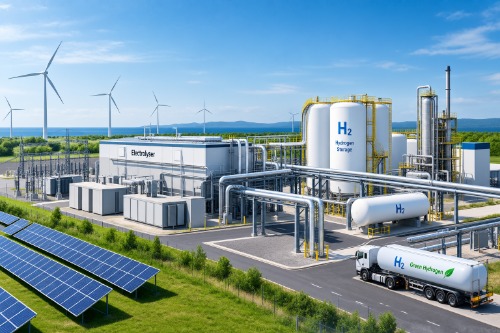
Hyundai Engineering & Construction (Hyundai E&C) is set to lead a South Korean state-backed project to develop large-scale green hydrogen production facilities with electrolysis capacity exceeding 100 megawatts (MW).
The project, promoted by the Ministry of Climate, Energy and Environment, will be led by Hyundai E&C’s HMG Construction Research Institute. Its objective is to develop an integrated design package for large-scale hydrogen production covering plant systems, core processes and operating configurations, with the technology intended to advance towards demonstration and commercialisation.
Hyundai E&C will work with a consortium comprising Hyundai Engineering, Hyundai Motor, Hanwha Global, Korea Midland Power, Mirae Standards Research Institute, Seoul National University and Korea University.
Consortium to develop large-scale hydrogen plant design
Hyundai E&C will take responsibility for preparing the basic engineering package and carrying out an economic feasibility assessment under the project.
The planned design work will cover the systems and processes required for large-scale hydrogen production, with the aim of establishing a configuration that can progress beyond research towards demonstration and commercial deployment.
The source does not specify the number of plants ultimately targeted, their locations, construction costs or a planned commissioning date.
The project is focused on facilities with a generation scale of more than 100 MW, representing a substantial increase from the smaller electrolysis projects previously undertaken by Hyundai E&C.
AI and simulation to address renewable power fluctuations
A key element of the project will be the use of artificial intelligence and dynamic simulation models to account for variations in renewable electricity generation.
Green hydrogen production through electrolysis depends on electricity availability, and renewable generation can fluctuate according to operating conditions. Hyundai E&C said the modelling approach will be used to improve the stability and reliability of hydrogen plant operations under changing power-generation conditions.
The company also plans to use the project to strengthen its capability to integrate large-scale hydrogen production with renewable energy and respond to changes in the hydrogen market.
The source does not provide details on the specific AI models, simulation platforms or renewable generation technologies that will be incorporated into the eventual plant design.
Hyundai expands its hydrogen engineering capabilities
The HMG Construction Research Institute, the integrated research and development organisation of Hyundai E&C and Hyundai Engineering, is expected to bring together technologies spanning hydrogen production, storage, transportation and utilisation within Hyundai Motor Group.
Hyundai E&C has previous experience in hydrogen infrastructure. The company has worked on a hydrogen production base in Buan, North Jeolla Province, and is also developing a 5MW plant-type proton exchange membrane (PEM) electrolysis system in Jeju.
The new project will build on these activities by focusing on a significantly larger production scale and the integration of hydrogen systems with renewable electricity.
Project targets demonstration and commercialisation
The consortium’s work is intended to move large-scale green hydrogen plant technology towards a level suitable for demonstration and eventual commercialisation.
Hyundai E&C said the research could strengthen its competitiveness in domestic and overseas electrolysis projects and contribute to the development of a Korean green-hydrogen platform.
However, the announcement concerns an engineering and research-development project rather than an operating 100MW-plus hydrogen plant. Details of any subsequent demonstration project, commercial facility, investment commitment or construction schedule have not been disclosed.
Bioenergy Business Analysis
The project reflects a shift towards addressing the engineering challenges associated with scaling green hydrogen production beyond individual electrolysis units. By combining basic engineering, economic assessment and operational modelling, the consortium is targeting the design and integration issues that become increasingly important as hydrogen plants are connected to variable renewable electricity.
The emphasis on AI and dynamic simulation is particularly relevant to plant operation because renewable power availability can change over time. The project’s success will depend on how effectively the resulting design can accommodate those fluctuations while maintaining reliable hydrogen production.
For Hyundai E&C, the initiative also provides a platform to combine its existing hydrogen project experience with capabilities across the wider Hyundai group. The immediate outcome, however, will be an engineering and technology-development package rather than confirmed commercial deployment of a 100MW-plus facility.
Further project details, including the eventual plant configuration, location, investment requirement and demonstration timeline, will be needed to assess the commercial scale of the initiative.