


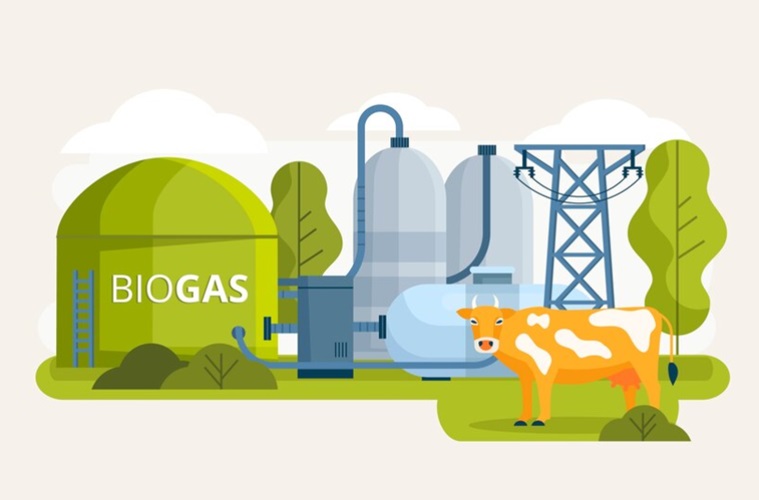
Goa biogas plants are set for major expansion this year as the state government plans to install nearly 200 new units under an enhanced renewable energy subsidy scheme aimed at boosting rural clean energy and organic waste management.
Goa Biogas Plants Expansion Gains Momentum
The initiative follows the installation of around 40 units in Sattari last year and reflects a broader effort by state authorities to revive biogas adoption after years of limited deployment. Officials say the latest phase will rely heavily on prefabricated, technology-driven systems designed to improve operational reliability and reduce installation complexity, according to the local media news report.
Deputy Director of Agriculture Shivdas Gaonkar said the new-generation digesters are intended to address long-standing challenges associated with traditional masonry-based plants, including gas leakage and maintenance difficulties.
Unlike earlier brick-and-cement structures, the prefabricated systems can be installed more quickly and are backed by a 25-year warranty, potentially improving investor confidence among farmers and rural institutions such as gaushalas. The shift also aligns with a wider trend across India’s bioenergy sector toward modular and standardized biogas technologies that lower lifecycle costs and improve scalability.
Under the revised subsidy framework, beneficiaries will receive financial assistance covering 90% of the approved standard cost of construction and installation. The updated cost structure now includes excavation, transportation and Goods and Services Tax (GST), reducing upfront financial barriers that have historically constrained rural adoption.
The programme also introduces performance-linked incentives for grassroots promoters. Agriculture assistants, field assistants and Krishi Mitras involved in facilitating installations of constructed plants will receive Rs 1,500 per unit, a move aimed at strengthening field-level implementation and improving outreach in livestock-intensive regions.
Also read: EU Bioeconomy strategy designates biogas plants as strategic ‘Biorefineries’
Authorities said plant capacity approvals would be linked to cattle ownership to ensure sufficient availability of feedstock, primarily cow dung and organic farm waste, for sustained gas production. In addition, beneficiaries will be eligible for maintenance support equivalent to 20% of the standard project cost after six years of operation, an unusual provision in small-scale biogas schemes that could improve long-term asset performance and reduce plant abandonment rates.
The state has also capped lifetime eligibility at three units per beneficiary, indicating an attempt to balance broader participation with prudent subsidy allocation.
India has been intensifying efforts to scale compressed biogas (CBG), decentralized biomethane and organic waste-to-energy systems as part of its wider energy transition strategy. While large-scale commercial CBG projects have attracted most investor attention in recent years, small rural digesters continue to play a critical role in reducing dependence on LPG, lowering methane emissions from unmanaged agricultural waste and supporting circular farming models.
For Goa, where livestock density and tourism-related waste streams create opportunities for localized waste conversion, the expansion could help strengthen rural energy resilience while supporting climate and sanitation goals. Small biogas systems can also reduce household cooking fuel expenses and generate nutrient-rich slurry that can substitute for chemical fertilizers, an increasingly important consideration amid volatile global fertilizer markets.
Why This Matters
The programme highlights how state-level policy interventions are becoming increasingly important in India’s distributed bioenergy market. By combining high capital subsidies with maintenance assistance and standardized technology, Goa is attempting to solve a recurring problem in India’s rural biogas sector: poor operational continuity after installation.
The inclusion of transportation, excavation and GST costs within the subsidy framework is particularly significant because these ancillary expenses often discourage smaller farmers from participating in renewable energy schemes. The adoption of prefabricated systems may also create new opportunities for domestic biogas equipment suppliers and rural service providers.
From a climate perspective, wider deployment of household and community biogas plants can contribute to methane mitigation, improved waste management and lower reliance on fossil-based cooking fuels. Such projects also support India’s broader ambitions under its clean energy and emissions reduction agenda.
Expected Industry Impact
The expansion is likely to generate incremental demand for prefabricated digester manufacturers, rural EPC contractors, organic waste handling equipment providers and after-sales maintenance services. If the Goa model demonstrates stronger long-term plant utilization rates, other states may consider replicating similar subsidy structures tied to operational sustainability rather than installation alone.
The initiative could also support growth in decentralized biofertilizer markets as biogas slurry gains traction among farmers seeking lower-input agricultural practices. In the longer term, successful rural biogas deployment may complement India’s push toward larger compressed biogas ecosystems by improving feedstock collection networks and increasing farmer familiarity with anaerobic digestion technologies.
For policymakers, the scheme offers a test case for integrating renewable energy access, rural development and waste management into a single subsidy-driven framework.
Concluding Outlook
Goa’s renewed investment in small-scale biogas infrastructure reflects a broader shift toward localized renewable energy systems capable of delivering both environmental and economic benefits at the community level. While the programme remains modest in scale compared with India’s industrial biofuel ambitions, its emphasis on durability, maintenance support and implementation incentives could improve adoption rates and provide a replicable template for rural clean energy deployment across other states.




[…] Goa Biogas Plants: State plans 200 new units under 90% subsidy scheme […]