


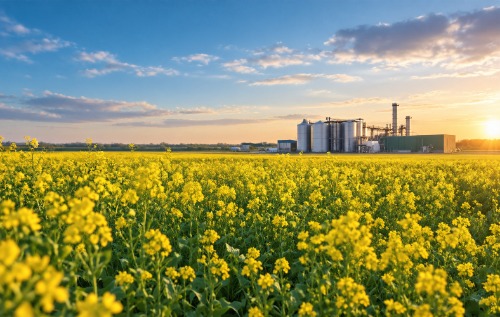
Bayer and Neste have finalised a commercial agreement to scale newgold® winter canola across the Southern Great Plains of the US, expanding a potential lower-carbon feedstock supply for renewable diesel and sustainable aviation fuel (SAF).
The agreement is designed to increase the acreage of winter canola in the Southern Great Plains while developing an additional agricultural feedstock for the expanding renewable fuels market.
Winter canola is an oilseed crop that can provide both vegetable oil for renewable fuel production and protein-rich meal for animal feed. Bayer said the crop can also serve as a rotational crop alongside wheat, potentially improving land utilisation for growers.
Bayer and Neste are establishing a newgold® network with additional value-chain partners to support winter canola expansion and provide farmers with an additional market for their production.
Winter canola positioned as renewable fuel feedstock
The companies are targeting winter canola as a feedstock for both renewable diesel and SAF, sectors where demand for renewable raw materials is increasing.
Bayer said the broader biofuels market is expected to grow substantially, with demand for renewable diesel and SAF estimated to increase almost threefold to approximately 40 billion gallons by 2040.
The companies also point to the role of biofuels in transport segments where direct electrification may be more difficult, including aviation, rail, heavy-duty equipment and marine transport.
Bayer plans newgold® launch in 2027
Bayer aims to launch its newgold® winter canola hybrids in fall 2027. The hybrids are expected to incorporate winter-hardiness, TruFlex® trait technology and pod-shatter resistance. Bayer said the combination is intended to support yield performance and higher oil content while giving growers greater flexibility in incorporating the crop into their farming operations.
The company views the Southern Great Plains as an opportunity to introduce winter canola as an additional rotational crop for farmers.
Quotes highlight supply chain collaboration
Speaking about the agreement, Frank Terhorst, Head of Strategy and Sustainability for Bayer’s Crop Science division, said geopolitical tensions and the need for energy security are contributing to demand for renewable fuels.
“This agreement further underscores Bayer’s commitment to help scale biofuels production,” Terhorst said.
He added that Bayer sees the Southern Great Plains as an “untapped opportunity” for winter canola, with the crop offering farmers a potential rotational option with wheat while connecting them to the growing biofuels market.
Artturi Mikkola, Senior Vice President, Renewable Products Feedstock Sourcing and Trading at Neste, said scaling new feedstocks requires collaboration across the supply chain.
“By building robust value chains, we can turn agricultural innovations into scalable realities for growers and energy markets,” Mikkola said.
He said the collaboration is intended to establish a value chain in one of Neste’s key markets while creating opportunities to increase farm yields and grower income.
Bioenergy Business Analysis
The Bayer-Neste agreement is significant because it links agricultural crop development directly with renewable fuel feedstock demand. Scaling winter canola could give the Southern Great Plains an additional oilseed crop while creating a dual-value stream from both renewable fuel feedstock and high-protein animal feed.
For the biofuels industry, the move also highlights the importance of diversifying feedstock supply as renewable diesel and SAF demand expands. The key test will be whether newgold® winter canola can achieve sufficient acreage, yields, oil content and supply-chain scale following its planned 2027 launch.
Read also: Sunoil Biodiesel secures approval to supply sustainable fuels in Belgium