


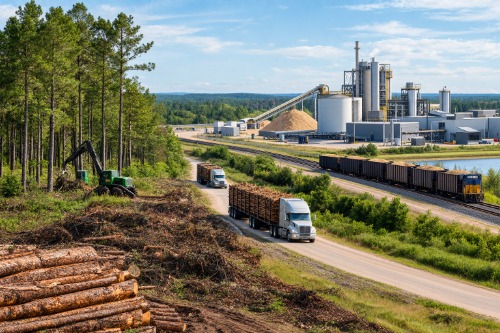
Bowie County in Northeast Texas has received an ‘AA’ rating from the BDO Zone Initiative, highlighting the area’s prospective strength in woody biomass feedstock availability and supporting industrial infrastructure.
The BDO Zone has been assessed at 800,000 bone dry tons of low-risk woody biomass per year within a 75-mile drive radius of its central point in Texarkana, Texas.
The rating reflects a timber resource in which annual net growth significantly exceeds annual removals, creating a surplus of pine pulpwood and forest thinning material that could support new bio-based industrial development.
The assessment also considers the infrastructure available to process and transport biomass, with the 140-acre Boone-Copeland Industrial Park in Hooks serving as the Zone’s industrial anchor.
Timber Growth Creates Biomass Surplus
The BDO Zone assessment identifies sustainably managed timber resources in Bowie County as a key factor behind the rating.
Annual forest growth is reported to substantially outpace removals, leaving additional pine pulpwood and thinning material available as potential feedstock.
The Zone’s stated annual resource assessment of 800,000 bone dry tons provides developers with a quantified estimate of the biomass available within the defined 75-mile transport radius.
Such quantification can help developers assess feedstock availability when considering wood-based manufacturing and bioenergy projects.
Industrial Infrastructure Supports Development
The Boone-Copeland Industrial Park provides the principal industrial site associated with the Zone.
Located in Hooks within the TexAmericas Center, the 140-acre site is described as suitable for both light- and heavy-industrial activity and is served by major utilities.
The site also has on-site rail access, while road connections include access to US Highway 82/Interstate 30 and US Highway 59/Interstate 369.
The combination of a quantified biomass resource and existing industrial infrastructure forms a central part of the BDO Zone assessment.
Biomass Could Support Multiple Bio-Based Industries
The quantified feedstock resource is relevant to more than conventional biomass energy applications.
According to Eric Voyles, Executive Vice President and Chief Economic Development Officer at TexAmericas Center, the assessment provides companies considering biofuels, renewable chemicals, advanced materials and other wood-based manufacturing with information on both feedstock scale and risk.
He said the report could help developers move from assessing whether a project could work in the region towards determining how a project could be developed there.
The range of potential applications means the biomass resource could be relevant to several segments of the emerging bio-based industrial economy, subject to individual project requirements and commercial viability.
TexAmericas Center Highlights Investment Potential
Scott Norton, Chief Executive Officer of TexAmericas Center, said the ‘AA’ rating confirmed the region’s position in the bio-based industrial market.
“Northeast Texas has the natural resources, infrastructure, workforce and industrial capacity to compete for the next generation of bio-based industries.”
Norton also pointed to the wider timber resource across Northeast Texas and the transportation and industrial infrastructure available throughout the greater Texarkana region.
The assessment is intended to provide prospective developers with a more clearly quantified picture of the region’s feedstock and infrastructure characteristics.
BDO Zone Sees Potential for Gulf South Development
Jordan Solomon, Chairman of the BDO Zone Initiative, described Bowie County as one of the strongest woody biomass zones assessed by the initiative.
He highlighted the combination of what he characterised as a large underutilised biomass surplus and existing infrastructure, saying the assessment could encourage further discussions with developers considering projects in the Gulf South.
The rating does not itself represent a committed bioenergy investment or confirm that a specific biomass project will be developed in Bowie County. Instead, it provides a resource and infrastructure assessment intended to support project evaluation.
Bioenergy Business Analysis
Bowie County’s 800,000-bone-dry-ton annual biomass assessment gives prospective developers a defined feedstock figure rather than relying solely on broad descriptions of the region’s forest resources. The combination of surplus pine pulpwood and thinning material with rail, highway and industrial-site infrastructure could be relevant to projects seeking reliable woody biomass supply.
The broader significance lies in the range of technologies that could potentially use the resource, from biofuels and renewable chemicals to advanced wood-based materials and biomass energy.
However, the ‘AA’ designation is an assessment of prospective feedstock and infrastructure viability, not a guarantee of project investment or commercial success. Individual developments would still need to establish their own feedstock contracts, technology, financing, permitting and market economics.
Read also: Furajny Hrany opens 3.4 MW biomass boiler to cut gas use in Bulgaria