


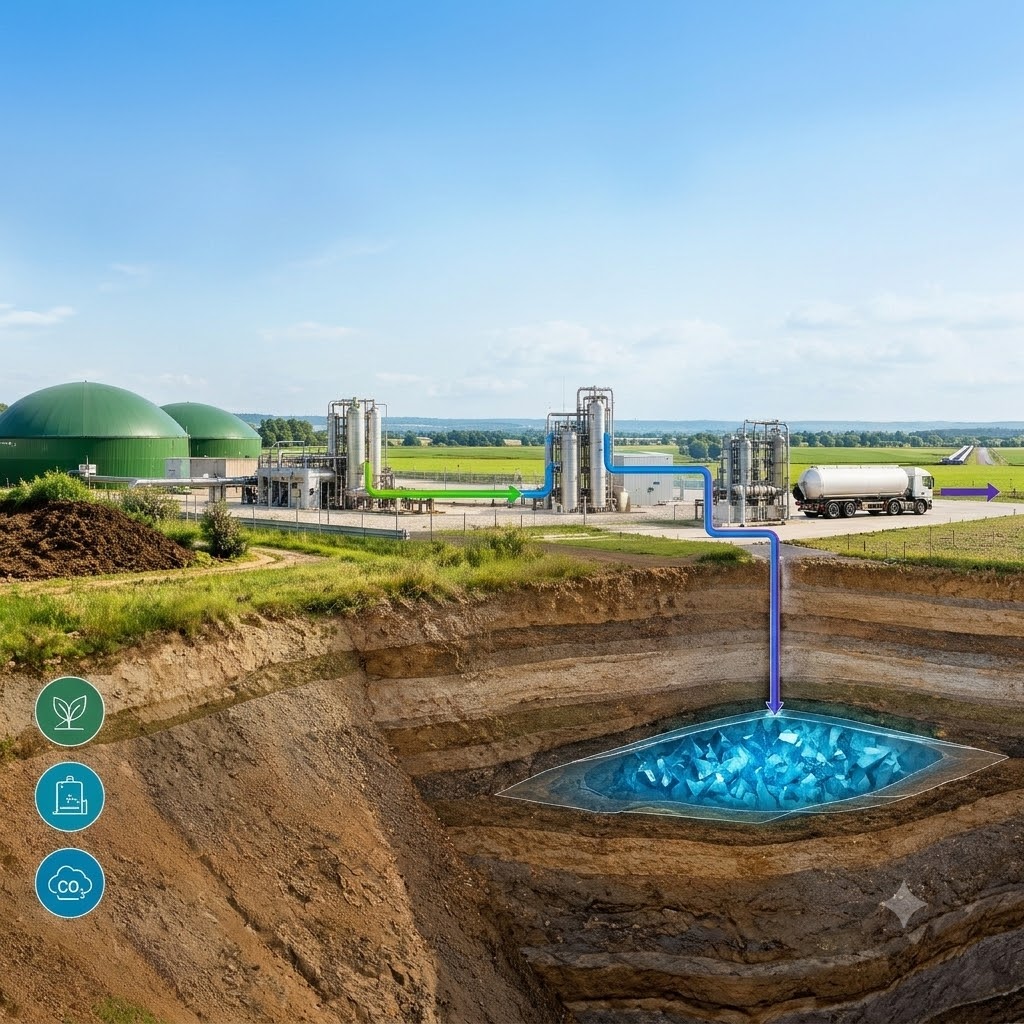
The UK’s biomethane industry could provide a significant source of low-cost greenhouse gas removals if producers gain better access to carbon capture and storage (CCS) infrastructure, according to a report from gas distribution network operator Cadent.
The report argues that previous CCS allocation processes have disadvantaged biomethane plants by favouring large industrial emitters with direct pipeline connections and imposing minimum scale requirements that smaller producers cannot meet individually. It calls for expanded access to non-pipeline CO₂ transport, allowing biogenic carbon dioxide from dispersed rural plants to be collected and transported to storage facilities.
The opportunity could create an additional revenue stream for biomethane producers while supporting the UK’s engineered greenhouse gas removal ambitions. Cadent estimates that carbon-removal revenues could be worth up to £20 per megawatt-hour (MWh) of biomethane production, potentially reducing the sector’s subsidy requirement by around one-third. These figures are estimates presented in the report, rather than guaranteed returns for individual plants.
Cadent identifies the UK’s planned and developing CCS infrastructure, including the HyNet and East Coast clusters, as potential destinations for captured biogenic CO₂. However, many biomethane plants are located in rural areas without practical direct pipeline connections to these networks.
The report therefore highlights non-pipeline transport as a way to connect smaller, geographically dispersed CO₂ sources with larger transport and storage systems. Captured CO₂ could be transported by road to aggregation facilities before being delivered to CCS infrastructure.
Carbon-removal revenues could improve biomethane economics
Cadent estimates that selling verified carbon removals could generate additional revenue of up to £20/MWh of biomethane production. According to the report, this could reduce the sector’s current subsidy requirement by approximately one-third.
The potential revenue would depend on several factors, including the amount of CO₂ captured, transport and storage costs, the price received for carbon-removal credits, and the rules governing credit eligibility.
The additional income could improve the economics of existing biomethane plants and support investment in new projects. It could also help diversify project revenues in a sector where development costs and dependence on policy support can influence investment decisions.
Nevertheless, the estimated £20/MWh should be treated as a potential value, not a standard price available to every producer. Projects would need access to suitable transport and storage arrangements, alongside credible systems for measuring and verifying removals.
UK biomethane sector could generate 17 million tonnes of bioCO₂ annually
Cadent’s report estimates that the UK could generate approximately 17 million tonnes of biogenic CO₂ annually if biomethane production reaches its full potential of 120 TWh per year.
The report compares this potential volume with approximately half of the UK’s international aviation emissions. It also suggests that even at half the projected biomethane production capacity, the sector could deliver roughly one-quarter of the Climate Change Committee’s engineered greenhouse gas removals target for 2050.
These figures describe the potential scale of the opportunity. They should not be interpreted as an estimate of carbon removals already being delivered by the UK’s biomethane industry. Actual removals would depend on the quantity of biogenic CO₂ captured and permanently stored, rather than simply the volume generated during biomethane production.
The distinction is important: CO₂ separated during gas upgrading does not become a permanent carbon removal unless it is stored durably and the removal is appropriately accounted for.
Non-pipeline transport could widen access to CCS
Cadent says previous CCS allocation processes have created barriers for smaller biogenic CO₂ sources. Large industrial projects with direct pipeline connections can be easier to integrate into established carbon transport systems, while rural biomethane plants may struggle to meet minimum volume thresholds independently.
The report points to the government’s Non-Pipeline Transport Pathfinder process as a potential step towards addressing this gap. The initiative is intended to enable a CCS cluster to source CO₂ delivered without a direct pipeline connection, potentially allowing more biomethane producers to participate.
Cadent has 47 biomethane production plants connected to its gas distribution network across North West England, the Midlands, Yorkshire, the East of England and North London, according to the supplied report.
Dr Angie Needle, Cadent’s director of strategy, said the report highlights an opportunity to capture additional value from biomethane production, including carbon removal, employment and the use of digestate as agricultural fertiliser.
Cadent calls for expanded access to carbon storage infrastructure
The report recommends continued development of non-pipeline CO₂ transport, faster expansion of CCS infrastructure and improved access arrangements for smaller carbon producers.
It also calls for further assessment of how carbon-removal revenues could affect the future level of government support needed by biomethane projects.
The recommendations centre on making carbon transport and storage accessible to a wider range of producers, rather than limiting participation to large industrial facilities. Implementation will depend on infrastructure development, commercial arrangements, regulatory frameworks and the availability of buyers for verified removals.
Bioenergy Business Analysis
Cadent’s report highlights a potential connection between two parts of the UK energy transition: renewable gas production and engineered greenhouse gas removals. Biomethane plants already separate biogenic CO₂ during gas upgrading, creating a potential feedstock for carbon-removal projects without requiring the entire process to be developed from scratch.
The main obstacle is infrastructure access. If captured CO₂ from smaller rural plants can be aggregated and transported economically to permanent storage, biomethane producers could gain an additional source of revenue. This could strengthen project economics while expanding the pool of potential carbon-removal suppliers.
However, the opportunity is conditional. Road transport, aggregation facilities, carbon handling, storage fees and verification all carry costs. The financial case will depend on whether the value of verified removals exceeds these expenses and whether buyers are willing to contract for the resulting credits.


