


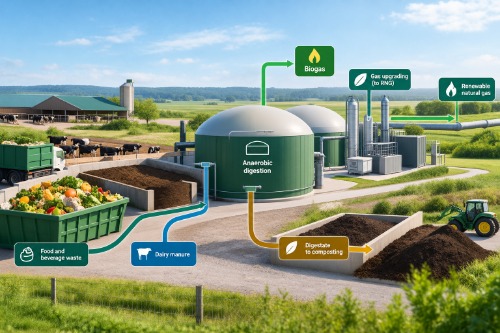
A dairy farm in Virginia is being developed as a large-scale organic waste-to-energy site, with more than 105,000 tonnes of food and beverage waste a year set to be diverted from landfill or incineration and processed alongside dairy cow manure to produce renewable natural gas (RNG).
The Oakmulgee Dairy Farm in Amelia Court House, Virginia, is the site of the project being developed by TotalEnergies and Vanguard Renewables. The companies broke ground on the project in October 2024.
The facility is expected to produce more than 259,000 MMBtu of renewable gas annually, creating an integrated route for recovering energy from both agricultural manure and food-industry organic waste.
Food waste and dairy manure feed the digester
The project uses anaerobic digestion to process the organic material. Food and beverage waste collected from commercial sources will be combined with dairy manure and fed into an anaerobic digester, where microorganisms break down the material in the absence of oxygen.
The resulting biogas can then be upgraded into renewable natural gas for energy use.
According to The Times of India, the Oakmulgee project is designed to give discarded food and beverage material an alternative to landfill or incineration while creating renewable energy from the same organic feedstock.
The project also reflects the operating model behind TotalEnergies and Vanguard Renewables’ wider US renewable-gas partnership. Their 2024 agreement established a 50:50 joint venture to develop, build and operate farm-based RNG projects across the United States.
Renewable gas linked to industrial energy demand
The renewable gas produced at Oakmulgee is expected to supply AstraZeneca’s Maryland biopharmaceutical production facilities, connecting the farm-based digestion project with an industrial energy customer.
This creates a closed-loop model in which organic waste from food and beverage operations becomes an energy feedstock, while dairy manure provides an additional source of material for anaerobic digestion.
The digestate, another output of the process, can also be recovered and managed as a nutrient-rich agricultural product. TotalEnergies said the wider project model involves recovering digestate from the farm-based digesters for use as a low-carbon fertiliser.
TotalEnergies and Vanguard expand US RNG pipeline
Oakmulgee forms part of a broader development programme by TotalEnergies and Vanguard Renewables.
When the companies announced their joint venture in April 2024, they said they planned to advance 10 RNG projects into construction, with combined annual capacity of 0.8 TWh, equivalent to about 2.5 billion cubic feet of renewable natural gas.
The partners also identified a potential pipeline of around 60 additional projects, with a combined potential capacity of about 5 TWh per year.
The partnership is focused on farm-based anaerobic digestion, with food and beverage waste supplemented by dairy manure. Vanguard manages feedstock supply, project assets, operations and RNG sales, while TotalEnergies contributes industrial expertise in facility design, engineering and operational performance.
Farm-based digestion creates multiple waste-recovery routes
The Oakmulgee project demonstrates how agricultural facilities can serve as processing sites for waste streams originating beyond the farm itself.
Instead of treating food waste and dairy manure separately, the model combines the materials within an anaerobic digestion system. This provides a route to renewable gas production while also creating a pathway for managing the remaining digestate.
TotalEnergies has said its US partnership with Vanguard is part of a broader strategy to expand renewable gas production. The company reported 1.1 TWh of biogas production capacity in Europe and has an objective of producing 10 TWh of renewable natural gas by 2030.
Bioenergy Business Analysis
The Oakmulgee model highlights the commercial value of combining two organic waste streams: food and beverage waste provides an alternative to landfill or incineration, while dairy manure supplies a readily available agricultural feedstock. Locating digestion infrastructure directly on a dairy farm can also connect waste management, renewable gas production and agricultural nutrient recovery within one operating model.
For the US RNG sector, the project is significant less because of its individual capacity than because it forms part of a larger farm-based project pipeline. The ability to secure consistent feedstock, maintain digester performance, establish long-term gas offtake and manage digestate will remain central to the commercial performance of this type of development.
The project’s connection to AstraZeneca also illustrates the role of corporate energy buyers in creating demand for renewable gas generated from waste-based systems.
The Virginia project is expected to produce more than 259,000 MMBtu of renewable gas annually while diverting more than 105,000 tonnes of food and beverage waste from landfill or incineration each year.
As TotalEnergies and Vanguard continue developing their wider US portfolio, Oakmulgee provides another example of how anaerobic digestion can connect agricultural operations with commercial organic-waste management and renewable-energy markets.