


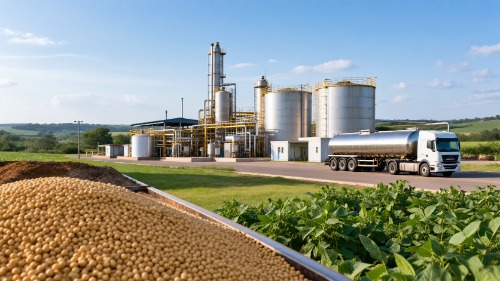
Rising global oil prices and growing concerns over diesel imports are strengthening Brazil’s biodiesel industry push for an increase in the country’s mandatory biodiesel blending rate to 16%, as farmers face potential fuel supply disruptions during a critical agricultural period.
Brazil currently imports around 25% of its diesel consumption, while domestic refining capacity is insufficient to meet the full requirement. The widening gap between domestic diesel prices and international import costs has prompted some fuel importers to postpone purchases, according to fuel importers’ association Abicom.
The supply concerns come as Brazilian farmers move the soybean crop and prepare for winter-crop planting, increasing the importance of reliable diesel availability for agricultural operations.
Diesel supply pressures raise concerns for agriculture
International oil prices approached $110 a barrel during the week, according to The AgriBiz report, increasing the price difference between diesel sold by state-controlled Petrobras and imported fuel.
Abicom estimated the gap at about $0.58 per litre (3 reais) in September, compared with approximately $0.50 per litre (2.56 reais) in August.
Farm federation Farsul, representing farmers in the southern state of Rio Grande do Sul, has warned Brazil’s oil and biofuels regulator ANP about delivery delays. The federation said disruptions could affect summer-crop planting and potentially reduce yields.
A federal subsidy of approximately $0.19 per litre (1 real) announced on September 9 is also expected to translate into adequate fuel availability, regular deliveries and lower prices, according to Farsul’s communication to the regulator.
Industry seeks earlier move to B16
The supply situation has added urgency to calls for Brazil to move from its current 15% mandatory biodiesel blend to B16.
The higher blend had been scheduled for March, but biodiesel producers and industry associations are now arguing that the increase could help reduce fossil-diesel requirements while making greater use of domestic biodiesel production.
Biodiesel is currently more than $0.39 per litre (2 reais) cheaper than fossil diesel at the distributor level after freight and taxes, according to figures cited by The AgriBiz.
Abiove, Brazil’s vegetable-oil industry association, and Aprobio, which represents biofuel producers, estimate that moving to B16 could reduce diesel prices at the pump by around $0.004 per litre (0.02 real), from approximately $1.54 (7.92 reais) to $1.53 (7.90 reais). The calculation excludes the fossil-diesel subsidy announced this month.
B16 could add 750 million litres of annual biodiesel demand
An increase from B15 to B16 would raise annual biodiesel demand by an estimated 750 million litres, according to Abiove.
The association estimates that replacing imported diesel with additional biodiesel could have saved approximately $28 million (145 million reais) between August and December if B16 had been implemented in August.
Carlos Eduardo Hammerschmidt, vice president for new business, investments and institutional relations at Paraná-based Grupo Potencial, said biodiesel producers had already been investing in additional capacity in anticipation of demand under Brazil’s Fuel of the Future law.
He argued that the issue now extends beyond compliance with the legislation to maintaining fuel availability for the wider economy.
Higher blends already permitted in selected sectors
Brazil has already allowed biodiesel blends above the mandatory level in selected applications. In July, ANP authorised higher blends for sectors including public and rail transport, shipping, captive fleets, agricultural tractors and machinery.
However, the volumes remain relatively small, according to Hammerschmidt. A nationwide increase in the mandatory blend would therefore have a substantially larger effect on biodiesel demand.
B16 testing remains a near-term hurdle
The wider adoption of B16 is also linked to the completion of technical testing.
Hammerschmidt said advanced testing at Instituto Mauá in São Paulo has demonstrated the technical viability of the higher blend. The testing is expected to support reports for the government.
Abiove, Aprobio and biodiesel industry group UbraBio said they are mobilising resources to complete the required testing.
The groups also said Brazil’s biodiesel sector has both production capacity and inventories that could help support fuel availability while the country remains dependent on imported fossil diesel.
Brazil has significant unused biodiesel capacity
Brazil’s biodiesel industry has considerable capacity available to accommodate additional demand, according to the industry figures cited in the report.
The country currently has biodiesel production capacity of approximately 16 billion litres a year, with capacity expected to reach 18 billion litres in 2027. Actual annual production, however, is estimated at around 6 billion–8 billion litres.
The additional biodiesel demand resulting from a one-percentage-point increase in the blending mandate could therefore be absorbed by existing capacity, according to industry representatives.
Soybean processing capacity is also expanding. Paraná alone added four soybean crushing plants during the past year, increasing annual capacity by an amount equivalent to almost 1 billion litres of biodiesel, Hammerschmidt said.
Bioenergy Business Analysis
Brazil’s diesel supply concerns are bringing the country’s biodiesel policy into sharper focus. Moving from B15 to B16 would represent only a one-percentage-point increase in the mandatory blend, but the additional 750 million litres of annual biodiesel demand cited by Abiove would create a larger domestic market for a sector with substantial installed capacity.
The immediate question is therefore less about whether Brazil has the industrial capacity to produce additional biodiesel and more about policy timing, technical validation, feedstock availability and fuel-market conditions. If B16 is adopted, it could marginally reduce the country’s reliance on imported fossil diesel while increasing demand for domestically produced biodiesel, particularly from Brazil’s large soybean-processing industry.