


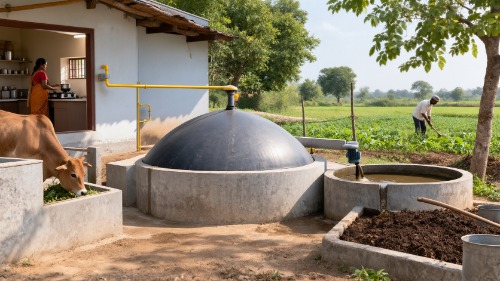
Mahendra, a farmer in Rajgarh is using a household biogas plant to reduce dependence on conventional cooking fuels while also lowering the cost of crop cultivation through the use of organic slurry.
Mahendra uses biogas generated from his plant for an average of eight hours each day for cooking and other household activities. The availability of biogas has reduced his dependence on LPG cylinders and firewood, helping lower the amount he spends on household fuel.
The experience demonstrates how small-scale biogas systems can provide a locally produced alternative to conventional household fuels while making use of organic feedstock.
Biogas Slurry Replaces Part of Chemical Fertiliser Use
The benefits extend beyond household energy. Mahendra uses the organic slurry generated as a by-product of the biogas plant as manure for his crops.
According to the source, regular use of the slurry has reduced his reliance on chemical fertilisers and lowered farming expenses. It has also improved soil fertility and contributed to crop production and quality.
This creates a combined energy-and-agriculture benefit from a single biogas system: the plant supplies fuel for household use while its residual slurry is returned to farmland as an organic input.
Biogas Links Household Energy With Farm Productivity
Mahendra’s experience highlights the potential of decentralised biogas systems to address more than one rural need. Producing cooking fuel locally can reduce dependence on purchased fuels, while recovering nutrients through digestate or slurry can provide an additional input for agriculture.
The model also demonstrates the circular nature of household-scale bioenergy, where organic material can generate energy before its nutrient-rich residue is used in farming.
Bioenergy Business Analysis
The case highlights one of the key advantages of biogas at the household level: its ability to combine clean energy production with agricultural nutrient recovery. Where suitable feedstock is consistently available and plants are properly operated, biogas can help reduce household fuel purchases while generating a useful agricultural by-product.
For rural communities, the economics of such systems therefore extend beyond energy savings alone. The potential reduction in fertiliser expenditure and the reuse of organic slurry can strengthen the overall value proposition of decentralised biogas, particularly where farming and household energy needs are closely connected.
Read also: Petronet LNG to develop 10 CBG plants in joint venture with Gruner Renewable Energy