


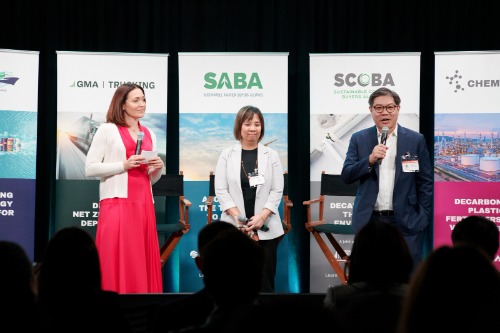
Green Fuel Forward (GFF), the sustainable aviation fuel (SAF) demand initiative launched by GenZero and the World Economic Forum (WEF), is moving into a more transaction-focused phase, with a strengthened steering committee and three new corporate members aimed at accelerating SAF and SAF certificate procurement across Asia-Pacific. The changes were announced on 22 September 2026 during Green Markets Day at New York Climate Week.
The Center for Green Market Activation (GMA) and Singapore Sustainable Aviation Fuel Company (SAFCo) have joined founding steering committee member GenZero. At the same time, Amazon, Bain & Company and Temasek Trust have joined the wider alliance, taking total GFF membership to 48.
The restructuring moves GFF beyond its initial emphasis on market awareness and procurement readiness towards facilitating corporate participation in SAF and SAF certificate (SAFc) transactions.
GFF expands steering committee for SAF procurement
The new steering committee brings together expertise in investment, demand aggregation, procurement and SAF market development.
GMA’s involvement adds experience in collective procurement and book-and-claim models, while SAFCo brings experience from Singapore’s emerging SAF market infrastructure. GenZero remains the founding steering committee member.
GFF said the expanded structure is intended to translate corporate interest into more credible and scalable demand for SAF in Asia-Pacific. The initiative argues that stronger demand signals can help support investment in additional production capacity in a market where SAF remains more expensive than conventional jet fuel and supply is still developing.
Frederick Teo, Chief Executive Officer of GenZero, said aggregated corporate participation could create demand at a scale capable of supporting SAF production growth.
Kim Carnahan, CEO of GMA, said the organisation’s experience with book-and-claim and demand aggregation would be applied to the Asian market, including through alignment with initiatives such as the Sustainable Aviation Buyers Alliance.
SAF certificates become a central part of GFF’s next phase
A major component of the expanded initiative will be the development of the SAF certificate market.
SAFc enables companies to support SAF use and account for associated emissions reductions even when they cannot directly take physical delivery of the fuel. This is particularly relevant for companies with business-travel or supply-chain emissions spread across countries where physical SAF procurement may not be practical.
GFF said it will work with industry participants, policymakers and standards organisations to establish a trusted framework for SAFc transactions across Asia-Pacific.
The initiative is also expected to help companies understand procurement pathways and accounting requirements associated with SAF certificates.
One unresolved issue is how SAF certificate purchases should be treated under the Greenhouse Gas Protocol. GFF also identified limited visibility into regional SAF supply and a lack of dedicated procurement expertise within some companies as barriers facing potential buyers.
Singapore’s SAF infrastructure could support regional market
SAFCo’s participation gives GFF access to experience emerging from Singapore’s national SAF policy and procurement infrastructure.
Seow Hui Tan, CEO of SAFCo, said systems and processes being developed in Singapore could help provide a foundation for a voluntary SAF and SAF certificate market across the wider Asia-Pacific region.
SAFCo was established by Singapore’s Civil Aviation Authority to develop a SAF demand market connecting airlines, corporate buyers, fuel producers, registry providers, carbon-market platforms and other aviation fuel stakeholders.
The regional relevance of such infrastructure is tied to the difficulty of matching physical SAF supply with geographically dispersed corporate demand. Certificate-based and book-and-claim approaches can separate the environmental attribute associated with SAF from the physical fuel flow, although their effectiveness depends on robust accounting, verification and market governance.
World Economic Forum hands over secretariat role
The restructuring also changes WEF’s role in GFF. WEF helped establish the initiative with GenZero in May 2025 and played a central role during its initial phase, including stakeholder engagement, market awareness and procurement-readiness work.
The organisation will now hand the initiative’s secretariat function to the steering committee as GFF moves towards more direct market participation.
Pedro Gomez, Head of Industry Agenda and a member of WEF’s Executive Committee, said the initiative had helped generate greater corporate interest in SAF and that GenZero and the new steering committee would take the next phase forward.
The transition effectively separates GFF’s initial market-building phase from its next stage, which is centred more directly on procurement and transactions.
Amazon, Bain and Temasek Trust join 48-member alliance
The addition of Amazon, Bain & Company and Temasek Trust broadens the buyer base participating in GFF.
The alliance’s members include companies with substantial business-travel emissions, logistics and air-cargo operations, as well as multinational businesses seeking to address emissions associated with Asian value chains.
Temasek Trust is also participating as a catalytic funder, providing support intended to offset procurement costs and encourage SAF adoption among participating companies. GFF said cost offsets and co-matching support will be available to selected first-time buyers.
Bain & Company said SAF forms part of its approach to reducing emissions associated with business travel. The company has previously purchased SAF certificates through the Sustainable Aviation Buyers Alliance and the First Movers Coalition.
Temasek Trust said its participation combines membership with funding intended to lower barriers for other companies entering the SAF market.
Bioenergy Business Analysis
The evolution of Green Fuel Forward from capacity building towards procurement and market activation is an important development in Asia’s SAF market. The first phase concentrated on helping companies understand SAF and SAFc; the next phase is intended to turn that interest into transactions.
That shift matters because the central challenge for SAF is not simply corporate willingness to buy. Producers require sufficiently credible demand to justify investment in expensive new production capacity, while corporate buyers need confidence that the fuel, certificate and associated emissions claims are properly documented.
GFF’s expanded structure addresses both sides of that equation by combining demand aggregation, procurement expertise and Singapore’s developing market infrastructure. Its model also reflects the growing role of book-and-claim mechanisms in situations where physical SAF cannot easily be delivered to every participating corporate buyer.
The main uncertainty is how quickly voluntary SAFc demand can scale and how accounting frameworks develop. GFF itself identifies questions around treatment under the Greenhouse Gas Protocol, while regional SAF supply remains constrained.