


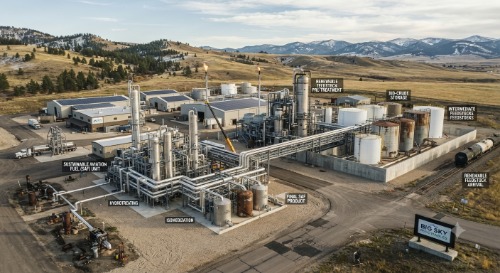
Montana Renewables plans to raise sustainable aviation fuel (SAF) production at its Great Falls, Montana, facility to approximately 200 million gallons (757 million litres) a year by the end of 2028, using a revised expansion strategy centred on existing refinery equipment rather than a large new-build project. The company, an unrestricted subsidiary of Calumet, says the approach significantly reduces the capital required for the next phase of its MaxSAF programme.
The company is currently operating at a SAF production run rate of about 60 million gallons a year. It expects to exceed 80 million gallons a year by the end of 2026, surpass 120 million gallons by spring 2027 and ultimately reach approximately 200 million gallons a year in 2028.
The revised plan follows completion of the first phase of the MaxSAF 150 expansion during the second quarter of 2026. Calumet said the project was completed successfully, while Montana Renewables completed performance testing of its newly installed MaxSAF catalyst.
Montana Renewables to Repurpose Existing Refinery Assets
Instead of transporting another reactor from the US Gulf Coast, Montana Renewables plans to repurpose selected equipment already operating at the adjacent Calumet Montana Refining facility in Great Falls.
The revised expansion includes the redeployment of a hydrotreater, hydrogen plant and naphtha splitter under a long-term lease arrangement. The second reactor will be integrated into Montana Renewables’ renewable fuels operation and used in a polishing configuration designed to increase SAF yields while limiting the generation of lower-value by-products.
Calumet said the revised strategy reduces the remaining capital requirement for the expansion to approximately $137 million, compared with the $1.2 billion contemplated under the original Phase 2 plan. The company has also structured the expansion as a series of smaller projects rather than one large construction programme.
The company expects the second reactor to enter SAF service during the winter of 2026. The tie-in is associated with a planned fourth-quarter 2026 turnaround at the site.
MaxSAF Strategy Shifts Away From Original Mega-Project
The revised approach represents a substantial change from the expansion originally supported by the US Department of Energy (DOE).
In January 2025, the DOE announced the closing of a $1.67 billion loan guarantee, comprising $1.44 billion of principal and $233 million of capitalised interest, to support the Great Falls renewable fuels expansion. The project was intended to expand production of SAF, renewable diesel and renewable naphtha.
Under the amended financing arrangement, Phase 2 DOE funding has been reduced to a final $34 million draw, with the balance of the revised expansion expected to be funded from Montana Renewables’ earnings. The company said the amended structure does not require third-party equity.
The original DOE-backed project contemplated a much larger expansion than the current 200-million-gallon SAF target. DOE’s project description had envisaged total biofuel production rising to approximately 315 million gallons a year, with most of the output expected to be SAF.
The redesigned programme instead focuses on extracting more SAF production from existing infrastructure and improving the economics of the operating site.
Montana Renewables Financial Performance
The MaxSAF expansion was completed alongside a period of significant operational disruption associated with the project turnaround.
Calumet’s second-quarter 2026 filing shows that the Montana/Renewables segment generated $26.6 million of Adjusted EBITDA with Tax Attributes, compared with $16.3 million in the second quarter of 2025. The company said the first phase of MaxSAF 150 was completed during the quarter, while planned downtime in April and May resulted in an estimated production loss of approximately 450,000 barrels.
Calumet reported consolidated second-quarter Adjusted EBITDA with Tax Attributes of $175.2 million.
Montana Renewables’ Great Falls operation produces several renewable fuels and products, including SAF, renewable diesel, renewable hydrogen and renewable naphtha. Its feedstock portfolio includes used cooking oil, tallow, distillers corn oil, camelina oil, canola oil and soybean oil.
The facility has operated as a renewable fuels plant since late 2022. DOE says the project expansion is intended to use vegetable oils, fats and greases to produce renewable fuels, while Montana Renewables identifies a broader range of renewable feedstocks for its operations.
The site is part of Calumet’s wider North American manufacturing business. Calumet operates specialty products and renewable fuels facilities across the region, with its corporate headquarters in Indianapolis.
What the Revised Expansion Means for SAF Capacity
The revised MaxSAF strategy illustrates an alternative to large greenfield or major brownfield SAF projects: increasing output through asset repurposing, process integration and incremental debottlenecking.
For Montana Renewables, the approach substantially lowers the capital still required to reach its stated production target. It also allows the company to retain the option of using additional equipment later in the expansion programme. Calumet said a third renewable fuels reactor currently located offsite could provide additional expansion capability beyond the 200-million-gallon target over time.
However, the 2028 target remains dependent on the successful completion and integration of the planned equipment changes. Calumet’s own disclosures identify equipment performance, turnaround execution, access to feedstocks, renewable fuel margins, policy changes and market demand among the factors that could affect the outcome.
Bioenergy Business Analysis
Montana Renewables’ revised MaxSAF strategy is significant because it changes the capital profile of a major SAF expansion without abandoning the company’s longer-term production objective. The reduction in remaining project capital from the $1.2 billion originally contemplated for Phase 2 to about $137 million indicates how existing refinery infrastructure can potentially be repurposed to reduce the cost and construction requirements of renewable-fuel capacity.
The approach also highlights an important operational consideration for SAF producers: increasing SAF output is not solely a question of adding capacity. Reactor configuration, feedstock throughput, by-product generation and the relative economics of SAF and renewable diesel can materially influence the optimal product mix. Montana Renewables’ polishing configuration is intended to address those factors, although its ability to deliver the company’s projected yields and production ramp remains subject to execution and market conditions.
For the wider SAF industry, the project provides a case study in brownfield optimisation rather than greenfield capacity development. Whether similar strategies can be replicated elsewhere will depend on the availability of suitable legacy assets, compatible process configurations, feedstock supply, financing structures and local market conditions.