


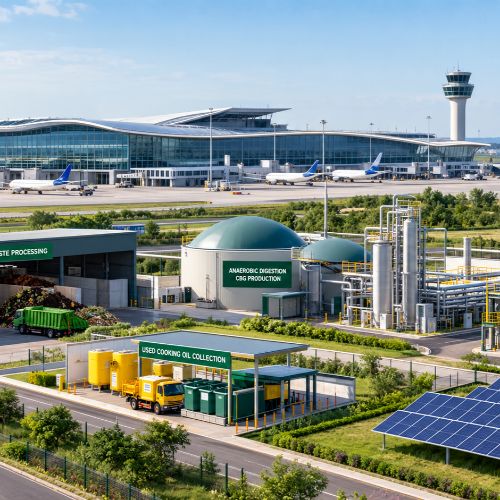
Karnataka is exploring an airport bioenergy and circular economy model that could combine waste-to-energy, compressed biogas (CBG), biodiesel and other renewable-energy solutions within airport ecosystems.
The proposal was discussed during a meeting between S E Sudheendra, chairman of the Karnataka State Bioenergy Development Board (KSBDB), and V Prem Watsa, founder, chairman and CEO of Fairfax Financial Holdings, with discussions also covering Karnataka’s emerging bioenergy policy and potential investment in the sector. Fairfax confirms Watsa as its founder, chairman and CEO.
The proposed airport model would seek to use waste and other resources generated within airport premises as inputs for energy and fuel production. Potential applications discussed included processing used cooking oil from airport restaurants, hotels and canteens into biodiesel, while food and other suitable green waste could be processed into CBG.
The discussions also covered potential investment, technology partnerships, project development and knowledge exchange, with Karnataka-based pilot projects potentially serving as models for replication at other airports.
Airport waste identified as a potential bioenergy feedstock
Under the proposed model, waste generated within airport ecosystems would be assessed and directed towards appropriate recovery and energy-conversion pathways.
Used cooking oil from food-service operations could provide a feedstock for biodiesel production, while segregated food and green waste could be directed towards anaerobic digestion and subsequent CBG production.
The approach would potentially connect waste management, renewable fuels and airport infrastructure within a single resource-recovery framework.
However, the suitability of individual waste streams would depend on segregation quality, contamination levels, collection systems and the technical and commercial viability of the proposed conversion technology.
The stakeholders discussed developing pilot airport projects in Karnataka before potentially applying the model at other airports across India. The areas identified for possible collaboration include:
The proposed model would effectively treat an airport as an integrated resource ecosystem rather than only a consumer of electricity and fuel.
Investment and partnerships could support airport projects
The meeting also examined opportunities for investment and collaboration with organisations experienced in infrastructure and airport-related businesses.
For airport operators, integrating waste recovery with renewable-fuel production could potentially create additional value from organic waste streams while reducing dependence on disposal routes.
For bioenergy developers, airports could offer concentrated sources of food waste and used cooking oil, although the economics would depend on the volume and consistency of feedstock, collection logistics, land availability, regulatory requirements and access to suitable offtake markets.
The proposed Karnataka pilots could therefore provide an opportunity to test whether airport-based bioenergy systems can operate at commercial scale before wider replication.
Circular economy approach extends beyond waste disposal
The proposed model places circular-economy principles at the centre of airport energy planning.
Instead of treating food waste and used cooking oil solely as waste requiring disposal, the concept would seek to recover their energy and material value through separate processing routes.
Food and other biodegradable waste could be converted into biogas and upgraded to CBG, while used cooking oil could serve as a feedstock for biodiesel. Other renewable-energy technologies could potentially be integrated into the airport’s broader energy system.
The effectiveness of such an approach would depend heavily on source segregation and reliable feedstock collection. Mixing organic waste with plastics, metals or other contaminants can reduce the quality and economic value of feedstock available for biological processing.
From Karnataka pilots to national application
The discussions indicate an interest in developing a model that could eventually be replicated beyond Karnataka.
A successful pilot would need to demonstrate more than technical feasibility. It would also need to establish a reliable feedstock supply chain, commercially viable fuel production, appropriate waste-handling arrangements and a clear framework for ownership and operation.
Representatives from St Joseph’s University, including Vice-Chancellor Fr Victor Lobo and Pro-Vice-Chancellor Dancil Lobo, also attended the meeting.
Bioenergy Business Analysis
The proposed airport bioenergy model is notable because it brings together several areas that are often developed separately: waste management, biofuels, CBG and airport energy infrastructure. Airports have concentrated food-service operations and other commercial activities that can generate relatively consistent waste streams, potentially creating an identifiable feedstock base for localised resource-recovery projects.
The main issue is likely to be execution rather than the availability of individual technologies. Used cooking oil collection requires an organised segregation and aggregation system, while CBG production requires sufficiently clean and consistent organic feedstock. Airport projects also face additional requirements around land, safety, logistics and uninterrupted airport operations. A Karnataka pilot could therefore provide useful evidence on whether these systems can be integrated into operating airport environments and what commercial structure is required for replication.