


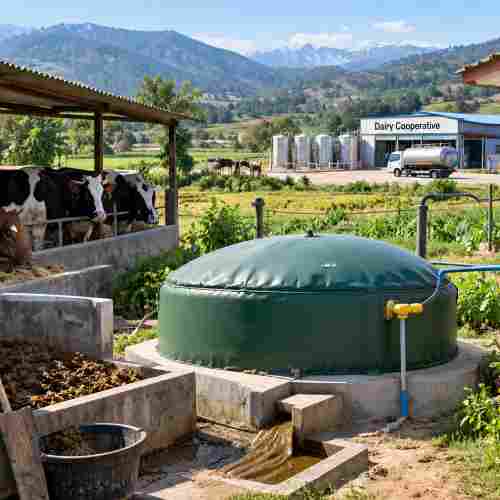
One hundred dairy producers in Uttarakhand’s Udham Singh Nagar district are set to receive flexi biogas plants under a National Dairy Development Board (NDDB)-linked initiative, with subsidised units designed to convert cattle dung into household cooking fuel.
According to Amar Ujala report, each plant will cost ₹33,270, with 66% of the cost covered through subsidy and the remaining 34% contributed by the beneficiary. The programme is intended to support dairy farmers while creating a productive use for cattle dung.
The initiative will use a cluster-based selection model. Dairy cooperative societies will identify groups of eight to 10 members, with beneficiaries required to be members of a milk producers’ cooperative society.
NDDB has promoted household-scale flexi biogas as part of its wider manure-management programmes. Its recent materials describe small flexi plants as a decentralised route for converting cattle dung into cooking energy while also generating bio-slurry that can be used as an agricultural input.
Farmers to supply 45–50 kg of dung daily
Under the reported eligibility criteria, selected dairy producers should have three to five cattle, generating approximately 45–50 kg of dung per day.
Beneficiaries must also have sufficient space for installation, with the reported requirement being a 15-by-20-foot area located near the household kitchen.
The feedstock requirement is broadly consistent with NDDB’s established smallholder flexi-biogas model. NDDB says its 2-cubic-metre plants under the Zakariyapura model can operate with around 40–50 kg of cattle dung per day.
This creates a direct link between dairy production and household energy: manure that might otherwise be discarded or used through less efficient pathways can instead be processed through anaerobic digestion to produce biogas.
Flexi biogas plants designed for household cooking
The reported programme uses portable flexi biogas systems intended for relatively simple household installation and operation.
According to the source report, the units can generate enough gas to meet the cooking requirements of a household of approximately six to eight people. The system is also described as portable, allowing it to be relocated when necessary.
The reported estimate is that a household could save the equivalent of approximately 1.5–2 LPG cylinders per month.
NDDB has reported similar performance from its decentralised flexi-biogas model. The organisation says a 2-cubic-metre household plant can generate clean cooking energy equivalent to 1.5–2 LPG cylinders per month, while the resulting slurry can be used as manure or processed into organic fertiliser.
Manure management adds an agricultural benefit
The value of the programme extends beyond cooking fuel.
Anaerobic digestion produces a nutrient-rich digestate or bio-slurry alongside biogas. NDDB’s manure-management programmes have sought to use this material as an agricultural input, including through slurry processing and organic-fertiliser production.
This creates a small-scale circular model in which cattle dung provides both an energy product and a potentially useful agricultural input.
NDDB has also reported wider deployment of flexi-biogas technology. In its 2022-23 reporting, more than 850 flexi biogas plants were installed at beneficiary household level during the year under manure-management initiatives.
More recently, NDDB has said that more than 27,000 small flexi biogas plants have been installed under its Zakariyapura model, highlighting the technology’s use as a decentralised manure-management solution.
Cluster approach could support wider dairy-sector adoption
The proposed Udham Singh Nagar programme combines individual household plants with a cooperative-based selection process.
Selecting beneficiaries through clusters of eight to 10 dairy producers could help local dairy organisations coordinate implementation, training and monitoring while maintaining individual household-level energy systems.
The approach also fits into a broader shift within India’s dairy sector towards treating cattle manure as a resource rather than solely as waste. NDDB has pursued both decentralised household systems and larger centralised biogas models, including facilities producing compressed biogas and organic fertilisers.
For small dairy producers, the economics will ultimately depend on the subsidy structure, plant performance, availability of sufficient dung, maintenance requirements and the value of displaced LPG and agricultural inputs.
Bioenergy Business Analysis
The Udham Singh Nagar programme demonstrates how small-scale biogas can connect dairy production, household energy and manure management without requiring a large centralised biogas facility. The reported 45–50 kg daily dung requirement is aligned with the feedstock range used in NDDB’s established household flexi-biogas model, while the reported 1.5–2 LPG-cylinder monthly saving is also consistent with NDDB’s published experience.
The key consideration for scaling will be long-term plant utilisation and maintenance. Household digesters depend on a reliable daily supply of dung and appropriate operation, while the economic value of the system increases when both biogas and bio-slurry are productively used. The cooperative-cluster approach could provide an institutional mechanism for supporting farmers beyond initial installation, although the source report does not provide details on the programme’s maintenance, training or post-installation monitoring arrangements.