


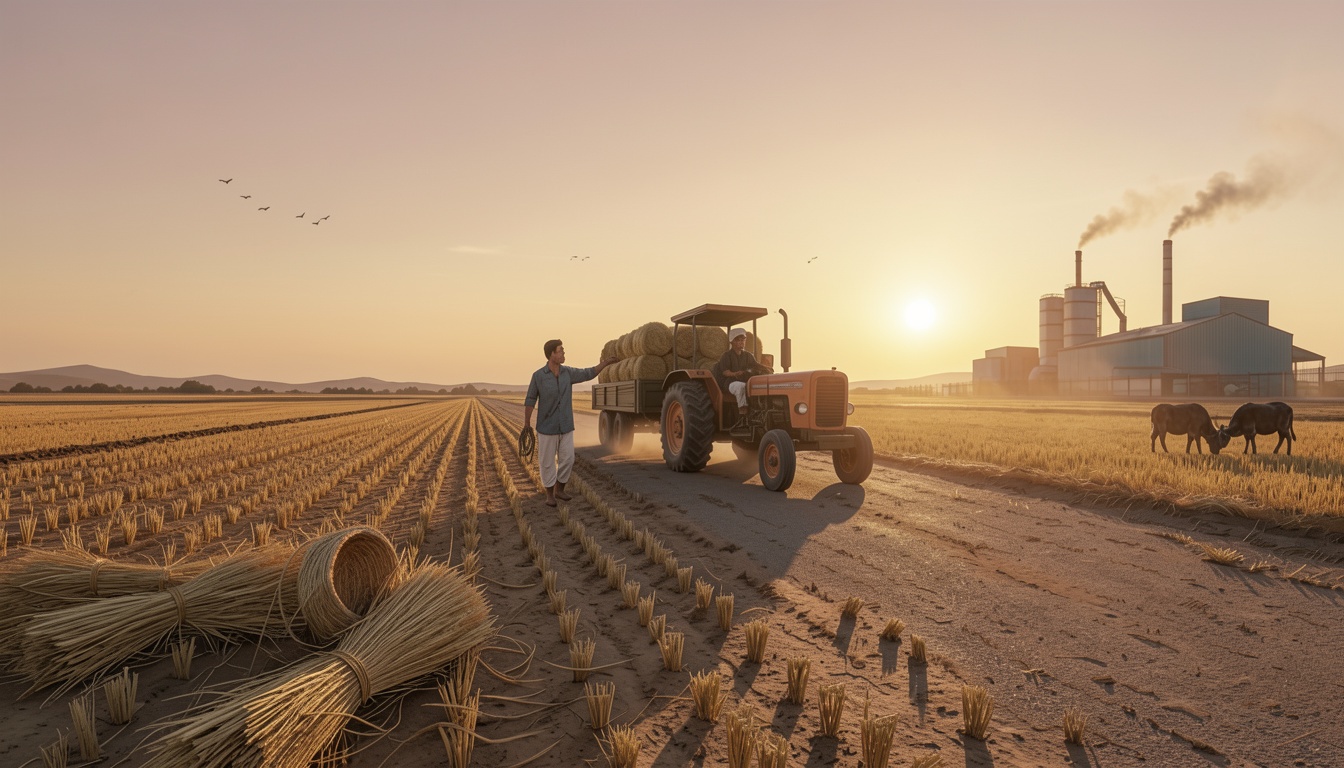
Punjab is expanding the commercial use of paddy straw as an industrial and energy feedstock, with 73 industrial units in the state set to consume around 4.087 million tonnes of the crop residue as fuel.
The move marks a shift in Punjab’s paddy-straw management strategy, which is increasingly focused on converting agricultural residue into an economic resource alongside efforts to reduce open-field burning.
According to a report by Dainik Jagran, around 18.8 million tonnes of paddy straw is expected to be generated in Punjab during the current paddy season. The state’s management strategy combines in-situ treatment, where residue is managed within agricultural fields, with ex-situ utilisation, where straw is collected and transported to industrial and energy facilities.
Under the reported plan, approximately 10.15 million tonnes of paddy straw will be managed through in-situ methods, while around 7.8 million tonnes will be removed from fields for use as feedstock or fuel by factories, brick kilns, biogas facilities and thermal power plants.
Ludhiana leads industrial paddy-straw use
Industrial adoption is spread across several districts, with Ludhiana recording the highest number of factories using paddy straw.
Fourteen industrial units in Ludhiana are using the residue as fuel, followed by 11 units in Fatehgarh Sahib, seven in Mohali and six in Sangrur.
The wider deployment creates a potential market for collected crop residue while providing industries with an alternative solid fuel source.
For Punjab, the model also links agricultural-residue management with rural supply chains, as straw needs to be collected, baled, transported and supplied consistently to end users.
CBG and biogas plants add to demand
The use of paddy straw is also expanding beyond conventional industrial fuel applications.
According to the reported data, six compressed biogas (CBG) plants in Punjab are using around 0.3032 million tonnes of paddy straw. A further 1.17 million tonnes is being used by 11 conventional biogas plants.
The use of paddy straw in anaerobic digestion facilities creates an additional route for converting agricultural residue into biogas and, where upgraded, biomethane or CBG.
This could also strengthen the connection between Punjab’s agricultural sector and its emerging bioenergy infrastructure by creating demand for a feedstock that has traditionally been associated with seasonal burning.
Brick kilns and thermal plants expand residue demand
Paddy straw is also being diverted towards brick manufacturing and power generation.
Around 0.48915 million tonnes of paddy straw is reportedly being used across 2,245 brick kilns in Punjab.
Five thermal power plants are using a further 1.183 million tonnes of the residue.
These applications expand the market for ex-situ crop-residue collection and provide additional outlets for straw during the post-harvest period.
Crop residue becomes an energy feedstock
The scale of planned utilisation illustrates the range of markets that can absorb agricultural residue.
Instead of treating paddy straw solely as a waste-management problem, Punjab is developing multiple end-use pathways spanning:
- Industrial boilers and process heat
- CBG production
- Conventional biogas
- Brick kilns
- Thermal power generation
The approach depends on establishing reliable logistics between farms and users. Collection, aggregation, storage and transportation are particularly important because paddy straw is generated over a relatively short harvesting period but must often be supplied to facilities throughout the year.
Bioenergy Business Analysis
Punjab’s paddy-straw strategy demonstrates how crop-residue management can become part of an industrial bioenergy supply chain.
The reported figures indicate demand across several sectors, with industrial users, CBG and biogas plants, brick kilns and thermal power facilities collectively creating multiple outlets for collected straw. This diversification can reduce dependence on a single end-use market.
For the bioenergy sector, the CBG and biogas volumes are particularly relevant because paddy straw can serve as a lignocellulosic feedstock in anaerobic digestion, although its characteristics can make handling and digestion more complex than some conventional organic feedstocks. Pre-treatment, feedstock blending, moisture management and reliable aggregation can therefore influence plant economics and operational performance.
The larger challenge is logistics. Managing millions of tonnes of straw requires sufficient baling, storage, transportation and aggregation infrastructure close to farms and end-use facilities. If those supply chains develop alongside demand, Punjab’s crop-residue problem could increasingly become a source of industrial fuel and bioenergy feedstock rather than remaining primarily an agricultural-waste challenge.