


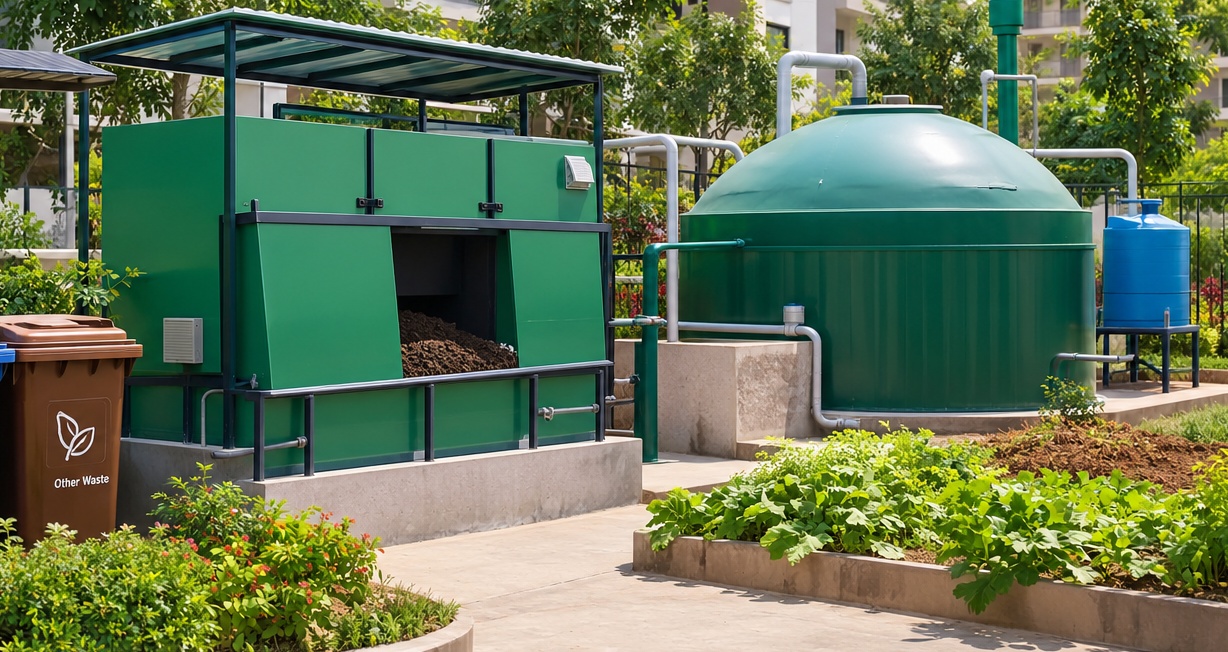
Malkajgiri Municipal Corporation (MMC) is planning to expand decentralised organic waste processing through aerobic composters in gated communities and biogas plants at the premises of bulk waste generators.
The initiatives were discussed during a review meeting on projects being implemented under SBMU 2.0, chaired by MMC Commissioner T Vinay Krishna Reddy on Wednesday. The Commissioner directed officials to accelerate pending works and maintain field-level monitoring to ensure projects are initiated and completed within their specified timelines.
Aerobic composters planned in gated communities
Under the plan, aerobic composters will be established in all gated communities within the Malkajgiri Municipal Corporation area to process wet waste at source. The Commissioner emphasised processing organic waste where it is generated to reduce the need for transporting wet waste and promote its conversion into compost.
The decentralised approach is intended to address wet waste closer to its point of generation rather than relying entirely on transportation to centralised processing facilities.
Bulk waste generators to be identified for biogas plants
MMC officials have also been instructed to identify and register bulk waste generators operating within the corporation’s jurisdiction.
The Commissioner directed officials to take steps to establish biogas plants at the premises of these generators, enabling wet waste to be utilised for biogas production instead of being discarded or transported without processing.
Coconut shells and flower waste also included in waste strategy
The waste-management plans extend beyond wet waste and biogas. Officials were advised to connect remaining coconut shell traders under the MMC with coir industries through an appropriate collection, transportation and utilisation system.
The objective is to prevent coconut shells from being discarded and instead channel them into coir production.
The Commissioner also directed officials to involve women members of self-help groups in the utilisation of flower waste. Training is planned for producing value-added and eco-friendly products such as dhoop sticks and incense sticks from processed flower waste.
The programme is intended to combine flower-waste management with skill development and employment opportunities for women self-help group members.
Focus on decentralised organic waste processing
The Malkajgiri plans bring several organic waste streams under a broader decentralised management approach, with different treatment routes proposed for wet waste, coconut shells and flower waste.
For wet waste, aerobic composting and anaerobic digestion through biogas plants provide two separate processing pathways. The choice between the two would depend on factors including waste characteristics, available space, scale and the intended use of the resulting products.
Bioenergy Business Analysis
Malkajgiri’s proposed combination of source-level composting and biogas production reflects a decentralised approach to managing urban organic waste. Establishing aerobic composters in gated communities could reduce the movement of wet waste, while biogas plants at bulk waste generators could create an energy-recovery pathway for suitable organic waste streams.
The approach also highlights the importance of segregating organic waste before processing. Consistent feedstock quality and reliable collection systems are important for maintaining the performance of decentralised biological treatment facilities. For biogas projects in particular, the economics will depend on factors such as feedstock volume and composition, plant utilisation, capital and operating costs, and how the resulting biogas and digestate are used.
At this stage, the Malkajgiri initiative remains a planned municipal intervention. No plant capacities, investment values, commissioning schedules or projected biogas volumes have been disclosed in the available report, so its eventual scale and impact cannot yet be quantified.