


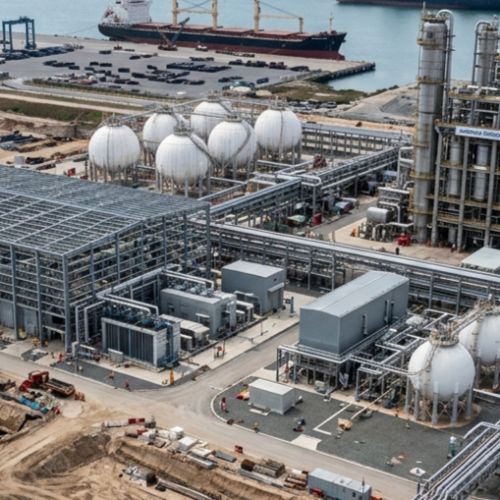
MadoquaPower2X has started construction activities on the first phase of its 500 MW green hydrogen and renewable ammonia project in Sines, Portugal, marking the transition from engineering and development to physical site preparation.
The project consortium announced that the site had been handed over to Portuguese engineering and construction company Mota-Engil, which began earthworks and ground levelling on 9 November 2026. Engexpor has been appointed to supervise the works.
The initial construction activities involve preparing the site for the installation of the hydrogen and ammonia production facilities. A notice published by the Sines parish authority on 27 October 2026 stated that the earthworks would take approximately 31 weeks and would initially focus on land movement and the creation of platforms for the future production units.
First Phase Targets 51,000 Tonnes of Green Hydrogen Annually
Phase 1 of MadoquaPower2X involves developing a 500 MW electrolysis facility capable of producing approximately 51,000 tonnes of green hydrogen annually. The hydrogen will be used as feedstock for a renewable ammonia production facility with an expected annual capacity of 300,000 tonnes.
The first phase represents an estimated investment of €1.3 billion.
According to the project developers, the hydrogen will be produced using alkaline water electrolysis technology powered by renewable electricity. The ammonia production facility will use the Haber-Bosch process to convert hydrogen and nitrogen into ammonia.
The project plans to source electricity primarily through a renewable energy community with access to dedicated solar and wind assets being developed in Portugal.
The green hydrogen is intended for local industrial users and the regional hydrogen network, while renewable ammonia will be transported by pipeline to the Port of Sines for export or use in applications including maritime fuel and European fertiliser production.
European Hydrogen Bank Awards €245 Million in Support
MadoquaPower2X secured support through the European Hydrogen Bank’s first renewable hydrogen auction, organised by the European Commission under the EU Innovation Fund.
The project was awarded a fixed premium of €0.48 per kilogram of renewable hydrogen produced, covering approximately 51,000 tonnes of annual hydrogen production over a 10-year support period.
The supported production volume amounts to approximately 510,000 tonnes of hydrogen over the full period, corresponding to an expected subsidy allocation of €245 million.
The funding is linked to hydrogen production after the facility becomes commercially operational, rather than being an upfront construction grant. The original award announcement, published by Power2X on 30 April 2024, described the support as an operational subsidy intended to narrow the gap between hydrogen production costs and sales prices.
Phase 2 Could Expand Electrolysis Capacity to 1.2 GW
The development is planned across two phases. Following the initial 500 MW installation, Phase 2 is expected to add another 700 MW of electrolysis capacity, taking the project’s total capacity to 1.2 GW.
At full development, the project targets annual production of approximately 150,000 tonnes of green hydrogen and 1 million tonnes of renewable ammonia.
The overall investment across both phases is estimated at €2.8 billion, according to the project developers. Phase 2 therefore represents a substantial expansion of the initial production infrastructure and is intended to increase the project’s contribution to Europe’s renewable hydrogen and ammonia supply chains.
The second phase remains a planned development; the current construction announcement concerns the first phase.
MAIRE Group Companies Supported Project Engineering
The engineering and design work for MadoquaPower2X has involved Italy’s MAIRE Group and its subsidiaries.
NextChem was awarded the pre-front-end engineering design (pre-FEED) contract in 2022, followed by Tecnimont’s selection to undertake the front-end engineering design (FEED) work in 2024.
The start of earthworks marks the beginning of the project’s implementation phase following these earlier engineering activities.
The first phase is currently expected to become operational in 2029, according to the November 2026 project update reported by HydroNews.
The MadoquaPower2X development is led by Madoqua Renewables in partnership with Copenhagen Infrastructure Partners (CIP), through its Energy Transition Fund, and Dutch project developer Power2X. The consortium is developing the facility within the Sines Industrial and Logistics Zone (ZILS), positioning it to connect renewable hydrogen and ammonia production with Portugal’s industrial and port infrastructure.



