


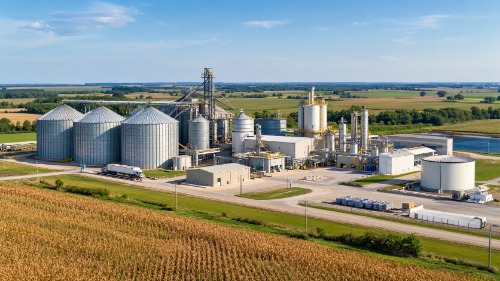
Green Plains Inc. has announced that its ethanol production facility in Superior, Iowa, has produced its one-billionth gallon of ethanol, marking nearly two decades of continuous operation since the plant was commissioned in 2008.
The milestone, announced on October 1, highlights the long-term operating history of one of the earlier production assets in Green Plains’ fleet and its continuing role in the agricultural economy of northwest Iowa and southwest Minnesota.
Superior facility has operated since 2008
The Superior ethanol plant was commissioned in 2008 and was originally developed by Superior Ethanol LLC under the leadership of Iowa agricultural entrepreneur and Green Plains Board Member Brian Peterson.
The facility was established with the objective of creating a dependable local market for grain producers while contributing to long-term economic activity in the region.
Nearly two decades later, the plant employs close to 50 people and maintains commercial links with local farmers, grain haulers, contractors and agribusiness companies across Northwest Iowa and Southwest Minnesota.
Green Plains said the facility’s one-billion-gallon milestone represents sustained production over its operating life rather than a single expansion or capacity event.
Green Plains highlights operational performance
Chris Osowski, President and Chief Executive Officer of Green Plains, attributed the milestone to the facility’s continued focus on safety, reliability and operational performance.
“Producing one billion gallons of ethanol is a meaningful accomplishment that represents nearly two decades of consistent execution,” Osowski said.
He added that reaching the milestone required sustained attention to safety, reliability and operational excellence and said the facility’s performance reflects the contribution of its workforce and the operational foundation established over its history.
The company did not disclose additional production-capacity or future expansion figures in its announcement.
Plant remains linked to regional agricultural supply chain
The Superior facility was initially developed around the availability of locally produced grain and the need for a reliable market for regional agricultural producers.
Peterson said the original objective was to create long-term value for local agriculture and surrounding communities by investing in an ethanol facility and maintaining a dependable market for grain.
The one-billion-gallon milestone therefore also illustrates the scale of the facility’s cumulative role in converting agricultural feedstock into renewable fuel over its operating period.
For the surrounding agricultural economy, the plant’s operations involve more than ethanol production itself, with its supply chain encompassing grain producers, transportation providers, contractors and other agribusiness participants.
One-billion-gallon milestone comes amid evolving ethanol industry
The milestone comes as the US ethanol industry continues to operate within a broader renewable-fuels market shaped by agricultural feedstock availability, fuel demand, environmental policy and developments in low-carbon fuels.
For an established ethanol plant, long-term operational reliability remains important because production economics depend on maintaining plant availability while managing feedstock, energy and logistics costs.
The Superior facility’s operating history also demonstrates the durability of the conventional grain-to-ethanol production model in an agricultural region where corn production provides a significant feedstock base.
Bioenergy Business Analysis
Green Plains’ Superior milestone is primarily an indicator of long-term asset operation and cumulative ethanol production, rather than evidence of a new capacity addition. The one-billion-gallon figure represents the scale of production achieved over nearly 20 years at a facility originally designed to connect regional grain production with renewable-fuel demand.
The facility’s continued integration with farmers, grain transporters and other agricultural businesses also illustrates an important characteristic of established ethanol assets: their economic contribution extends beyond the fuel produced at the plant. At the same time, the announcement provides limited information about the facility’s current production capacity, operating efficiency, carbon intensity or future investment plans. Those factors would be necessary to assess its competitiveness within the evolving US low-carbon fuels market.