


The Renewable Energy India Expo (REI Expo) 2026 could facilitate more than ₹2,800 crore in fresh investment opportunities for India’s bioenergy sector, according to the Indian Biogas Association (IBA), as the industry prepares to meet demand created by the newly approved GOBARdhan National Circular Bioenergy Scheme.
The three-day REI Expo is scheduled for 22–24 October 2026 at India Expo Mart, Greater Noida. The event will include a dedicated Bio-Energy Pavilion organised by IBA, bringing together bioenergy companies, technology providers, developers, investors and policymakers.
The ₹2,800 crore figure is an investment pipeline estimate cited by IBA, rather than committed investment. IBA said the potential pipeline is equivalent to nearly 12% of the ₹23,731 crore outlay approved for the GOBARdhan scheme.
The timing coincides with a major policy shift for India’s compressed biogas (CBG) industry. The Union Cabinet approved GOBARdhan on 6 August 2026, with implementation planned from FY2026-27 through FY2035-36 and an objective of increasing domestic CBG production by nearly tenfold.
GOBARdhan creates stronger investment framework for CBG
The ₹23,731 crore GOBARdhan scheme is designed to provide several forms of support to India’s CBG ecosystem, including assured demand, a government-backed pricing framework, capital assistance, pipeline infrastructure and financing support.
Under the scheme, City Gas Distribution (CGD) entities will procure CBG to support the notified blending obligation, which rises from 3% in FY2026-27 to 4% in FY2027-28 and 5% from FY2028-29 onwards for the CNG transport and domestic PNG segments.
The government has also introduced an administered CBG price of ₹2,110 per MMBtu, with a minimum 10-year pricing framework. Eligible greenfield CBG projects can receive capital assistance of up to ₹2 crore per tonne per day (TPD) of installed capacity. Support also extends to feedstock aggregation, organic-manure processing and other value-chain infrastructure.
These measures are intended to improve project bankability and provide greater visibility for developers considering new CBG facilities.
REI 2026 puts biogas and CBG in focus
IBA said the 2026 edition will place greater emphasis on biogas and its role in India’s clean-energy transition.
The Bio-Energy Pavilion 2026 is scheduled for 22–24 October at India Expo Center in Greater Noida. IBA’s event material lists technologies and applications spanning biogas, CBG, waste-to-energy and related circular-economy solutions.
According to IBA, this year’s pavilion will have 35% more exhibitors than in 2025, with participation expected from technology companies, startups and policymakers.
The official REI Expo platform also lists bioenergy equipment manufacturers among its exhibitor categories.
Investment opportunity extends beyond CBG plants
The policy environment could create opportunities across the broader CBG value chain rather than only in biogas plant construction.
GOBARdhan provides for pipeline infrastructure connecting CBG plants with trunk pipelines and City Gas Distribution networks. The scheme also includes a credit-guarantee mechanism for eligible MSME projects and support for district-level planning, feedstock assessment and technology adoption.
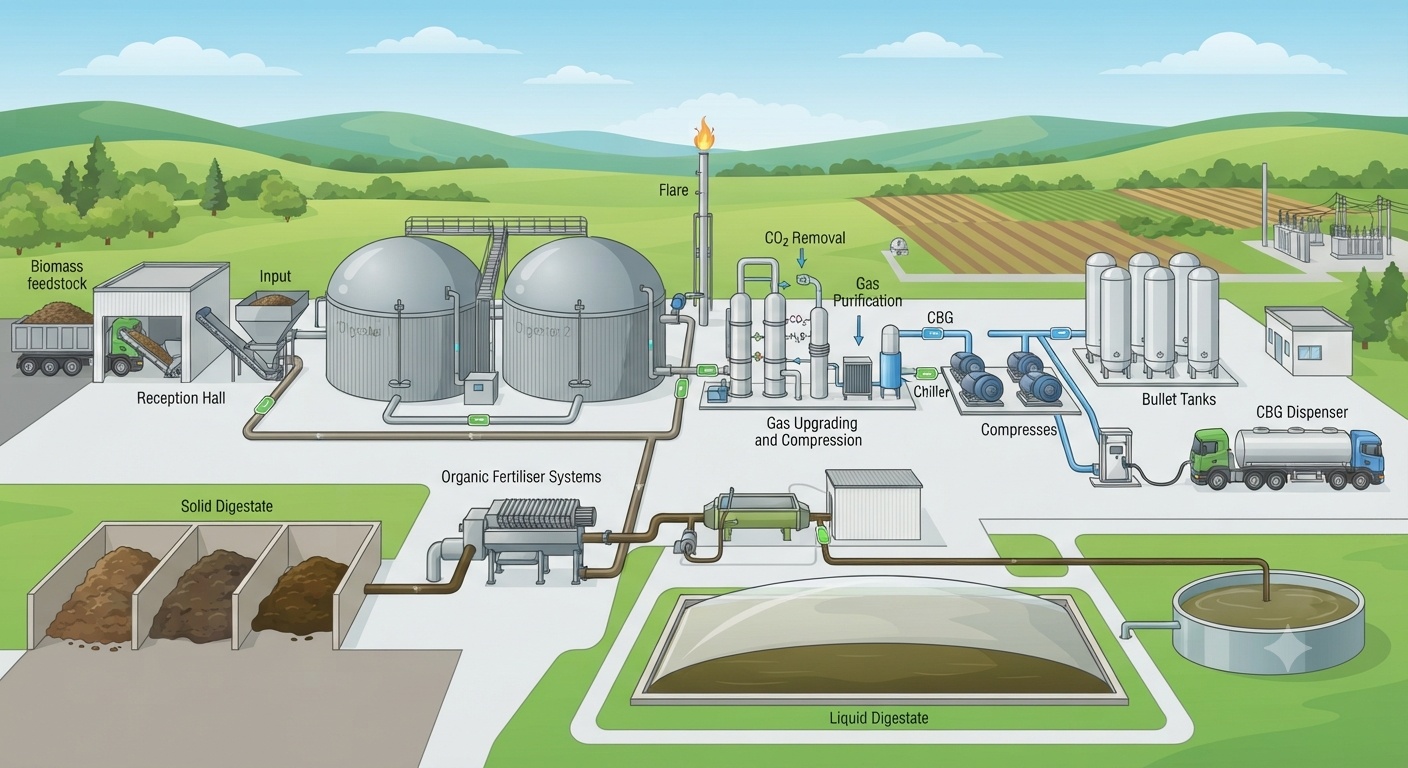
This could expand the addressable investment base to include feedstock aggregation, organic-manure processing, gas purification, compression, pipeline connectivity, monitoring systems and other supporting infrastructure.
India’s CBG ecosystem already includes a substantial project pipeline. Government data published in August 2026 showed 1,929 CBG/Bio-CNG plants registered, of which 217 had been commissioned and 357 were under construction as of the reported dates.
IBA links Expo to India’s CBG scale-up ambitions
IBA President A R Shukla said the sector is moving beyond its traditional association with rural applications and towards a broader clean-energy role spanning transport, agriculture and industrial energy.
IBA Chairman Gaurav Kedia also highlighted the potential for domestic CBG production to reduce fossil-fuel imports and create employment through development of the wider circular-bioeconomy ecosystem.
The association has estimated that India could eventually produce more than 62 million tonnes of CBG annually. This is an industry estimate and should be distinguished from current production or installed capacity.
The government’s stated policy objective is more specifically focused on nearly tenfold growth in domestic CBG production under GOBARdhan through 2035-36.
REI Expo expected to connect investors and project developers
REI Expo 2026 is positioned as a broader clean-energy event covering bioenergy alongside solar, wind, hydrogen, e-mobility and energy storage.
The official event organiser says the 2025 edition attracted more than 55,000 professionals and over 1,000 brands, providing a baseline for the scale of the platform.
IBA’s projected ₹2,800 crore bioenergy investment opportunity therefore comes at a point when policy support, project development and technology deployment are converging.
However, the extent to which the Expo translates this pipeline into actual financial closures will depend on individual project economics, feedstock availability, offtake arrangements, financing conditions, technology performance and execution capacity.
Bioenergy Business Analysis
The ₹2,800 crore figure should be treated as an industry pipeline estimate rather than a confirmed investment commitment. Its significance lies in the timing: the investment opportunity is being discussed shortly after the government established a much larger national framework for CBG through GOBARdhan.
The new scheme addresses several constraints that have historically affected CBG project development, including offtake visibility, pricing, capital requirements and pipeline connectivity. Yet policy support alone does not guarantee project execution. Developers will still need dependable feedstock, viable plant economics, financing, appropriate technology and long-term operating performance. REI Expo 2026 could consequently serve as a useful indicator of whether India’s strengthened CBG policy framework is translating into new partnerships, project pipelines and investment decisions across the bioenergy value chain.



[…] 22 to 24 at the India Expo Mart & Centre in Greater Noida. According to the IBA, the expected ₹2,800 crore investment pipeline would be equivalent to nearly 12% of the ₹23,731 crore GOBARdhan scheme outlay. The association […]