


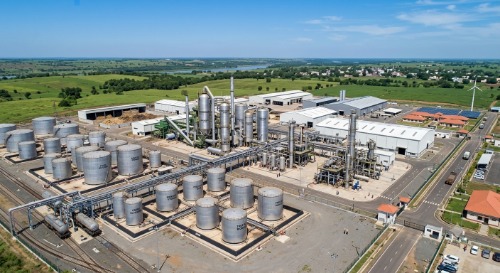
XCF Global Inc. has completed its all-stock business combination with Southern Energy Renewables Inc. and DevvStream Corp., bringing the two companies under XCF as wholly owned subsidiaries and creating a combined platform spanning renewable fuels, biomass conversion and environmental-attribute monetisation.
Following the transaction, former Southern shareholders hold approximately 20% of XCF’s outstanding common stock, while former DevvStream equity holders hold approximately 10.43%, according to the company’s announcement. XCF remains the publicly traded parent.
The company said the combined platform is intended to connect existing renewable fuel production capabilities with future biomass-conversion technologies and systems for monetising carbon credits, renewable fuel incentives and other environmental attributes.
XCF has also updated its full-year 2027 financial outlook following the closing. It now expects gross product sales of $650 million to $700 million, net revenue of $120 million to $130 million and EBITDA of $70 million to $75 million.
XCF combines renewable fuels with biomass conversion
The transaction brings together three areas of activity. XCF’s New Rise Renewables platform uses a hydroprocessed esters and fatty acids (HEFA) pathway for renewable fuel production. Southern adds biomass-to-fuels development and a future gasification technology pathway, which XCF says could enable the use of lower-cost feedstocks. DevvStream contributes capabilities in carbon management and the monetisation of environmental attributes.
HEFA is a technology pathway that can convert lipid-based feedstocks, such as used cooking oil and certain fats and oils, into renewable fuels, including sustainable aviation fuel (SAF) and renewable diesel. Gasification, by contrast, converts carbon-containing materials into a gas that can be processed into fuels and other products. The feedstocks, conversion processes and project economics differ between pathways.
XCF said the combined platform is designed to source waste and biomass feedstocks regionally and produce fuels closer to end markets. Its intended product and service portfolio spans renewable diesel, SAF, renewable methanol and environmental attributes, targeting aviation, marine, industrial and other sectors seeking lower-carbon alternatives.
The announcement does not establish that all of these pathways are already operating commercially across the combined business. In particular, Southern’s gasification route is described as a future technology pathway.
XCF updates 2027 outlook after closing
XCF also distinguishes gross product sales from net revenue and flags gross product sales as a non-GAAP measure in its announcement.
The revised gross product sales range is lower than the $775 million–$825 million range disclosed in earlier transaction-related materials. At the same time, the updated net revenue and EBITDA ranges are higher than the previously stated ranges of approximately $110 million–$120 million and $65 million–$70 million, respectively. The company’s latest outlook therefore changes the mix of its stated financial expectations rather than increasing every metric.
XCF also set out combined 2030 targets of more than $1.4 billion in annual gross product sales, more than $400 million in net revenue and more than $300 million in EBITDA. The company explicitly states that these figures are targets, not projections, and that they are subject to forward-looking-statement risks and assumptions.
Environmental-attribute monetisation becomes part of the platform
DevvStream’s role is to support the management and monetisation of carbon credits, renewable fuel incentives and other environmental attributes associated with the combined business.
For renewable fuel producers, these attributes can be an important part of project economics, depending on the fuel pathway, feedstock, lifecycle emissions performance and the policy framework in the relevant market. Their value is not automatic: eligibility requirements, credit prices, regulatory changes and verification processes can affect whether attributes are generated and how much revenue they deliver.
XCF said integrating these capabilities within the company is intended to strengthen its ability to capture value across the alternative fuels chain. The announcement, however, does not quantify how much of its updated outlook or 2030 targets is expected to come from environmental-attribute monetisation.
Board changes follow the transaction
In connection with the closing, Chad Langley, John Wharton and Carl Stanton joined XCF’s board of directors. Carter McCain stepped down from the board.
XCF Chief Executive Officer Chris Cooper said the combination brings renewable fuel production, new technology pathways and environmental-attribute optimisation onto one platform. He said the company intends to use the expanded capabilities to support emissions reduction, energy security and alternative uses for domestic agricultural resources.
Bioenergy Business Analysis
The combination reflects a strategy to integrate several components of the renewable fuels value chain: feedstock conversion, fuel production and monetisation of associated environmental attributes. If the businesses can coordinate these capabilities effectively, the structure could give XCF a broader set of routes to serve hard-to-abate sectors such as aviation, marine transport and industry.
However, the strategic rationale should be separated from demonstrated operating performance. A vertically integrated corporate structure does not, by itself, confirm that future technologies are commercially ready, that feedstock supply will be reliable or that projected margins will be achieved. Southern’s gasification pathway remains a future capability in the announcement, and XCF has not provided a quantified contribution from that pathway to its financial outlook.
For the wider bioenergy sector, the deal highlights a growing focus on combining physical fuel production with technology development and environmental-asset management. Whether that approach translates into durable commercial value will depend on execution, project delivery and the regulatory and market conditions governing low-carbon fuels.


