


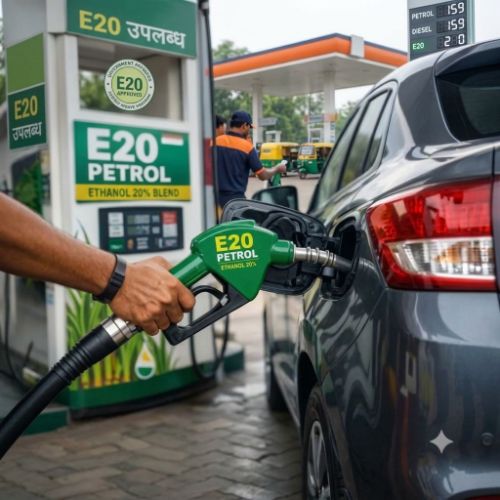
Union Road Transport and Highways Minister Nitin Gadkari has described criticism of India’s E20 petrol rollout as a “paid campaign”, claiming that four crore cars have been running on the 20% ethanol-blended fuel since 2022 without reported vehicle breakdowns.
Speaking at the Confederation of Indian Industry’s (CII) national conference on “Highways of India’s Future: Smart, Safe and Sustainable” in New Delhi, Gadkari defended the ethanol-blending programme amid concerns raised by opposition parties and consumer groups about the fuel’s compatibility with older vehicles.
His remarks came a day after the government notified amendments to the Central Motor Vehicles Rules, 1989, permitting flex-fuel vehicles capable of operating on petrol-ethanol blends containing up to 100% ethanol (E100).
The debate highlights a key issue in India’s ethanol-fuel transition: balancing the expansion of domestically produced renewable fuels with questions about vehicle compatibility, consumer concerns and the pace of changes to the transport fuel system.
Gadkari defends E20 rollout amid vehicle compatibility concerns
Responding to criticism of E20 petrol, Gadkari argued that the controversy had subsided and pointed to the number of vehicles he said had used the fuel without problems.
“Three months ago, there was a great hue and cry against the E20; now it has ended… It was a paid propaganda,” Gadkari said.
He added, “Since 2022, four crore cars and 20 scooters are running on E20. Not a single vehicle had an issue or breakdown.”
E20 petrol contains up to 20% ethanol blended with petrol. Ethanol can be produced from feedstocks including sugarcane, maize and other eligible agricultural materials, making blending policy an important component of India’s efforts to expand biofuel use in transport.
However, concerns have persisted over the suitability of E20 for older vehicles that were not specifically designed or certified for higher ethanol blends. Compatibility can depend on the vehicle’s engine design, fuel-system materials, calibration and manufacturer specifications.
The distinction between the fuel’s broader policy benefits and its compatibility with individual vehicles remains central to the debate.
E100 rules open the door to higher-ethanol flex-fuel vehicles
The E20 controversy comes as the government expands the regulatory framework for vehicles capable of using higher ethanol concentrations.
Flex-fuel vehicles are engineered to accommodate varying ethanol-petrol mixtures. Their introduction could broaden the potential use of ethanol as a transport fuel, although wider adoption will depend on vehicle availability, fuel-distribution infrastructure, affordability and consumer acceptance.
India’s ethanol-blending programme has been developed to increase renewable fuel use and reduce reliance on conventional petroleum fuels. Its wider effects depend on feedstock availability, production costs, lifecycle emissions and the ability to supply ethanol sustainably at scale.
Gadkari announces stricter highway pavement monitoring
Alongside his comments on ethanol, Gadkari addressed concerns about the integrity of Network Survey Vehicle (NSV) reports used to assess road conditions.
He said three NSVs would independently survey the same road stretch, with separate reports used to assess pavement health and reduce the risk of manipulated results.
“I know that they will manage the NSV report. So for a road, three NSVs will go separately. And 3 separate reports will be sought,” Gadkari said.
The minister also warned contractors and officials that potholes on national highways would be accounted for and that those responsible could face penalties.
Gadkari said he had directed that the road roughness index should not exceed 1,800 millimetres per kilometre (mm/km). He contrasted this target with road roughness levels of 4,000–4,400 mm/km that he cited and a contractual figure of 2,200 mm/km.
The road roughness index measures variations in a road surface, with higher values generally indicating a rougher ride. Independent surveys and consistent reporting could help strengthen oversight, although the effectiveness of the proposed approach will depend on measurement standards, verification procedures and enforcement.
The highway-monitoring announcements were separate from the ethanol discussion but formed part of Gadkari’s wider address on transport infrastructure and road safety.
Bioenergy Business Analysis
Gadkari’s defence of E20 places the public debate over ethanol blending at the intersection of energy security, vehicle technology and consumer confidence. India has expanded ethanol blending as part of its efforts to diversify transport fuels, create demand for agricultural feedstocks and reduce dependence on imported fossil fuels.
However, the minister’s assertion that no vehicles have experienced problems should be treated as a political statement rather than conclusive evidence of universal E20 compatibility. Establishing the scale of any vehicle-related effects would require independently verifiable information, including manufacturer guidance, vehicle age and model, maintenance records and documented cases of fuel-system problems.
The newly notified E100 rules could provide a regulatory pathway for vehicles designed to use higher ethanol concentrations. Yet the practical impact will depend on whether manufacturers introduce suitable models, whether fuel supply becomes accessible and whether the economics of high-ethanol fuels are attractive to consumers.


