


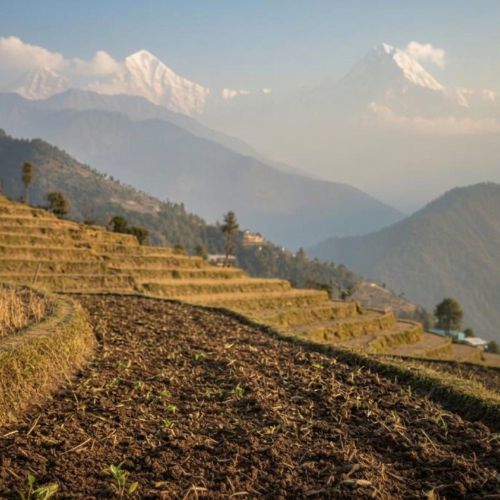
The Uttarakhand government has allocated ₹70 crore in its supplementary budget to advance a programme exploring carbon-credit generation through climate-resilient farming, with the initiative targeting agricultural land left uncultivated and opportunities to channel carbon-market revenues to farmers.
The state’s Watershed Management Department is conducting a feasibility study under the Uttarakhand Climate-Resilient Rainfed Farming Project in collaboration with Hyderabad-based Core CarbonX. The company is expected to identify suitable land, assess farmer participation and determine which agricultural activities could generate carbon credits.
The initiative aims to integrate agriculture and horticulture, improve the productivity of underused farmland and create additional income opportunities for rural households. However, the extent of any future farmer earnings will depend on the feasibility study, project registration, carbon-credit generation and the terms under which revenue is distributed.
The supplementary budget also provides ₹35 crore for the Prime Minister’s Formalisation of Micro Food Processing Enterprises (PMFME) Scheme, which operates under the state’s Horticulture Department.
Uttarakhand plans carbon credit projects for farmers
The Uttarakhand government has earmarked ₹70 crore in its 2026–27 supplementary budget for its climate-resilient rainfed agriculture programme, which is exploring carbon-credit generation as a potential source of additional income for farmers. The initiative includes a feasibility study to identify suitable farmland, assess farmer participation and develop projects that could qualify for carbon-credit registration.
The state’s Watershed Management Department has signed a memorandum of understanding (MoU) with Hyderabad-based Core CarbonX to assess how climate-resilient farming practices could generate carbon credits and how the resulting benefits could reach participating farmers.
The study will examine agricultural land left uncultivated, potential agriculture-horticulture models and activities that may qualify for carbon-credit projects. Core CarbonX is also expected to prepare a Project Development Document (PDD), a key document for project registration.
The initiative forms part of the Uttarakhand Climate-Resilient Rainfed Farming Project, which began implementation in 2024 across 519 gram panchayats in eight districts. The government aims to improve the productivity of underused agricultural land while exploring additional income opportunities linked to carbon markets.
Carbon credit feasibility study to identify eligible farmland
Under the proposed approach, Core CarbonX will identify land that could be included in carbon-credit projects, assess which farmers are willing to participate and determine the agricultural activities that could support credit generation.
The study may also extend to areas surrounding the existing project locations if the Watershed Management Department considers a wider assessment necessary.
The planned agriculture-horticulture model is intended to bring some abandoned or underused cultivable land back into productive use. Depending on the activities selected and the applicable carbon-credit methodology, eligible projects could potentially generate credits by demonstrating measurable greenhouse gas reductions or removals.
However, identifying suitable land does not automatically establish that a project will qualify for credits. Project developers will need to determine the appropriate methodology, establish a baseline, demonstrate additional climate benefits, monitor results and meet the requirements of the selected carbon-crediting programme.
The study’s findings should therefore help determine the technical and commercial feasibility of the proposed initiative before its potential benefits to farmers can be assessed.
Project development document to support carbon credit registration
A key task assigned to Core CarbonX is preparing the Project Development Document required for carbon-credit project registration.
Such documentation generally sets out the project’s boundaries, baseline conditions, proposed activities, emissions-reduction or removal methodology, monitoring arrangements and other information needed for assessment under the chosen carbon-crediting standard.
For agricultural projects, the methodology will be particularly important. Depending on the practices adopted, potential areas of assessment could include soil carbon, changes in fertiliser-related emissions, agroforestry or other measurable improvements in land management. These are possible project pathways, not confirmed activities under Uttarakhand’s initiative.
Credible carbon-credit generation requires evidence that the claimed climate benefits are measurable and meet the applicable methodology. Monitoring, reporting and independent verification may also be necessary, depending on the programme selected.
The feasibility study should therefore establish which activities are suitable for Uttarakhand’s farming conditions and whether the anticipated credit revenue can justify the costs of implementation and verification.
Allocates ₹35 crore for PMFME scheme
The supplementary budget includes a separate allocation of ₹35 crore for the Prime Minister’s Formalisation of Micro Food Processing Enterprises (PMFME) Scheme, administered through the state’s Horticulture Department.
The allocation is intended to support the expansion of PMFME stores across Uttarakhand, with the stated aim of benefiting farmers and consumers.
While the carbon-credit initiative focuses on climate-resilient agricultural practices and potential environmental-market revenue, the PMFME scheme addresses the processing and marketing side of the agricultural value chain.
Together, the two allocations cover different aspects of rural economic development: improving the productive use of agricultural land and supporting channels through which agricultural products can reach consumers.
Bioenergy Business Analysis
Uttarakhand’s carbon-credit initiative could create a new link between climate-resilient agriculture and rural income generation, but its success will depend on whether the proposed projects can generate credible, commercially viable credits and deliver a meaningful share of the proceeds to farmers.
For the wider bioenergy and climate-finance sector, the initiative is worth following because agricultural carbon projects could complement existing rural development programmes. However, the immediate milestone is the feasibility assessment and preparation of the project documentation, not the issuance of credits.
If the proposed model proves viable and delivers transparent benefits to farmers, Uttarakhand could establish a framework for connecting climate-resilient farming, productive land use and carbon-market participation in other regions.


