


Eco Wave Power has received its first purchase order from Bharat Petroleum Corporation Limited (BPCL) for a site assessment at the company’s Marine Oil Terminals in Mumbai, advancing the proposed wave energy pilot in India.
The purchase order marks the first implementation step under the Memorandum of Understanding (MoU) signed by the two companies in 2025. The assessment will examine the technical feasibility of deploying Eco Wave Power’s onshore wave energy technology at BPCL’s existing marine infrastructure at Jawahar Deep, Mumbai.
The study is expected to be completed within four months of the purchase order’s issuance. Its findings will help determine whether the proposed site can accommodate a wave energy installation and support subsequent decisions on the planned pilot project.
BPCL Purchase Order Advances 2025 Wave Energy Agreement
The purchase order covers a comprehensive site assessment of BPCL’s Marine Oil Terminals in Mumbai.
The assessment will evaluate the suitability of the existing coastal infrastructure for Eco Wave Power’s technology, which is designed to generate electricity from ocean waves using structures such as breakwaters, piers and jetties.
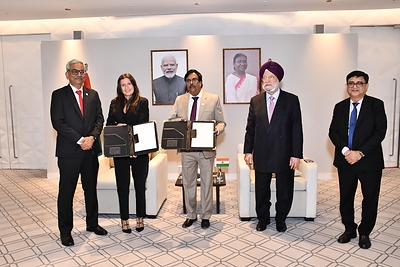
The agreement builds on the MoU signed during India Energy Week in 2025. The signing took place in the presence of Union Minister of Petroleum and Natural Gas Hardeep Singh Puri, alongside BPCL’s then Chairman and Managing Director G. Krishnakumar.
The MoU was signed by Chandrasekhar N, then Head of Research and Development at BPCL, and Inna Braverman, Founder and CEO of Eco Wave Power.
The latest purchase order moves the collaboration beyond its initial agreement stage into technical project assessment. However, it does not yet represent a confirmed construction contract or a commitment to commercial-scale electricity generation.
India’s 40,000 MW Wave Energy Resource Potential
India’s coastline has an estimated theoretical wave energy potential of approximately 40,000 MW, according to information published by the Ministry of New and Renewable Energy (MNRE). The government has described this figure as a preliminary estimate, rather than an established commercially exploitable capacity. Press Information Bureau
The resource estimate provides a broader context for interest in ocean energy technologies, although translating theoretical potential into operational electricity generation will depend on site-specific marine conditions, technology performance and project economics.
For the proposed Mumbai project, the immediate focus is on assessing whether BPCL’s existing marine facilities can support the installation of wave energy equipment.
How Eco Wave Power’s Technology Works
Eco Wave Power develops an onshore wave energy system that uses existing coastal and marine structures, including breakwaters, piers and jetties, to capture energy from moving seawater.
The system is designed to position its energy conversion equipment onshore rather than requiring a fully offshore generating installation. This approach could offer opportunities to use existing port and industrial infrastructure for renewable electricity generation.
The company has also developed wave energy projects in other markets, including a grid-connected installation in Israel and a pilot project at the Port of Los Angeles in the United States.
For India, the BPCL collaboration is intended to establish whether the technology can be deployed at an existing petroleum terminal before the companies consider further development.
BPCL’s Renewable Energy and Decarbonisation Strategy
The proposed wave energy project adds another technology pathway to BPCL’s broader exploration of lower-carbon energy solutions.
The state-owned oil and gas company has stated a target of achieving net-zero emissions by 2040. Its interest in wave energy reflects the potential to examine renewable electricity options alongside its established refining, petroleum marketing and distribution operations.
The Mumbai assessment will be particularly relevant because it focuses on integrating renewable energy equipment with existing marine infrastructure. This could help determine whether industrial coastal facilities can serve as suitable locations for additional renewable energy technologies.
However, the purchase order covers only the initial assessment work. The companies have not announced a confirmed generating capacity, project investment, electricity offtake arrangement or commercial commissioning date for the proposed Mumbai installation.
Bioenergy Business Analysis
BPCL’s purchase order for Eco Wave Power represents a useful development for India’s emerging ocean energy segment, but its immediate significance lies in project evaluation rather than new renewable electricity capacity.
The collaboration brings together an established Indian petroleum company with a technology developer seeking to commercialise wave energy through existing coastal infrastructure. For Eco Wave Power, BPCL’s involvement could provide access to an industrial marine site and an opportunity to assess the technology under Indian operating conditions.
The project’s potential value will depend on what the four-month assessment establishes. Local wave intensity, seasonal variations, marine corrosion, structural compatibility, equipment durability and maintenance requirements will all be relevant to determining technical and operational feasibility.
For now, the key milestone is that the 2025 MoU has progressed into a funded assessment assignment through BPCL’s purchase order. Whether this translates into a viable pilot and, eventually, larger commercial projects will depend on the technical and economic findings of the next development phase.
Related: India and Netherlands explore cooperation in green hydrogen, clean energy and port infrastructure
Source: Eco Wave Power announcement on the BPCL assessment order


