


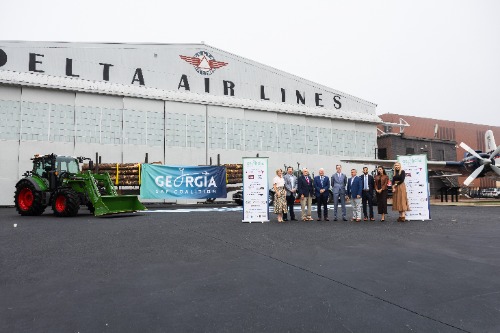
Delta Air Lines and partners from Georgia’s aviation, agriculture, forestry and business sectors have launched the Georgia Sustainable Aviation Fuel (SAF) Coalition, a statewide initiative aimed at accelerating SAF development, production and investment in the state.
The coalition was established by the Metro Atlanta Chamber, Delta, the Georgia Forestry Association and Georgia Farm Bureau. It brings together industry representatives, policymakers and other stakeholders to develop an SAF ecosystem based on Georgia’s agricultural and forestry resources, research capabilities, aviation infrastructure and logistics network.
The initiative was announced at an event at the Delta Flight Museum, where elected officials and industry leaders discussed Georgia’s potential role in the emerging SAF market.
Speakers included Georgia House Speaker Jon Burns, Georgia Agriculture Commissioner Tyler Harper, Metro Atlanta Chamber President and CEO Katie Kirkpatrick and Delta President Peter Carter.
“Georgia is well positioned to become a national leader in SAF,” said Peter Carter, President of Delta Air Lines.
Carter said the coalition is intended to bring organisations together to support SAF industry development, investment, innovation and potential economic benefits for communities across Georgia.
Coalition targets SAF production and investment
The Georgia SAF Coalition is intended to coordinate efforts across several parts of the SAF value chain.
Its stated priorities include strengthening public-private partnerships, supporting research and commercialisation, attracting investment, advancing policies that support industry growth and connecting Georgia’s existing agricultural, forestry, aviation and logistics capabilities with emerging SAF opportunities.
The initiative comes as the aviation industry seeks to expand the supply of lower-carbon aviation fuels and diversify the feedstocks and technologies available for SAF production.
SAF can be produced from a range of renewable and waste-based feedstocks and, depending on the production pathway and feedstock, can deliver substantially lower lifecycle greenhouse-gas emissions than conventional fossil jet fuel.
Forestry and agricultural feedstocks at the centre of strategy
Georgia’s forestry and agricultural resources are central to the coalition’s approach.
The coalition builds on the state’s Keep Georgia Forested Act, legislation that the founding organisations say creates additional opportunities for investment in forestry manufacturing and for converting Georgia-grown agricultural and forestry feedstocks into products including SAF.
The strategy could create potential links between the state’s farmers and forest-product sector and future renewable-fuel production facilities.
However, the availability of feedstock alone does not establish commercial SAF production. Projects would also require appropriate conversion technology, reliable supply chains, investment, certification and market demand.
The sustainability performance of individual SAF projects would likewise depend on the specific feedstocks used, production pathway, energy inputs and lifecycle emissions.
Delta brings aviation demand to coalition
Delta’s participation gives the coalition a direct link to one of the world’s largest airline groups and to Georgia’s aviation infrastructure.
Delta is headquartered in Atlanta, while Hartsfield-Jackson Atlanta International Airport serves as the airline’s largest hub.
The coalition argues that this existing aviation presence, combined with Georgia’s resource base and logistics infrastructure, could support development of an SAF ecosystem within the state.
For airlines, access to additional SAF production is important as the industry works to increase the availability of lower-carbon aviation fuel. SAF can be incorporated into existing aviation fuel supply chains when it meets the applicable technical and certification requirements.
Delta has separately committed to increasing its use of SAF and has pursued agreements with SAF producers and suppliers as part of its broader decarbonisation strategy.
Research and commercialisation form part of the plan
The coalition also intends to connect Georgia’s research institutions with SAF development.
Research and development could play a role in evaluating locally available feedstocks, improving conversion technologies and establishing commercially viable production pathways.
The coalition’s focus on commercialisation is significant because moving from laboratory or pilot-scale research to commercial SAF production requires substantial capital investment and long-term market certainty.
It also requires projects to demonstrate that feedstock collection, preprocessing, conversion, fuel upgrading and distribution can operate reliably at commercial scale.
Georgia seeks to build a broader SAF ecosystem
The coalition’s stated objective extends beyond establishing individual SAF production projects.
By bringing together an airline, forestry and agricultural organisations, business leaders and policymakers, the initiative aims to create a framework connecting feedstock suppliers with researchers, producers, investors and fuel users.
The coalition says such an ecosystem could support farmers, foresters and local communities while creating additional economic activity across Georgia.
Whether those benefits materialise will depend on the development of commercially viable projects and the ability to secure sustainable feedstock supplies, financing, technology and long-term SAF demand.
Bioenergy Business Analysis
The launch of the Georgia SAF Coalition reflects a state-level cluster approach to SAF development, bringing together aviation demand with agricultural and forestry feedstock interests, research capabilities and investment networks. Georgia’s existing aviation and logistics infrastructure provides potential advantages for connecting future SAF production with fuel demand.
The coalition’s formation, however, is an enabling step rather than evidence that large-scale SAF production has already been established in Georgia. The next indicators to watch will be concrete project announcements, feedstock-supply agreements, technology selection, investment commitments and long-term offtake arrangements. The implementation of policies such as the Keep Georgia Forested Act will also influence how agricultural and forestry resources can be integrated into future SAF supply chains.