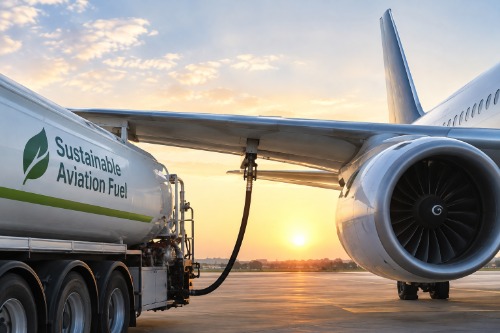
Envision has implemented its Sustainable Aviation Fuel certificate (SAFc) solution internationally for the first time at Global Citizen NOW: Perth, reporting environmental attributes equivalent to a 10-tonne reduction in carbon dioxide emissions.
The initiative, delivered as part of Envision’s role as a sustainability partner at the summit, links the claimed emissions reduction to the production and use of actual sustainable aviation fuel (SAF). The company said the associated environmental attributes were recorded and retired through a global registry to support transparency and traceability.
The announcement marks Envision’s first overseas application of its SAFc solution, extending its use beyond China to an international event. The company said the approach can help businesses and large-scale event organisers address emissions associated with air travel across their value chains.
SAFc initiative targets aviation-related event emissions
SAFc allows the environmental attributes associated with SAF use to be accounted for separately from the physical fuel. In this case, Envision said it provided attributes corresponding to 10 tonnes of CO₂ emissions reductions for Global Citizen NOW: Perth.
The company did not identify the registry used, disclose the volume of SAF associated with the certificates or provide details of the emissions-accounting methodology in its announcement.
The distinction is relevant because the initiative concerns the environmental attributes associated with SAF production and use; it does not establish that SAF was physically supplied to aircraft carrying summit participants.
Envision participates in clean energy investment discussions
Alongside the SAFc initiative, Envision’s Australian team took part in discussions on clean energy investment and industrial decarbonisation, as well as bilateral meetings and a Capital Mobilization Roundtable and Masterclass.
The discussions brought together business leaders, investors and members of the climate community to consider Western Australia’s potential to develop next-generation green industries. Topics included opportunities to strengthen collaboration, attract investment and accelerate the clean energy transition.
Global Citizen and the Government of Western Australia co-hosted the summit from 18 to 20 October 2026, ahead of COP31. The event brought together representatives from government, business, philanthropy and First Nations communities to discuss clean energy access, climate resilience and inclusive economic development.
Initiative builds on Envision’s China deployment
The Perth implementation follows Envision’s use of SAFc at the 26th China International Fair for Investment and Trade (CIFIT), held in Xiamen in September 2026.
At CIFIT, the company demonstrated how SAF certificates could be used to address emissions associated with air travel for large-scale conferences. The Perth initiative extends this model to an international event and forms part of Envision’s effort to develop applications for SAFc among businesses and event organisers.
Envision’s wider clean energy portfolio includes wind and solar power, energy storage, green molecules, net-zero industrial parks and green computing. The company positions these solutions as part of its approach to reducing emissions across corporate operations and value chains.
“Envision will continue to explore the application of green fuels in the aviation sector and international events, strengthen collaboration along the green fuel value chain, and support the transition to low-carbon aviation through transparent and traceable environmental attribute management,” said Bella Zhang, Head of Global SAF at Envision.
Bioenergy Business Analysis
Envision’s Perth deployment illustrates how SAF certificates are being positioned as a tool for addressing aviation-related emissions associated with activities such as international conferences, where participants may travel from multiple countries. The model separates the accounting of SAF’s environmental attributes from the physical delivery of fuel to individual aircraft, potentially allowing organisations to support SAF use without arranging direct fuel supply for every flight.
However, the reported 10-tonne reduction should be read as an emissions benefit represented by the certificates, rather than as evidence that the summit’s total aviation footprint was reduced by 10 tonnes. The announcement does not disclose the underlying SAF volume, feedstock, lifecycle emissions assessment, certificate methodology or name of the registry. These details would help readers assess how the reduction was calculated and how the environmental attributes were tracked.