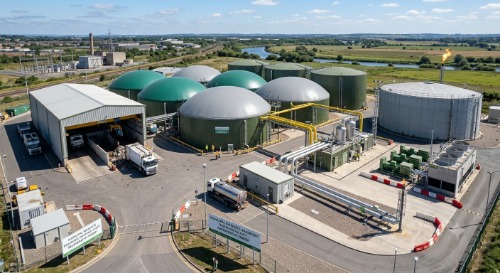
Azerbaijan plans to establish anaerobic digestion facilities near municipal solid waste landfills by 2035 to process organic waste into biogas, according to the country’s newly approved Long-Term Low-Carbon Development Strategy.
The proposed facilities form part of Azerbaijan’s wider waste management and decarbonisation plans, which identify methane emission reductions and expanded waste sorting as priority measures. The country’s waste sector generated approximately 4.9 million tonnes of carbon dioxide equivalent (CO₂e) in 2022, according to the strategy-related reporting by Report.az.
The strategy also outlines plans to upgrade existing wastewater treatment facilities and construct new installations equipped with methane capture systems. The captured gas is intended for use in energy generation.
Azerbaijan targets biogas production from organic waste
Under the strategy, anaerobic digestion plants are planned in the immediate vicinity of municipal solid waste landfills by 2035. These facilities will process organic material to produce biogas.
Anaerobic digestion is a biological process in which microorganisms break down organic matter in the absence of oxygen. The process produces biogas, primarily consisting of methane and carbon dioxide, which can be used as a fuel for electricity and heat generation or further processed for other energy applications.
Locating the proposed facilities near landfills could support the treatment of biodegradable waste while contributing to efforts to reduce methane emissions from waste disposal.
However, the strategy-related announcement does not specify the number, individual capacities, investment requirements or exact locations of the planned plants.
Waste sector identified as a methane reduction priority
Azerbaijan’s waste management sector recorded emissions of approximately 4.9 million tonnes of CO₂e in 2022.
Reducing methane emissions and expanding waste sorting have been identified as key priorities for addressing the sector’s environmental impact.
The country’s Nationally Determined Contribution (NDC 3.0), submitted to the United Nations Framework Convention on Climate Change (UNFCCC), also identifies organic waste disposal and wastewater treatment as significant contributors to waste-sector emissions.
The NDC reports that solid organic waste disposal accounted for approximately 2.4 million tonnes of CO₂e in 2022, while wastewater treatment contributed a further 2.4 million tonnes of CO₂e. UNFCCC
Waste collection and wastewater infrastructure targets extend to 2060
Beyond the planned anaerobic digestion facilities, Azerbaijan’s strategy envisages achieving 100% coverage of collected waste by 2060.
The government also plans to modernise existing wastewater treatment complexes and establish new facilities equipped with methane capture systems. The captured methane is intended to be used for energy purposes rather than released into the atmosphere.
These measures form part of the country’s broader long-term decarbonisation framework, which covers waste management alongside energy, transport, industry, agriculture and other economic sectors.
Bioenergy Business Analysis
Azerbaijan’s proposed anaerobic digestion programme could create opportunities for the development of waste-to-energy infrastructure, particularly in the treatment of organic fractions of municipal solid waste.
Converting biodegradable waste into biogas offers a dual benefit: recovering energy from organic material and reducing methane emissions associated with uncontrolled decomposition.
The integration of methane capture into wastewater treatment infrastructure could also expand the country’s potential sources of renewable gas.
However, the strategy currently establishes policy direction and timelines rather than a pipeline of fully defined biogas projects. The absence of announced plant capacities, investment figures, implementation partners and construction schedules means that the scale of the proposed programme remains to be determined.
The next important developments will be the identification of individual projects, financing arrangements and implementation plans ahead of the 2035 target.