


India’s Ministry of Civil Aviation is considering the formation of a National Council on Sustainable Aviation Fuel (NC-SAF) to coordinate implementation of the country’s proposed Sustainable Aviation Fuel (SAF) Policy, bringing aviation regulators and several government departments into a common framework.
The proposed Council will be co-chaired by the Secretaries of the Ministry of Civil Aviation and the Ministry of Petroleum and Natural Gas. Its membership is expected to include the Directorate General of Civil Aviation (DGCA), along with representatives from the ministries responsible for agriculture, environment, finance and consumer affairs.
The proposal comes as the Centre prepares a phased SAF blending framework for international flights, with an initial requirement of 1% from January 2027. The Ministry of Civil Aviation has circulated the Draft SAF Policy, 2026, which sets out a roadmap for increasing SAF use and developing the infrastructure and supply chains needed to support its adoption.
India outlines phased SAF blending roadmap
Under the draft policy, the proposed SAF blending requirement for international flights is scheduled to begin at 1% in 2027 and increase to 5% by 2030.
The longer-term roadmap indicates a potential increase to 20% by 2040. However, targets beyond 2030 are not yet finalised as binding requirements. The proposed NC-SAF is expected to play a role in determining the blending obligations for the subsequent period.
The policy is intended to support the development of a domestic SAF market while establishing a framework for fuel suppliers and airlines to meet future blending requirements. The draft also proposes penalties for aviation fuel suppliers and aircraft operators that fail to comply, although the penalty amounts have not yet been specified.
Proposed rules address fuel procurement and airport infrastructure
The draft policy also seeks to address economic tankering, a practice in which airlines carry additional fuel from another airport to avoid buying fuel at a destination where prices are higher. This can affect local fuel demand and airport operations.
To discourage the practice, the proposal includes a requirement for scheduled international airlines to uplift at least 90% of their annual sector aviation fuel requirements from international airports in India.
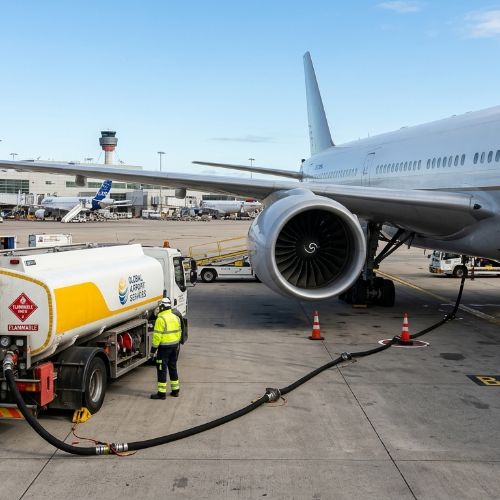
Airports would also have responsibilities under the proposed framework. Airport authorities and operators would be required to ensure that infrastructure for SAF storage, handling and distribution is ready. They would also be expected to coordinate with oil marketing companies (OMCs) on the logistics and blending operations required to supply SAF.
The draft places fuel suppliers, including OMCs, at the centre of the blending process. SAF would be blended with conventional aviation turbine fuel (ATF) at production facilities, refineries or intermediate storage facilities before the blended fuel is supplied to airports.
Coordination and supply-chain development remain key priorities
The proposed NC-SAF is intended to provide an institutional mechanism for coordinating the implementation of the policy across the aviation, petroleum, agriculture, environment and finance sectors.
The DGCA is also expected to oversee a proposed national SAF Registry to record and track SAF production, blending, supply and consumption. The registry would support monitoring and verification of SAF transactions and associated emissions.
The policy’s implementation will depend on more than the introduction of blending obligations. Domestic production capacity, feedstock availability, fuel certification, supply-chain logistics and airport readiness will all influence whether the proposed targets can be achieved.
Bioenergy Business Analysis
The proposed National Council on Sustainable Aviation Fuel signals an effort to align India’s aviation decarbonisation plans with its domestic biofuel and energy supply chains. Bringing the civil aviation and petroleum ministries together, alongside regulators and other government departments, could help address coordination challenges across SAF production, procurement, blending and distribution.
The proposed 2027 start to blending requirements also gives fuel producers and oil marketing companies a relatively short period to prepare for initial compliance. However, the commercial feasibility of the roadmap will depend on the availability and cost of domestically produced SAF, as well as the development of reliable feedstock and distribution networks.
The 20% figure for 2040 should be viewed as a longer-term policy direction rather than a finalised obligation. The proposed Council’s role in reviewing future blending requirements will therefore be important in determining the pace of India’s SAF market development.



