


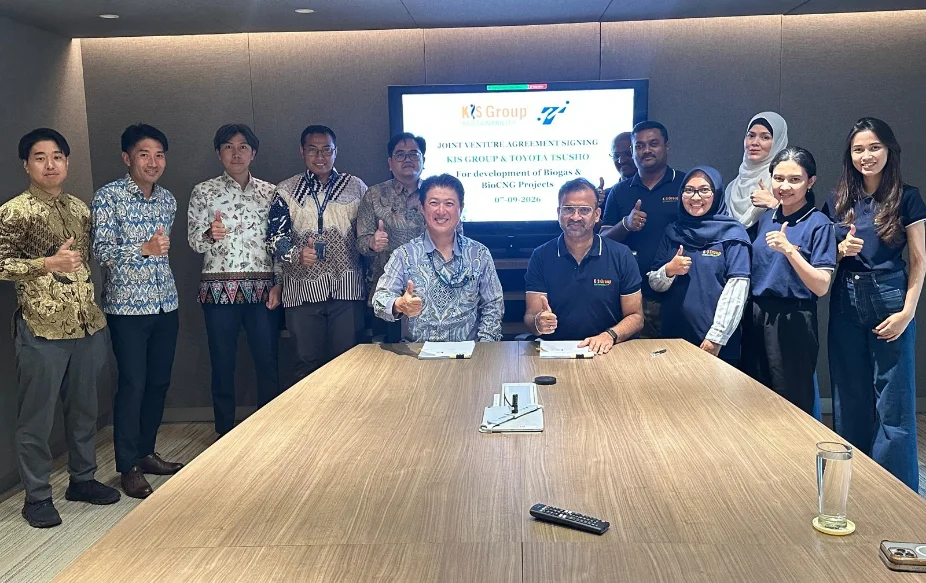
Toyota Tsusho Corporation and PT KIS Biofuels Indonesia have established a joint venture in Indonesia to develop a biomethane production and sales business, with the first commercial project expected to begin operations in 2027.
The joint venture, PT KIS Toyota Tsusho Biomethane Indonesia (KTBI), was established in September 2026 by Toyota Tsusho and KIS Biofuels Indonesia (KBI), the Indonesian subsidiary of the KIS Group.
The first project will upgrade biogas produced from palm oil mill effluent (POME) at a palm oil mill in South Sumatra into high-purity biomethane. The renewable gas is planned to be transported through the pipeline network operated by PT Perusahaan Gas Negara (PGN) to customers, including manufacturers in West Java.
KTBI plans annual biomethane sales of approximately 150,000 MMBTU.
South Sumatra POME Biogas to Supply West Java Manufacturers
The project will use biogas generated from POME, an organic wastewater stream produced during palm oil processing.
Under the planned arrangement, the biogas will undergo upgrading to produce higher-purity biomethane suitable for distribution through existing gas infrastructure.
The resulting biomethane is expected to be supplied through PGN’s pipeline network to industrial customers in West Java, a major manufacturing centre.
The companies describe the project as the first Indonesian initiative to transport biomethane from Sumatra to Java, linking the country’s palm oil-producing region with industrial gas demand in Java.
Commercial operations are targeted to start in 2027.
Existing Gas Infrastructure to Support Fuel Switching
A key element of the project is the planned use of existing gas infrastructure and customer-side equipment.
Rather than requiring customers to build an entirely new fuel-delivery system, the biomethane is intended to enter the existing gas pipeline network operated by PGN.
This could allow industrial customers to switch part of their gas consumption to a biomass-derived fuel while limiting additional capital requirements for gas-handling infrastructure.
The approach is particularly relevant for industrial users that already rely on natural gas and are seeking lower-carbon fuel options without replacing their existing gas-consuming equipment.
Project Targets 150,000 MMBTU of Annual Biomethane Sales
KTBI plans to sell approximately 150,000 MMBTU of biomethane annually from the first project.
MMBTU, or million British thermal units, is a unit of energy commonly used in natural gas and LNG transactions.
The companies estimate that approximately 52 MMBTU is equivalent to one metric tonne of LNG, although biomethane and LNG have different physical characteristics and should not be treated as interchangeable fuels on a mass basis.
The project will also seek International Sustainability and Carbon Certification (ISCC) certification.
According to the companies, certification would help quantify the environmental attributes associated with the biomethane and potentially improve their recognition and value in the market.
POME Provides Feedstock for Indonesia’s Biomethane Market
Indonesia’s position as the world’s largest palm oil producer provides a substantial potential feedstock base for POME-derived biogas.
POME is generated during palm oil processing and contains significant organic matter. When managed through anaerobic digestion, the resulting biogas can be captured and upgraded into biomethane rather than allowing methane emissions associated with untreated organic waste to escape into the atmosphere.
The KTBI project therefore combines waste management, methane recovery and renewable gas production within the palm oil value chain.
The companies intend to use the first project as a starting point for broader biomethane business development across Indonesia.
Toyota Tsusho and KIS Combine Commercial and Technical Capabilities
KBI is part of the KIS Group, which develops biogas and biomethane projects internationally.
According to the company announcement, the KIS Group has undertaken more than 90 biogas projects across more than 20 countries and KBI has previously launched Indonesia’s first commercial biomethane production and sales operation.
Toyota Tsusho brings its business platform and customer network in Indonesia, particularly across the manufacturing sector.
The partnership is intended to combine KBI’s biomethane development expertise with Toyota Tsusho’s commercial relationships to develop projects serving industrial customers, including Japanese companies operating in Indonesia.
Biomethane Could Support Indonesia’s Industrial Decarbonisation
Indonesia is a major natural gas producer and exporter, but declining domestic gas production alongside rising demand has increased attention on the country’s future energy supply.
At the same time, the country’s large palm oil industry provides substantial biomass resources that could support renewable-gas production.
The companies see biomethane as a potential complement to natural gas, particularly for industrial customers seeking to reduce the emissions associated with their fuel consumption.
The KTBI initiative is also linked to a memorandum of understanding with PGN signed in 2023 during the inaugural Asia Zero Emission Community (AZEC) Leaders Meeting.
Bioenergy Business Analysis
The KTBI project is significant because it moves Indonesian biomethane beyond an isolated waste-to-energy application towards regional renewable-gas distribution using existing natural-gas infrastructure. Converting POME-derived biogas in South Sumatra and supplying the upgraded gas to industrial customers in West Java creates a model in which biomass resources and industrial energy demand do not need to be located in the same region.
The project’s planned 150,000 MMBTU of annual sales is relatively modest compared with Indonesia’s overall industrial gas market, but its strategic importance could lie in demonstrating the commercial and infrastructure model. Using PGN’s pipeline network and existing customer equipment could reduce the infrastructure barrier normally associated with introducing a new renewable fuel. However, the project’s eventual scalability will depend on reliable POME feedstock, gas-upgrading performance, pipeline integration, certification, commercial offtake arrangements and the economics of biomethane relative to conventional natural gas.
The planned ISCC certification is also important because environmental attributes can be critical to the commercial positioning of biomethane. If the first project reaches commercial operation in 2027 as planned, its performance could provide practical evidence for whether POME-based biomethane can be scaled from individual palm oil mills into a wider Indonesian renewable-gas supply chain.