


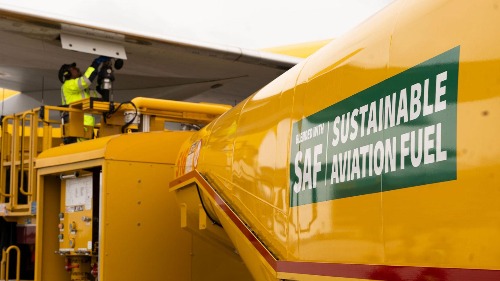
DHL Express has begun using sustainable aviation fuel (SAF) at Paris Charles de Gaulle Airport (CDG), becoming the first express logistics provider to deploy the fuel at the airport. The initiative follows a one-year supply agreement with TotalEnergies covering an initial volume of five million litres of SAF for aircraft operating from DHL’s regional hub.
Announced on 9 November 2026, the agreement marks the first use of SAF by DHL Express in France. The first aircraft using the fuel departed from Paris CDG on the same day.
The arrangement is renewable for further one-year periods and will cover flights departing from the DHL hub to the company’s air hubs in Leipzig, Casablanca, Milan and London.
DHL expects the initiative to reduce its emissions in France by approximately 11,800 tonnes of carbon dioxide equivalent (CO₂e) annually.
Five million litres of SAF to supply DHL’s Paris operations
The agreement between DHL Express and TotalEnergies establishes an initial annual supply of five million litres of SAF for DHL aircraft departing from Paris CDG.
The deployment coincides with the fifth anniversary of DHL’s French air hub at the airport. Opened in 2021 following an investment of €170 million, the facility is one of the key hubs in DHL’s European network.
Travis Cobb, Executive Vice-President of Global Network Operations and Aviation at DHL Express, said SAF accounted for 10% of the aviation fuel used across DHL’s own aircraft fleet in 2025. He described the Paris deployment as part of the group’s wider strategy to reduce emissions from express transportation and help customers address transport-related indirect emissions.
Philippe Prétat, CEO of DHL Express France, said the introduction of SAF at the hub marked a further step in the company’s efforts to reduce the environmental impact of international logistics.
Mathieu Soulas, Director of New Mobilities at TotalEnergies, said the agreement would strengthen the companies’ collaboration and support the wider adoption of SAF in aviation.
SAF deployment expected to cut emissions by 11,800 tonnes annually
DHL estimates that the use of SAF under the French initiative will reduce emissions by approximately 11,800 tonnes of CO₂e per year.
The company says SAF can reduce lifecycle greenhouse gas emissions by around 80% compared with conventional fossil-based jet fuel. The actual reduction depends on the feedstock and production pathway used, with lifecycle assessments accounting for emissions associated with fuel production, transport and use.
SAF can be used in existing aircraft and aviation fuel infrastructure, subject to applicable fuel specifications and blending limits. DHL identifies waste and residual materials, including used cooking oil, as potential feedstocks for the fuel.
The company plans to incorporate the SAF volumes supplied under the agreement into its GoGreen Plus offering. The programme uses a book-and-claim mechanism to allocate emissions reductions to participating customers. Under this approach, sustainable fuel can be used within DHL’s network while the associated environmental benefits are assigned to customers purchasing the service, even when their individual shipments are not carried on aircraft using that specific fuel.
SAF forms part of DHL’s wider transport decarbonisation strategy
The Paris deployment complements DHL Express France’s efforts to reduce emissions from its road transport operations.
The company reports that all its owned light commercial vehicles in France are electric. It also serves 55 city centres using lower-emission delivery methods, including walking, bicycles and cargo tricycles. DHL began deploying cargo tricycles in France in 2005 and says it continues to use parcel collection and drop-off points, alongside partnerships with start-ups, to reduce delivery journeys.
At group level, DHL has set a target for two-thirds of its last-mile delivery vehicles to be electric by 2030.
Paris CDG hub supports DHL’s European air cargo network
The SAF initiative is being introduced at DHL’s Paris Charles de Gaulle hub, which opened in 2021 and represents the company’s largest investment in France since it began operating in the country in 1976.
The facility occupies a 91,000-square-metre site, with 34,000 square metres of operational space. Its sorting system can process up to 38,000 parcels and documents per hour. The hub operates around the clock and employs approximately 760 people.
The five-million-litre SAF agreement adds an alternative aviation fuel supply to the hub’s operations, linking the Paris facility with DHL’s wider European air network.
Bioenergy Business Analysis
DHL’s agreement with TotalEnergies demonstrates how SAF procurement is moving from group-level sustainability commitments into specific airport operations. The five-million-litre initial supply gives the Paris CDG deployment a defined volume and a one-year timeframe, while the option to renew the agreement could provide scope for continued use.
The projected annual emissions reduction of 11,800 tonnes of CO₂e is significant for the French operation, but the wider impact will depend on the fuel’s lifecycle carbon intensity, the volume actually supplied and consumed, and how the associated reductions are accounted for through the GoGreen Plus book-and-claim system.
For the SAF market, the agreement also illustrates the importance of partnerships between fuel suppliers and large aviation customers. Securing recurring demand from logistics operators can support the development of supply chains, although the scale-up of SAF use will continue to depend on production capacity, feedstock availability and competitive pricing.



