


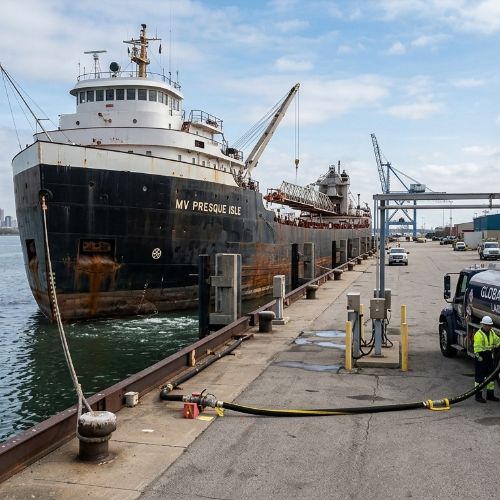
Global marine biodiesel demand is expected to more than double between 2025 and 2031, reaching nearly 2 billion litres annually, according to the International Energy Agency’s (IEA) Renewables 2026 report. The forecast assumes that the International Maritime Organization (IMO) does not adopt its proposed Net-Zero Framework during the period.
Demand is projected to increase from just under 1 billion litres per year in 2025 to nearly 2 billion litres in 2031. Despite the growth, marine biodiesel would account for only 0.6% of total marine fuel consumption by the end of the forecast period.
The IEA identifies marine biodiesel as the leading commercially available renewable fuel in maritime transport. However, it is expected to contribute only 1% of the growth in renewable energy use across the transport sector between 2025 and 2031.
Europe to drive 80% of marine biodiesel demand growth
Europe is expected to account for four-fifths of the projected increase in marine biodiesel demand, supported by the European Union’s FuelEU Maritime regulation.
The regulation, which has applied since January 2025, sets limits on the annual average greenhouse gas (GHG) intensity of energy used on board ships above 5,000 gross tonnage calling at European ports. It adopts a well-to-wake approach, accounting for emissions across the fuel lifecycle rather than considering only emissions from combustion.
FuelEU Maritime requires GHG intensity reductions of 6% by 2030 and 14.5% by 2035, relative to its 2020 reference level. The IEA expects marine biodiesel to deliver a significant share of the sector’s near-term emissions reductions while other alternative fuels and energy-efficiency measures expand.
Most of the remaining growth in the IEA’s main forecast is expected to come from Singapore and China. Ports in these markets supply vessels serving European trade routes, linking regional bunkering activity to demand created by EU regulations. Growth in other markets is expected to remain limited in the absence of stronger policy support.
IMO Net-Zero Framework could lift demand above 12 billion litres
The IEA’s accelerated scenario projects a substantially larger market if the IMO adopts its proposed Net-Zero Framework. Under this scenario, marine biodiesel demand could exceed 12 billion litres annually by 2031, equivalent to 4% of total marine fuel consumption.
The proposed framework would apply to oceangoing ships above 5,000 gross tonnage, representing roughly 97% of the global merchant fleet by tonnage. It would introduce a two-tier greenhouse gas fuel-intensity reduction system, combining targets with a pricing mechanism for emissions above the permitted thresholds.
Under the draft measures assessed by the IEA, ships missing the base target of an 8% reduction by 2030 would face a charge of US$380 per tonne of CO₂ equivalent. Those failing to meet the more ambitious 21% compliance target would face a lower charge of US$100 per tonne of CO₂ equivalent.
The IEA expects marine biodiesel, liquefied natural gas (LNG) and liquefied biomethane to be among the more commercially available options for ships seeking to meet the initial 8% target through lower-emission fuel use or credits.
Achieving the 21% reduction would be more challenging. Bio-methanol, e-methanol and ammonia remain relatively scarce and costly, while the lower charge associated with missing the more ambitious target could weaken the incentive to meet it.
The framework’s adoption process remains unresolved. Following the adjournment of the IMO’s extraordinary session in October 2025, further discussions are scheduled ahead of the Marine Environment Protection Committee’s 85th session from 30 November to 3 December 2026. The IMO has indicated that the resumed extraordinary session could take place on 4 December, subject to confirmation.
Asia-Pacific to capture the largest share in the accelerated scenario
If the IMO framework is adopted, Asia-Pacific is expected to account for the largest share of additional marine biodiesel demand. The region’s consumption could reach around 6 billion litres annually by 2031 under the accelerated scenario, approximately twice the projected level in Europe.
However, the IEA cautions that the availability of biodiesel could constrain this growth. Competition for sustainable feedstocks from road transport and aviation may limit the volumes available to shipping, particularly as demand for biodiesel, renewable diesel and sustainable aviation fuel increases.
The agency also notes that marine biodiesel prices have remained around twice the level of very-low-sulphur fuel oil over the past three years. Limited policy incentives outside the EU, feedstock competition and the cost of sustainable raw materials have contributed to the price premium.
The IEA says stronger policy support and measures to expand sustainable feedstock supplies will be needed to reduce costs and support wider adoption of marine biodiesel.
Bioenergy Business Analysis
The IEA forecast highlights the importance of maritime emissions policy in shaping the next phase of marine biodiesel demand. Under the main scenario, growth remains concentrated in Europe, where FuelEU Maritime provides a clear regulatory driver. Adoption of the IMO Net-Zero Framework could expand the market significantly by extending decarbonisation requirements across most of the global merchant fleet.
However, the accelerated outlook also exposes a potential supply constraint. Marine biodiesel will compete with road transport and aviation for sustainable feedstocks, while its current price premium over conventional marine fuel remains substantial. The ability to scale production without compromising feedstock sustainability will therefore be central to meeting additional demand.
Related: marine biodiesel supplier map for Great Lakes shipping