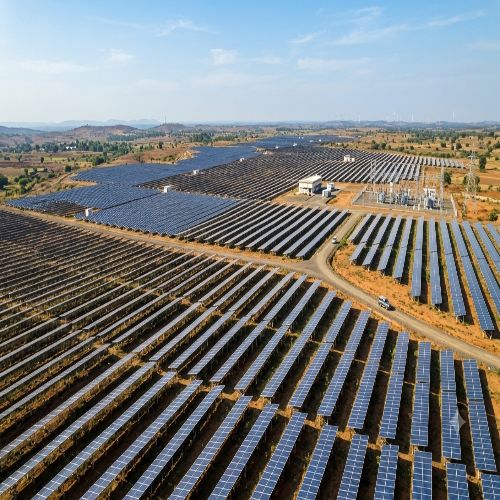
Fourth Partner Energy (FPEL) has signed a memorandum of understanding (MoU) with the Government of Andhra Pradesh to invest approximately ₹2,000 crore in three renewable energy projects, comprising two solar installations and a wind-solar hybrid facility.
The agreement was signed on 13 November 2026 in the presence of Andhra Pradesh Chief Minister N. Chandrababu Naidu during the 31st Confederation of Indian Industry (CII) Partnership Summit in Visakhapatnam.
Under the MoU, FPEL plans to develop two solar projects with capacities of 120 MWp and 117 MWp, respectively. The third project will combine 60 MW of wind capacity with 60 MWp of solar capacity.
The proposed investment will expand the company’s renewable energy portfolio in Andhra Pradesh, where it already operates solar projects serving commercial and industrial (C&I) customers.
FPEL outlines three solar and wind project developments
The proposed development programme includes two standalone solar installations and one hybrid renewable energy project.
The first solar project will have a capacity of 120 MWp, while the second will have a planned capacity of 117 MWp. The hybrid facility will combine 60 MW of wind generation with 60 MWp of solar capacity.
FPEL has not disclosed the proposed locations, individual project costs, commissioning schedules or expected annual electricity generation for the three developments.
The projects remain at the MoU and planning stage, with their implementation dependent on further development and applicable regulatory approvals.
Company seeks clarity on battery storage and wind project approvals
Alongside the investment announcement, FPEL highlighted regulatory issues affecting renewable energy project development in Andhra Pradesh.
Pradeep Namburi, Head of Finance and Accounts and Executive Committee member at Fourth Partner Energy, said the company welcomed the state’s commitment to transparent allocation of grid connectivity. He also called for faster single-window clearances and timely regulatory approvals to support the delivery of energy, infrastructure and manufacturing projects.
Pavan Kumar, Regional Lead – Open Access Projects at FPEL, highlighted the need for the state government to release government orders (GOs) associated with older wind energy projects that have not been developed over the previous three to five years.
He also said greater clarity on Andhra Pradesh’s battery energy storage system (BESS) implementation policy would help the company plan storage deployment and supply round-the-clock renewable electricity to industrial customers.
Battery storage can help address the variability of solar and wind generation by storing electricity for use when renewable generation is lower. Its integration with hybrid renewable energy projects can support more consistent electricity supply, although the company has not disclosed a storage capacity for the proposed Andhra Pradesh developments.
Existing solar operations support FPEL’s Andhra Pradesh expansion
FPEL already has an operational solar park at Chakrayapet in Andhra Pradesh, supplying renewable electricity to Brakes India, Hatsun Agro, INDO-MIM and CMR NLM Eco Aluminium.
The company has also installed rooftop solar systems for government institutions, including Tirupati Airport and the Greater Visakhapatnam Municipal Corporation (GVMC), as well as engineering colleges in Bhimavaram and Kurnool.
Its corporate rooftop solar portfolio in the state includes installations for companies such as Walmart, UltraTech, Colgate-Palmolive, Solara Pharma, Laurus Labs, Rockman Industries, Manjushree Technopak and Metro Cash & Carry.
The new MoU is expected to expand FPEL’s presence in the state’s utility-scale and open-access renewable energy segments.
FPEL targets 9 GW renewable energy portfolio by 2031
As of September 2026, FPEL had 2 GW of installed solar and wind capacity, with another 3 GW of projects under active development across India.
The company aims to expand its renewable energy portfolio to 9 GW by 2031 through faster project execution and growth in its commercial and industrial customer base.
The Andhra Pradesh agreement adds three proposed projects to this expansion strategy, although their individual implementation schedules and contribution to the company’s capacity target have not been disclosed.
For Andhra Pradesh, the investment commitment adds to the state’s efforts to attract renewable energy development and strengthen its clean energy infrastructure. The eventual contribution of the projects will depend on their execution, grid connectivity and regulatory clearances.