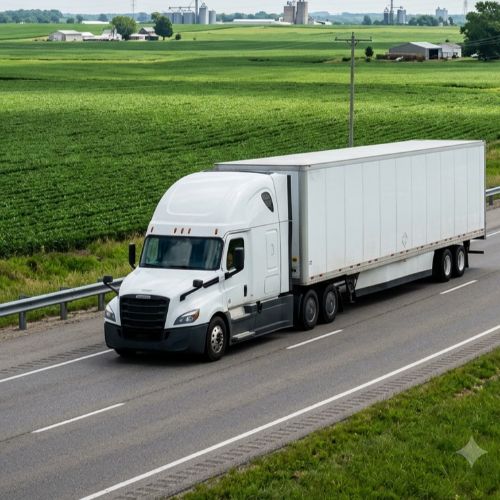
John Deere has launched a six-month trial using five heavy-duty trucks capable of operating primarily on 100% biodiesel (B100), in a collaboration with Optimus Technologies and Penske Truck Leasing. The trucks will transport John Deere parts and products on commercial routes in the US Midwest, with the deployment expected to consume more than 85,000 gallons of biodiesel and cover over 700,000 miles annually.
The initiative, named Field to Freight, uses five new 2027 Freightliner Cascadia trucks fitted with Optimus Technologies’ Vector System. Chevron will supply the B100 from its biodiesel production facility in Seneca, Illinois. The fuel is produced using agricultural feedstocks, including soybean oil and distillers corn oil.
According to the companies, the projected fuel requirement is equivalent to the oil produced from approximately 60,000 bushels of soybeans. The project is also expected to reduce lifecycle greenhouse gas emissions by up to 85% compared with petroleum diesel.
B100 deployment links agricultural feedstocks with freight operations
The trucks will carry John Deere parts and products from its North American Parts Distribution Center in Milan, Illinois, to warehouses and dealerships. The initial deployment covers routes in Illinois and Iowa, according to the Iowa Soybean Association.
The programme connects agricultural feedstock production with commercial freight demand. Soybean oil and distillers corn oil used to produce the biodiesel will supply fuel for trucks transporting agricultural machinery parts and other products through the company’s logistics network.
John Deere’s logistics operations currently consume nearly 4 million gallons of diesel annually across a fleet of approximately 400 semi-trucks, according to the Iowa Soybean Association. The five-truck trial will allow the company to assess the potential for expanding B100 use across its wider logistics operations.
The partners will evaluate vehicle reliability, maintenance requirements, fuelling arrangements, driver experience and operating economics during the deployment.
Optimus Vector System enables diesel engines to operate on B100
The trucks are equipped with Optimus Technologies’ patented Vector System, which allows conventional heavy-duty diesel engines to operate primarily on B100 while retaining the option to use petroleum diesel when required.
The system uses a dual-tank arrangement. The trucks start on conventional diesel, while engine heat warms the biodiesel tank. Once the fuel reaches the required operating conditions, the system switches the engine to B100. Before shutdown, the fuel lines are flushed back with diesel. The system can also switch to petroleum diesel if B100 is unavailable.
This arrangement is intended to support B100 use in heavy-duty vehicles while retaining a conventional diesel option. It is central to the programme’s evaluation of how renewable fuel can be incorporated into existing freight operations without requiring fleets to adopt an entirely different vehicle platform.
Optimus Technologies CEO Colin Huwyler said more than 1,300 trucks equipped with the company’s technology had travelled over 250 million miles in commercial service. The company said the collaboration would demonstrate how B100 technology could be incorporated into a full-service leasing model.
Penske provides leasing and maintenance support
Penske Truck Leasing is providing the vehicles through its full-service leasing model, which includes maintenance and over-the-road support. The arrangement is intended to allow John Deere to evaluate B100-powered freight operations while using an established vehicle leasing and service network.
CPC Logistics is managing John Deere’s fleet operations and drivers, while Chevron is supplying the biodiesel from its Seneca facility.
Penske’s involvement brings vehicle procurement, maintenance and operational support into the trial. The partners will use the six-month deployment to assess the practical requirements and costs associated with operating B100 trucks on regular commercial routes.
Bioenergy Business Analysis
The Field to Freight programme provides a real-world test of B100 in heavy-duty commercial transportation. Its significance lies not only in the planned use of more than 85,000 gallons of biodiesel, but also in the attempt to integrate the fuel into a fleet model supported by conventional truck leasing and maintenance services.
The trial also creates a direct link between agricultural feedstock markets and freight fuel demand. Soybean oil and distillers corn oil are being used to produce the biodiesel, while the trucks will transport products serving the agricultural sector.
However, the deployment remains limited to five vehicles over an initial six-month period. The projected annual mileage, fuel consumption and emissions reductions are estimates rather than independently reported operating results.