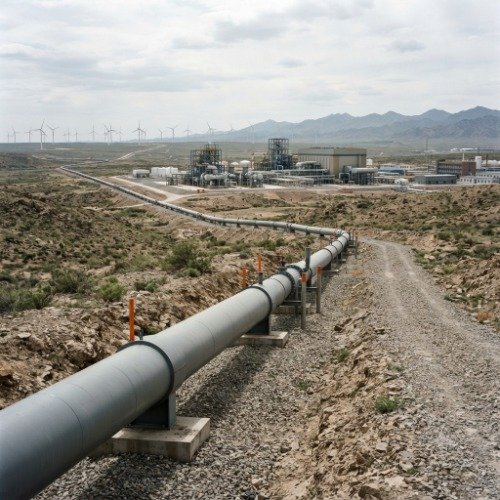
China has brought a 195-kilometre pure hydrogen pipeline into operation in Baotou, Inner Mongolia, establishing its first operational hydrogen pipeline exceeding 100 kilometres and creating a new transportation link between renewable hydrogen production and industrial consumers.
The pipeline connects green hydrogen production facilities in Darhan Muminggan United Banner with industrial users in Baotou. Its commissioning was announced during the 2026 Hydrogen Energy Industry Development Conference held in the city on 19 November 2026.
Designed to transport up to 100,000 tonnes of hydrogen annually, the pipeline is expected to reduce transportation costs from approximately RMB 13 per kilogram to RMB 3 per kilogram when operating at full capacity. This represents a potential reduction of around 77%, according to the project information reported by Chinese state media.
195-km pipeline connects hydrogen production with industrial demand
The pipeline is intended to support the movement of green hydrogen from renewable energy-rich areas of Inner Mongolia to industrial consumers.
Baotou benefits from substantial wind and solar resources, providing renewable electricity for hydrogen production. The city has an annual green hydrogen production capacity of approximately 7,800 tonnes, while its industrial base creates potential demand across chemicals, metallurgy, gas and transportation.
Baotou Mayor Meng Qingwei highlighted the combination of renewable energy resources and established industrial demand as important factors supporting the development of the local hydrogen economy.
The pipeline is designed to address one of the key infrastructure constraints facing the hydrogen sector: transporting hydrogen economically from production locations to end users.
Specialised steel developed to address hydrogen embrittlement
The construction of long-distance hydrogen pipelines presents technical challenges because hydrogen can interact with pipeline materials under high-pressure operating conditions.
Hydrogen atoms can diffuse into steel, potentially causing hydrogen embrittlement and reducing the material’s ductility and toughness. These effects can increase the risk of cracking and material failure.
To address this issue, Baotou Iron and Steel Group developed anti-hydrogen-embrittlement steel for the project.
Engineers also faced construction challenges associated with complex geological conditions, steep mountainous terrain, and the welding and protection requirements of high-pressure pure hydrogen pipelines.
The use of specialised steel and pipeline engineering measures was intended to address these challenges and support the safe transportation of hydrogen.
Pipeline targets 100,000 tonnes of annual transportation capacity
The infrastructure has a designed transportation capacity of 100,000 tonnes per year. At full utilisation, the projected reduction in transportation costs from RMB 13 to RMB 3 per kilogram could improve the economics of supplying hydrogen to industrial consumers.
Project developer Inner Mongolia Huadian Hydrogen Energy Industry Technology Development Co., Ltd. said the pipeline could support wider hydrogen use in chemicals, metallurgy and transportation.
Company representative Wang Xinyu also described the project as an opportunity to develop experience in constructing and operating large-scale pure hydrogen pipeline infrastructure.
However, the designed capacity should not be confused with actual annual throughput. The extent to which the pipeline achieves its target will depend on hydrogen supply, industrial demand, utilisation rates and commercial arrangements.
China advances its national hydrogen development strategy
China is seeking to expand hydrogen production and consumption as part of its broader energy transition and industrial decarbonisation strategy.
According to the supplied report, the country produced more than 39 million tonnes of hydrogen in 2025, making it the world’s largest hydrogen producer and consumer.
In 2022, China released its Medium- and Long-Term Plan for the Development of the Hydrogen Energy Industry (2021–2035). The strategy sets out a framework for developing the hydrogen industry, including renewable hydrogen production, infrastructure and industrial applications.
The commissioning of the Inner Mongolia pipeline adds a major transportation component to this development. By connecting renewable hydrogen production with industrial demand, the project could provide a model for larger-scale hydrogen distribution infrastructure in China.