


Hong Kong is positioning sustainable aviation fuel (SAF) as a strategic industry as it seeks to strengthen its role as an international aviation hub and develop deeper clean-fuel links across the Greater Bay Area (GBA).
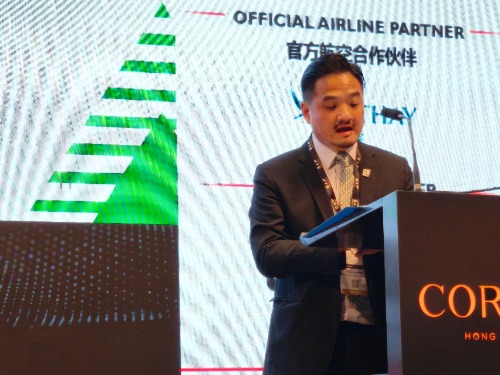
Stephen Wong Yuen-shan, head of Hong Kong’s Chief Executive’s Policy Unit (CEPU), said SAF could support both the city’s aviation ambitions and the development of a cross-boundary clean-energy industry. He was speaking at the Sustainable Aviation Futures China Congress.
Hong Kong’s first five-year plan sets a target for SAF to account for 1% to 3% of fuel consumption for flights departing from Hong Kong International Airport (HKIA) by 2030. The 2026 Policy Address also commits the government to study an SAF mandate by 2028, according to Wong.
SAF Moves Up Hong Kong’s Policy Agenda
Wong said SAF has gained a significantly larger role in Hong Kong’s policy framework in recent years.
He noted that SAF received limited attention in the 2023 Policy Address but now has a standalone heading in both Hong Kong’s first five-year plan and the 2026 Policy Address.
The five-year plan provides a longer-term framework for the development of SAF demand, while the proposed study of a mandate could determine whether Hong Kong moves beyond voluntary targets towards a regulatory requirement.
Wong argued that greater policy certainty could help create a clearer investment environment for SAF producers, airlines and other participants in the supply chain.
The 2030 consumption target applies to flights departing from HKIA, but the source does not specify the mechanism through which airlines would meet the target or how SAF eligibility and sustainability criteria would be administered.
Greater Bay Area SAF Supply Chain Takes Shape
Wong also highlighted developments involving EcoCeres, a Hong Kong-incubated company that converts waste cooking oil into certified SAF.
According to Wong, EcoCeres has signed an investment letter of intent for a new SAF production facility in Dongguan, Guangdong. The facility is expected to produce approximately 450,000 tonnes per year of SAF and renewable diesel at full production.
The announcement describes the project as a potential foundation for what could become the Greater Bay Area’s first end-to-end SAF value chain.
Under the model outlined by Wong, waste-based feedstock could be collected across the GBA, while refining and fuel production would take place in Dongguan. Hong Kong would contribute research and development and headquarters-related services.
The arrangement is intended to combine the capabilities of different GBA cities rather than replicate the same activities across the region.
The 450,000-tonne figure is an expected full-production capacity cited by Wong and should not be interpreted as current output. The source also does not provide a commissioning date or detailed investment value for the proposed Dongguan facility.
Hong Kong Seeks Role Beyond Fuel Consumption
The policy approach goes beyond securing SAF supplies for HKIA.
Wong said Hong Kong could use SAF to develop a wider regional industry encompassing feedstock collection, fuel production, research and development, certification and corporate services.
He pointed to the HKIA Dongguan Logistics Park as an example of how Hong Kong’s economic infrastructure can be extended into the Greater Bay Area while maintaining international connections.
For SAF, the proposed model would allow different locations to specialise in different parts of the value chain.
This could give Hong Kong a role in the development of clean aviation fuels without requiring every stage of production to be located within the city itself.
Global SAF Policies Increase Pressure on Aviation Hubs
The discussion comes as governments and aviation institutions increase their focus on SAF as part of aviation decarbonisation.
Wong referenced the International Civil Aviation Organization’s objective of reducing international aviation emissions by 5% by 2030 through SAF and other cleaner energy sources. He also pointed to SAF policies and targets being developed in the European Union, the United Kingdom, Singapore and Japan.
For Hong Kong, the policy challenge is therefore not limited to domestic fuel consumption.
Wong said aviation hubs increasingly need access to reliable SAF supplies and credible sustainability certification as international aviation regulations and commercial requirements evolve.
His comments link SAF availability directly to Hong Kong’s longer-term ambition of maintaining its position as an international aviation hub.
SAF Links Hong Kong’s Aviation and Industrial Strategies
The SAF strategy also connects with China’s broader clean-energy policy direction.
Wong said the national 15th Five-Year Plan calls for accelerating the green transformation of economic and social development and extending the green hydrogen value chain towards products including green ammonia, methanol and SAF.
Against that backdrop, Hong Kong is seeking to develop a role in the emerging clean-fuels economy while supporting its aviation sector.
The city’s first five-year plan provides a 2030 horizon for SAF consumption, while the planned study of a mandate by 2028 could provide further direction for the market.
Bioenergy Business Analysis
Hong Kong’s SAF strategy combines demand creation at HKIA with an attempt to build a wider regional supply chain. The 1–3% 2030 consumption target provides a defined demand signal, while the proposed study of a mandate could potentially provide a stronger regulatory framework if implemented.
The proposed Dongguan facility adds an industrial dimension to the strategy, particularly through its planned use of waste-based feedstock and its potential integration with Hong Kong’s research, headquarters and aviation infrastructure. However, the facility remains subject to the development and execution of the announced plans, and its expected 450,000-tonne annual output should not be treated as current production.
The next milestones to watch are Hong Kong’s work towards the planned 2028 SAF mandate study, implementation details for the 2030 consumption target and further development of the proposed Dongguan production facility.