


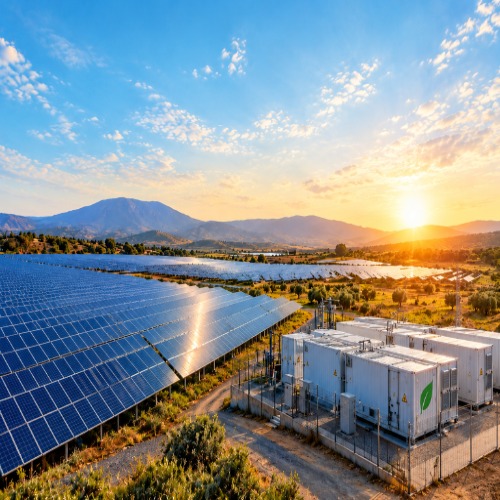
Spanish renewable energy company Bruc Alter Energias Renovables SA has secured €222 million in debt financing to support the operation of a 208 MW solar portfolio and its hybridisation with battery energy storage systems (BESS) with a combined capacity of 651 MWh.
The financing, provided by BNPP-AM, Banco Santander, Banco Sabadell and Banco Cooperativo, will support assets located in Spain’s Andalusia and Extremadura regions. The addition of battery storage is expected to improve operational flexibility and help the solar portfolio manage electricity generation more effectively.
Four Lenders Back Solar and Storage Hybridisation
Alter Enersun announced the financing on behalf of the joint venture, Bruc Alter Energias Renovables. Alter Enersun holds a 45% stake in the company, while Bruc Energy owns the remaining 55%.
The funding combines an operating solar portfolio with battery storage, reflecting the growing role of energy storage in renewable power projects. Solar generation varies with daylight and weather conditions, while battery systems can store electricity and discharge it at a later time, subject to system configuration and operating conditions.
For the Spanish assets, the integration of BESS is expected to provide greater flexibility in managing the electricity generated by the solar plants. The source announcement does not specify the individual project capacities, battery power ratings or commissioning timelines.
Joint Venture Originates from 550 MW Solar Development Plan
Bruc Alter Energias was established in 2010 by Bruc Energy and Alter Enersun to advance a portfolio of 12 solar projects with a combined planned capacity of 550 MW in Andalusia and Extremadura. The partnership brought together the two Spanish companies to develop photovoltaic assets in these regions.
The latest financing concerns a 208 MW solar portfolio paired with 651 MWh of battery storage. The figures represent different measures: megawatts (MW) describe power capacity, while megawatt-hours (MWh) indicate how much energy a battery system can store.
Bioenergy Business Analysis
The financing highlights the role of battery storage in the evolution of Spain’s renewable electricity market. Pairing solar generation with storage can help project operators shift some electricity delivery away from periods of peak solar output and respond more flexibly to market conditions. The actual benefits will depend on battery power ratings, operating strategy, grid access and electricity market prices.
The €222 million debt package also demonstrates lender participation in hybrid renewable energy assets. For developers, combining solar and storage within a portfolio may create additional options for managing generation and market exposure. However, the announcement does not disclose the financing terms, the expected revenue contribution from storage or the anticipated financial returns.
The key development to watch is how the 651 MWh storage capacity is integrated into the 208 MW portfolio and how effectively the combined assets use their flexibility in the electricity market. The deal adds to the broader trend of pairing battery systems with solar generation as Spain’s renewable energy sector develops its capacity to manage variable output.


