


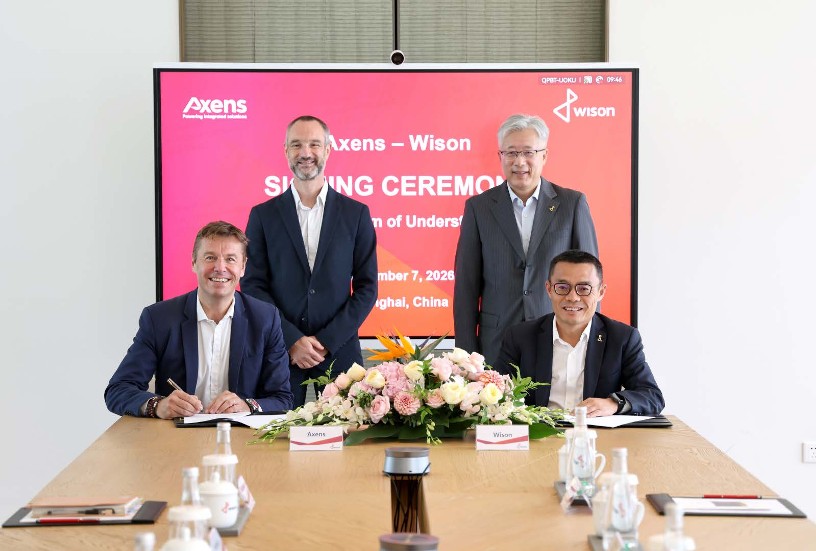
Axens and Wison Engineering have signed a memorandum of understanding (MoU) to explore collaboration on Sustainable Aviation Fuel (SAF) and electric Sustainable Aviation Fuel (eSAF) projects worldwide, including projects using the Fischer-Tropsch pathway.
Signed in Shanghai on September 7, the agreement will examine ways to combine Axens’ process technology expertise with Wison Engineering’s capabilities in standardised and modularised engineering, global supply-chain integration and international project execution. The companies aim to develop eSAF project solutions that can improve cost and schedule predictability while enabling faster deployment and replication across markets.
The collaboration comes as SAF developers face challenges extending beyond technology selection, with financing, project execution, capital costs and construction schedules increasingly important to bringing projects to final investment decision (FID).
Axens and Wison target more predictable eSAF projects delivery
Under the MoU, the companies will assess practical execution models for selected SAF projects, with a focus on reducing development complexity and improving certainty around project costs and timelines.
The partners said the framework is intended to help project developers streamline early-stage development, improve cost control and address barriers to bankability ahead of FID and commercial deployment.
Wison Engineering CTO Hengwei Liu said the main challenge for SAF and eSAF is no longer technology alone, but the ability to turn proven technologies into projects that are predictable, bankable and scalable.
“By combining Axens’ process technology with Wison’s capabilities in standardized and modularized engineering, global supply-chain integration and project execution, we aim to reduce development complexity, improve cost and schedule certainty, and create solutions that can be efficiently replicated across markets.”
Liu said the objective is to shorten the route from technology development to FID and commercial deployment.
Fischer-Tropsch pathway included in collaboration
The agreement includes the Fischer-Tropsch (FT) pathway, which can be used to convert synthesis gas into liquid hydrocarbons for applications including SAF.
Axens has technologies covering several SAF pathways, including Fischer-Tropsch. Its Gasel® technology converts synthesis gas derived from sources including biomass and captured carbon oxides into liquid fuels, while the company also has expertise in reverse water-gas shift and fuel upgrading technologies.
For eSAF production, Fischer-Tropsch synthesis can form part of a process chain in which hydrogen and carbon oxides are converted into synthetic hydrocarbons before upgrading into aviation fuel.
Axens Executive Vice President for Technology and Technical Support Jacques Rault said the partnership would combine Wison’s engineering and modular execution capabilities with Axens’ technology portfolio.
“By bringing Carboverseo™ and Gasel® (respectively Reverse Water Gas Shift, Fischer Tropsch and Upgrading) technology expertise and Wison’s engineering and modular execution capabilities, we aim to provide our customers with a more integrated and efficient pathway, from project definition to commercial operation.”
Focus shifts from technology to bankable SAF projects
The partnership reflects a broader challenge facing the emerging eSAF market: moving from technically viable production pathways to projects that can secure financing and be delivered at predictable cost and schedule.
Axens said its portfolio covers process technologies, catalysts, equipment and services across energy-transition applications, including SAF. Wison Engineering provides EPC and integrated technology services across the energy and chemicals sectors, with capabilities spanning consulting, engineering, procurement, construction and project management.
Their proposed combination of process licensing, modularisation and global engineering could allow future SAF developers to standardise parts of project design and supply chains. In principle, greater standardisation could reduce engineering duplication and shorten construction timelines, although the commercial impact will depend on individual project specifications, feedstock availability, financing and local regulatory requirements.
The companies have not announced a specific eSAF project under the MoU, nor disclosed investment values, production capacity or commissioning timelines.
Instead, the agreement establishes a framework for identifying and supporting selected SAF projects as they progress towards FID and eventual commercial operation.
Read also: China introduces dedicated SAF tariff codes as exports gain momentum