


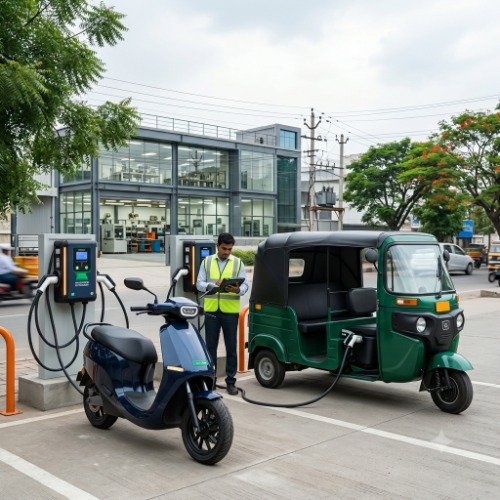
Bengaluru-based power electronics company Dynolt Technologies has reported more than 1 lakh deployments of its indigenously designed and manufactured electric vehicle (EV) chargers for two- and three-wheelers within 18 months of commercialisation, marking an expansion of its presence in India’s electric mobility supply chain.
The company said it is currently recording fivefold year-on-year growth, driven by demand for its charging technology from electric vehicle manufacturers and battery-swapping operators. The growth figure was disclosed by Dynolt, although the company did not provide the underlying revenue or deployment comparison.
Dynolt also said that three of India’s top 10 electric vehicle manufacturers source their charging technology exclusively from the company. This reflects its growing engagement with domestic vehicle manufacturers, which increasingly require charging systems designed around their vehicle architectures and performance requirements.
Dynolt to expand engineering workforce by 2027
As part of its expansion plans, Dynolt intends to strengthen its research and development (R&D) centre in Bengaluru and increase its engineering workforce to more than 150 professionals by the end of 2027.
Founded in 2022, the company currently employs more than 300 people, including over 100 engineers. It has also received a grant from the Ministry of Electronics and Information Technology (MeitY), although the announcement did not disclose the grant amount or the specific programme under which it was awarded.
Dynolt develops power conversion hardware, embedded firmware and control software for EV charging infrastructure, renewable energy and energy storage applications. The company said it designs and owns its technology stack, rather than assembling products from imported component kits.
New products planned for electric vehicles and energy storage
Beyond its existing two- and three-wheeler charging portfolio, Dynolt is developing charging systems for electric four-wheelers. Its planned technology development also includes power electronics for energy storage, vehicle-to-grid (V2G) and vehicle-to-load (V2L) applications.
V2G technology enables electricity to flow from an electric vehicle’s battery back to the power grid, while V2L allows a vehicle to supply electricity to external appliances and equipment. These applications can broaden the role of EVs beyond transportation, although their deployment depends on compatible vehicles, charging systems and supporting infrastructure.
The company works directly with EV manufacturers to develop charging technologies tailored to individual vehicle designs and performance requirements. It is also focusing on the serviceability of its products beyond their warranty periods, supported by proprietary technology and a nationwide after-sales service network.
Building domestic power electronics capabilities
Rajesh Sura, Co-founder and CEO of Dynolt Technologies, said the company was established to develop power conversion technologies in India and reduce dependence on imported power electronics.
He attributed the company’s deployment milestone to its end-to-end ownership of technology, adding that this provides a foundation for further investment in engineering, manufacturing and product development.
The company’s expansion comes as India’s electric mobility ecosystem requires charging systems and power electronics suited to a growing range of vehicle platforms. Domestic technology development can also support localisation efforts in the EV supply chain.



