


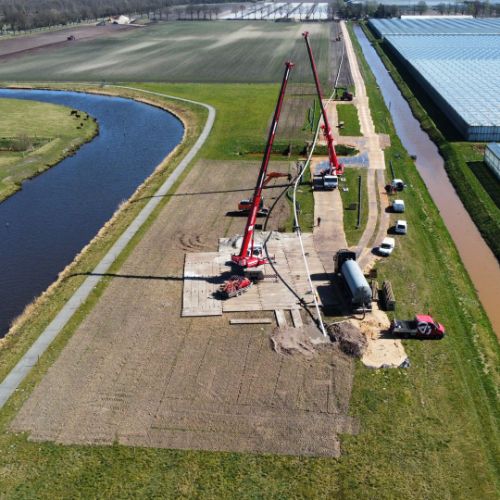
Dutch energy infrastructure company Gasunie has repurposed an existing 60-kilometre natural gas pipeline to collect biomethane from regional distribution networks and transport it into the country’s national gas transmission network, in collaboration with regional operators RENDO, Enexis and Coteq.
The pipeline, operated by Gasunie Transport Services (GTS), a wholly owned subsidiary of Gasunie, connects the three regional distribution networks to the national transmission system. It passes through five municipalities: Emmen, Coevorden, Hoogeveen, Hardenberg and Ommen.
The conversion allows biomethane produced in regional areas to be transported to locations with greater demand, addressing network constraints that can arise when local production exceeds consumption.
Gasunie Executive Board member Hans Coenen said,
“Our gathering pipeline creates more growth capacity for biomethane and increases the supply of home-grown renewable energy to households and industry.”
Gasunie installs two biomethane boosters at Ommen facility
Biomethane collected through the pipeline will be transported to a GTS facility in Ommen, where two new biomethane boosters increase the gas pressure to enable its injection into the national transmission network.
By repurposing an existing natural gas pipeline, GTS has also limited the impact of the infrastructure work on the surrounding areas.
The project brings together the national transmission operator and three regional distribution system operators to improve the movement of renewable gas between production sites and the wider gas network.
NV RENDO Managing Director Eddy Veenstra said,
“It is of the utmost importance for the energy transition that we scale up biomethane production. Besides, every single cubic metre of biomethane produced here in the Netherlands reduces our dependence on other countries. And the underlying idea in rural areas is that when you produce biomethane you reduce nitrogen emissions!”
He added: “The new gathering pipeline will make it possible, also in the longer term, to feed in and transport more and more biomethane in regional areas.”
Enexis CTO Walter Grootveld highlighted the growth in regional biomethane production, particularly in Drenthe province.
“We are seeing strong growth in biomethane feed-in in the Drenthe province. Connecting these production sites to Gasunie’s gathering pipeline enables large volumes of biomethane to be transported from regional areas to the national grid,” Grootveld said.
Coteq Managing Director Gerald de Haan said increasing biomethane volumes were already entering the company’s networks.
“Biomethane plays a key role in the energy supply, both today and tomorrow. Increasing volumes of biomethane are being fed into our networks. The gathering pipeline creates scope to further increase biomethane production, as we jointly make yet another key step towards a sustainable, reliable and affordable energy supply,” he said.
GTS Managing Director Jeroen Zanting also highlighted the cooperation involved in completing the infrastructure project.
“We have all worked very hard to make this happen. This project truly was a collective effort. That is also exactly what this milestone illustrates. If we want to make biomethane grow, we’re going to have to do it together,” Zanting said.
Pipeline addresses seasonal biomethane network constraints
The new collection infrastructure is intended to address a mismatch between biomethane production and gas consumption patterns.
Biomethane is produced throughout the year, while gas demand varies considerably by season. During summer, lower consumption can result in local surpluses in regional distribution networks, restricting the ability of producers to feed additional volumes into the system.
The gathering pipeline provides an alternative route for transporting these volumes to areas with demand, connecting regional production with the national transmission network.
According to Gasunie, biomethane production in the Netherlands increased by 14% in the preceding year, while the number of producers also continued to grow. The additional network capacity is intended to accommodate rising production and support further expansion of the domestic biomethane sector.
Dutch blending obligation expected to encourage biomethane investment
Gasunie expects the Netherlands’ biomethane blending obligation to play an important role in expanding the market for renewable gas.
The proposed obligation is intended to create more consistent demand for biomethane, providing producers with greater certainty over the sale of their output and potentially encouraging investment in additional production facilities.
Coenen said: “The blending obligation will create steady demand for biomethane, offering producers greater certainty that their biomethane will be sold. This will, in turn, incentivise them to invest in new plants and further ramp up their biomethane production.”
The proposed policy is part of the Netherlands’ wider efforts to increase the share of renewable gas in its energy mix. Its implementation is expected to influence future investment decisions across biomethane production and supporting infrastructure.
Biomethane’s role in the existing gas network
Biomethane is produced from organic waste streams, including food residues unsuitable for human consumption, manure and sewage sludge. These materials can be converted into renewable gas through anaerobic digestion, followed by upgrading to remove impurities and increase methane concentration.
Gasunie also identifies gasification technology as a potential future production pathway.
Unlike electricity generated from renewable sources, biomethane can be transported through compatible existing gas infrastructure and used by households and industrial consumers as a substitute for natural gas.
The Dutch pipeline conversion demonstrates how existing gas transmission assets can support the integration of renewable gases while connecting decentralised production facilities with larger energy markets.
Bioenergy Business Analysis
Gasunie’s 60-kilometre pipeline conversion highlights an important infrastructure requirement for scaling up biomethane: connecting regional production capacity with national demand.
As the number of biomethane producers increases, regional distribution networks may face limitations in accommodating additional gas volumes, particularly during periods of lower consumption. Collection pipelines connecting regional networks to national transmission systems can help address these constraints.
The project also demonstrates the potential of repurposing existing natural gas infrastructure to support renewable gas transportation, reducing the need for entirely new pipeline routes.
For the Netherlands, the combination of additional network capacity and a proposed blending obligation could support investment across both biomethane production and distribution. However, sustained growth will depend on the development of new production facilities, suitable grid connections and a stable regulatory framework.



