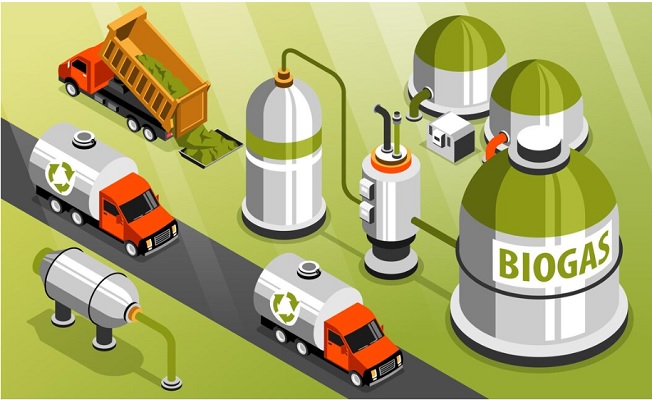
Gujarat Energy Ltd (GEL) is looking to develop 200 tonnes per day (TPD) of compressed biogas (CBG) capacity through joint ventures, marking a new phase in the state-owned gas distributor’s efforts to source more domestically produced renewable gas. The company has invited partners to develop plants in Gujarat and other states, with an estimated investment of ₹100 crore.
The proposed capacity will be divided equally between Gujarat and locations outside the state. Rather than developing a single large facility, GEL intends to establish multiple plants of 10–20 TPD, with the size of each project determined by the availability of agricultural and organic waste in the surrounding area.
The initiative is expected to support the company’s compressed biogas blending requirements while providing an additional source of gas for its existing distribution network.
GEL Proposes 49% Stake in CBG Joint Ventures
Under the expression of interest (EOI), GEL plans to hold a 49% equity stake in the proposed joint venture companies, with selected private partners owning the remaining 51%.
The joint ventures will be responsible for establishing and operating the CBG facilities, while GEL will facilitate the purchase and distribution of the gas through its city gas distribution (CGD) network.
Managing Director Avantika Singh told investors that the company had initiated its entry into the CBG business as part of a broader strategy to diversify its gas procurement portfolio.
The development is also intended to make use of existing natural gas infrastructure, potentially allowing locally produced CBG to replace a portion of imported gas over time.
CBG Plants to Use Agricultural Residues and Organic Waste
Feedstock availability will play a central role in determining the locations and capacities of the proposed plants.
GEL is considering several agricultural and organic waste streams, including paddy straw, sugar industry press mud, Napier grass, cattle dung, poultry litter and other crop residues.
The company plans to assess feedstock availability within the catchment area of each proposed facility before finalising its production configuration.
Plants may be developed within GEL’s existing CGD geographical areas or close to the pipeline infrastructure of Gujarat Integrated Gas Ltd (GIGL).
This would allow the renewable gas to be injected into the existing natural gas network, subject to applicable technical and quality requirements, rather than requiring a separate distribution system for every plant.
Gujarat Energy’s 200 TPD CBG Project: Key Details
| Particulars | Details |
|---|---|
| Company | Gujarat Energy Ltd (GEL) |
| Proposed CBG capacity | 200 TPD |
| Capacity in Gujarat | 100 TPD |
| Capacity outside Gujarat | 100 TPD |
| Estimated investment | ₹100 crore |
| Individual plant capacity | 10–20 TPD |
| GEL equity participation | 49% |
| JV partner equity participation | 51% |
| Feedstocks | Paddy straw, press mud, Napier grass, cattle dung, poultry litter and other agricultural residues |
| Project model | Joint venture ownership and operation |
| Gas offtake | Through GEL’s CGD network or connected pipeline infrastructure |
| Development status | Expression of interest issued |
CBG Blending Obligation Provides Policy Backdrop
GEL’s proposed investment comes as India’s city gas distribution companies prepare to increase the share of compressed biogas in their gas supply portfolios.
Under the Centre’s CBG Blending Obligation (CBO), the prescribed procurement obligation for the CNG transport and domestic PNG segments rises from 3% in FY2026–27 to 4% in FY2027–28 and 5% from FY2028–29.
The policy is intended to create a more predictable market for domestically produced CBG while supporting agricultural waste utilisation and reducing reliance on fossil-based gas.
For GEL, developing its own CBG production partnerships could provide greater visibility over renewable gas supplies as the blending requirement increases.
However, the commercial viability of individual projects will depend on feedstock costs, collection arrangements, plant utilisation and the ability to deliver gas economically into the distribution network.
Company Also Exploring Six LNG Fuelling Stations
Alongside its compressed biogas plans, GEL is evaluating the development of six liquefied natural gas (LNG) fuelling stations across its geographical areas.
The proposed stations would cater primarily to heavy commercial vehicles operating on long-distance routes, where LNG can offer greater onboard fuel storage capacity than conventional compressed natural gas systems.
The move would expand the company’s transport fuel business beyond its existing CNG station network.
GEL is also continuing to build its LNG sourcing portfolio. The company imported 24 LNG cargoes during the first half of FY2026–27, compared with 14 cargoes in the corresponding period of the previous financial year, according to the figures provided by management.
It is targeting an LNG sourcing portfolio of approximately 4 million tonnes per annum.
The parallel development of LNG infrastructure and compressed biogas capacity indicates that GEL is pursuing different supply strategies for different market requirements.
While LNG remains important to meeting near-term gas demand, domestic CBG production could gradually contribute to the company’s renewable gas procurement requirements.
What Comes Next for the CBG Projects?
The immediate priority will be the selection of suitable joint venture partners and the identification of locations where feedstock supply and gas offtake arrangements can support commercial operations.
The EOI process is expected to determine the potential developers and operating partners for the proposed facilities.
Construction timelines and commissioning dates have not yet been confirmed.
The proposed 200 TPD capacity therefore represents an initial development target rather than operational production.
If implemented, the projects would add a new domestic renewable gas supply source to GEL’s portfolio and contribute to India’s expanding compressed biogas industry.