


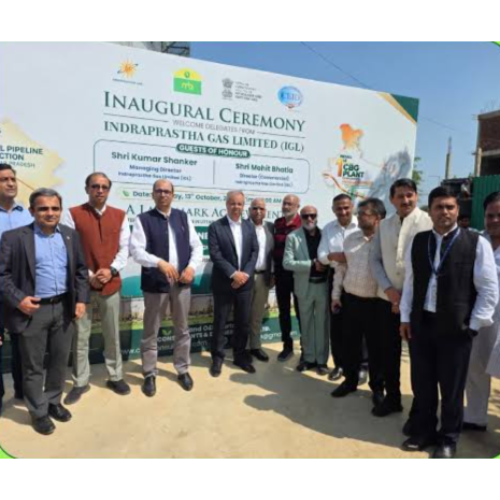
Indraprastha Gas Limited (IGL) has inaugurated a compressed biogas (CBG) plant operated by Mahelka Bioenergy Pvt. Ltd. in Meerut, Uttar Pradesh, introducing a gas-quality safeguard system designed to support the safe injection of CBG into the pipeline network.
According to IGL, the facility is the first CBG plant in India to incorporate its internally designed Gas Guard System. The plant has an initial production capacity of 10 tonnes per day (TPD), with a planned expansion to 40 TPD.
The inauguration was led by Mohit Bhatia, Director (Commercial) at IGL, in the presence of Ajai Tyagi, Executive Director (Business Development and Corporate Strategy), Bhudev Singh, Executive Director (PNG Operations and Maintenance), and other senior company officials.
CBG production and gas treatment technologies
The Meerut facility combines anaerobic digestion with gas upgrading and treatment technologies to produce compressed biogas. Its process configuration includes a continuously stirred tank reactor (CSTR)-based anaerobic digestion system, high-pressure water scrubbing, de-oxygenation and heat recovery.
Anaerobic digestion uses microorganisms to break down organic matter in an oxygen-free environment, producing biogas that can be upgraded by removing impurities and unwanted gases. The resulting fuel can be compressed for use as a substitute for conventional natural gas in suitable applications.
The Gas Guard System is intended to provide additional safeguards for gas quality before injection into the steel pipeline network. The announcement did not disclose detailed performance specifications or the system’s monitoring parameters.
Planned expansion to 40 TPD
The plant is expected to scale its capacity from an initial 10 TPD to 40 TPD in stages. The expansion would increase its potential contribution to CBG supply, although the timeline for reaching full capacity was not specified in the announcement.
IGL said the facility operates under the Government of India’s GOBARdhan initiative, which promotes the conversion of organic waste, including cattle dung and other biodegradable material, into biogas, compressed biogas and organic manure.
Alongside renewable fuel production, the project is intended to generate bio-manure as a useful by-product of the digestion process.
Bioenergy Business Analysis
The project highlights an important part of India’s CBG infrastructure build-out: integrating renewable gas production with systems that support quality control and pipeline delivery.
CBG plants must do more than produce biogas. The raw gas must be upgraded to meet applicable fuel-quality requirements, while contaminants and other unwanted components must be controlled before the gas enters a distribution network. Systems designed to safeguard gas quality can therefore play an important role in connecting decentralised waste-to-energy facilities with established gas infrastructure.
The proposed expansion from 10 TPD to 40 TPD could also increase the plant’s contribution to renewable gas supply. However, the commercial significance of that expansion will depend on implementation, feedstock availability, operational performance and sustained demand for the gas and its by-products.
For the wider Indian bioenergy sector, the project illustrates how CBG production, gas upgrading and distribution infrastructure need to develop together for waste-derived fuels to reach a broader market.


