

Jordan Green Ammonia has signed a 45-year land lease with the Aqaba Development Corporation (ADC) for approximately 30 hectares in Aqaba’s South Industrial Zone, completing the land arrangements for its planned renewable ammonia project in Jordan.
The agreement, announced on 19 November 2026, covers the site designated for the ammonia production facility. The project company had previously secured a separate lease for its solar generation site from the Aqaba Special Economic Zone Authority (ASEZA) in June 2026.
The development is planned to produce approximately 120,000 tonnes of renewable ammonia annually, with capital expenditure estimated at US$1.1 billion. The developers are targeting a final investment decision (FID) in 2027 and the start of operations in 2030.
The lease agreement was signed during the Jordan–European Union Investment Conference. However, it will take effect only after registration with the competent land department in Aqaba and fulfilment of the other contractual conditions. The project remains in the front-end engineering design (FEED) and permitting stages.
Jordan Green Ammonia completes leases for its principal sites
Jordan Green Ammonia is a project company established by Poland-based Hynfra P.S.A. and Jordan’s Fidelity Group. The newly signed agreement with ADC secures the land for the industrial facility, while the earlier ASEZA agreement covers the area intended for solar power generation.
The distinction is important because the approximately 30 hectares covered by the latest lease relate to the production site, not the combined area of the ammonia plant and its dedicated solar farm.
With both principal sites under lease, the project can progress with the development of its integrated production and energy infrastructure. The land agreements do not, however, represent a final investment decision or confirmation that project financing has been secured.
Plant designed for 120,000 tonnes of renewable ammonia annually
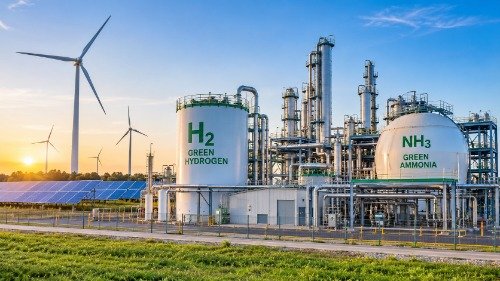
The planned facility will have nameplate production capacity of approximately 120,000 tonnes of renewable ammonia per year. Its proposed configuration combines dedicated solar generation, energy storage and desalination facilities, allowing the plant to operate independently of the electricity grid.
Hynfra’s project profile identifies a 550 MWp renewable energy installation for the development. The solar facility is intended to supply the electricity required to produce renewable hydrogen, which will then be converted into ammonia.
The desalination system is planned to provide the water required for the production process. Integrating power generation, storage, water supply and chemical production will be central to the project’s engineering and operating design.
The developers have not disclosed the planned energy storage capacity or the facility’s expected operating autonomy. These details will be important in assessing how the off-grid configuration will maintain production when solar generation fluctuates.
Engineering and financing remain ahead of the investment decision
The project is currently in the FEED and permitting phase. The developers have identified 2027 as the target for the final investment decision, while the estimated capital expenditure stands at approximately US$1.1 billion.
Jordan Green Ammonia has also reported progress in offtake arrangements with a major European agribusiness and fertiliser trading group. The prospective buyer has not been publicly identified, and the announcement does not disclose contracted volumes, pricing or the commercial terms of the arrangements.
Completion of engineering, regulatory approvals and financing will therefore be key steps before the project can move into construction.
Aqaba location supports domestic supply and export plans
The project is intended to serve both Jordan’s domestic market and international customers. Part of the planned ammonia output is expected to supply local industrial demand, including the phosphate fertiliser sector, while the remainder is intended for export through the Port of Aqaba.
The developers are targeting customers in fertiliser production, shipping and power generation. The project is also designed to meet the European Union’s requirements for renewable fuels of non-biological origin (RFNBO).
According to the announcement, Jordan’s Ministry of Energy and Mineral Resources estimates that the project could avoid approximately 200,000 tonnes of carbon dioxide emissions annually. This is a projected benefit, rather than an independently verified operational emissions reduction.
Securing the two principal sites marks a development milestone for Jordan Green Ammonia. The project’s progression towards its 2030 operating target will depend on completing engineering and permitting work, satisfying the lease conditions and securing the financing required for the estimated US$1.1 billion investment.