


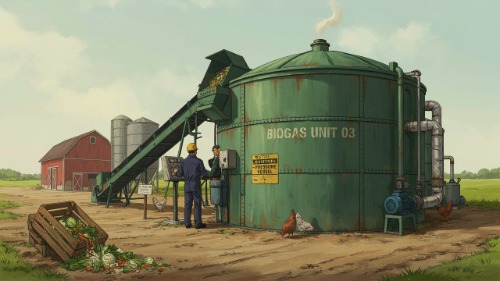
Kenya has demonstrated the potential of agricultural waste as an on-site energy resource, with 45,000 tonnes of vegetable waste converted into biogas at Vegpro’s Naivasha facility. Methane produced through the process was used to generate electricity for daily farm operations, according to the supplied source material.
The example highlights how organic residues from agricultural activity can be diverted into energy production rather than being managed solely as waste. At the Naivasha facility, vegetable waste serves as the feedstock for biogas production, with methane subsequently used as the fuel for electricity generation.
Vegetable Waste Used for On-Site Energy
The conversion of vegetable waste into biogas involves processing organic material to produce a methane-containing gas. In the Vegpro example, the methane generated from the vegetable waste was used to produce electricity that supported farm operations at the facility.
The supplied source does not specify the plant’s electricity-generation capacity, the quantity of biogas produced, or the amount of electricity generated. It also does not provide details on the technology provider, investment involved or the operating timeline.
The reported use of methane for farm electricity nevertheless illustrates an integrated approach in which agricultural residues can form part of an energy system serving the same site where the waste is generated.
Waste-to-Energy Technologies Offer Multiple Routes
The Vegpro example sits within a wider range of waste-to-energy technologies that can recover useful energy from discarded materials.
Incineration, for example, can use heat generated from waste combustion to produce steam and drive a turbine for electricity generation. The supplied source states that incineration can reduce waste volume by around 95–96%.
Other technologies, including gasification and pyrolysis, can process materials such as biomass, wood and plastic waste. These processes can produce a gas mixture containing carbon monoxide and hydrogen, although the specific technology, feedstock and operating conditions determine the resulting gas composition and its subsequent use.
Biogas production differs from these thermal conversion routes because it uses organic material as feedstock for biological conversion, producing biogas that contains methane and can subsequently be used for energy applications.
Agricultural Residues as an Energy Resource
The reported conversion of vegetable waste at Naivasha demonstrates one potential pathway for agricultural operations seeking to extract value from organic residues.
Rather than treating vegetable waste exclusively as a disposal challenge, the material can be incorporated into an energy-producing system. Where the resulting biogas is used on site, the approach can also connect waste management with local energy demand.
For agricultural businesses, the ability to use waste-derived methane for electricity generation creates a direct relationship between organic waste handling and energy production. The source, however, does not provide sufficient information to assess the project’s economics, overall energy efficiency or environmental performance.
Bioenergy Business Analysis
The Vegpro example highlights the practical connection between agricultural waste management and biogas-based energy generation. Converting 45,000 tonnes of vegetable waste into biogas demonstrates the scale at which organic residues can become an input for an energy system rather than simply a material requiring disposal.
For the wider bioenergy sector, the key issue is the ability to integrate feedstock availability, waste handling and energy demand into a commercially workable system. In this case, the reported use of methane-derived electricity for farm operations provides a direct end use for the recovered energy. More detailed information on plant capacity, biogas yields, electricity output and project economics would be needed to assess the facility’s overall performance.
The development also illustrates the broader range of waste-to-energy pathways available to agriculture and other sectors, with technology selection depending on the characteristics of the waste stream and the intended energy application.