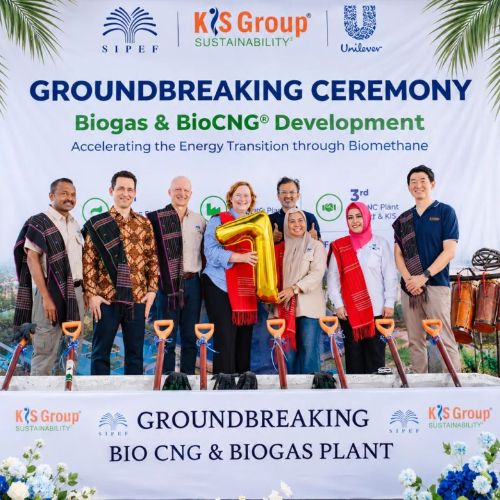
KIS Group and SIPEF Group have started construction of a new BioCNG facility at the Bukit Maradja Palm Oil Mill in Simalungun, North Sumatra, Indonesia. The project marks KIS Group’s seventh BioCNG plant globally and its third collaboration with SIPEF in Indonesia. The facility is expected to supply renewable gas to Unilever Oleochemical Indonesia, with operations targeted for the third quarter of 2027. Local outlet iNews Medan reported the groundbreaking at the Bukit Maradja mill.
The groundbreaking ceremony took place on 29 October 2026. The project is being developed by PT KIS Biofuels Indonesia, part of KIS Group, in collaboration with PT Tolan Tiga Indonesia, a SIPEF subsidiary. The project comes as the COP31 Biogas Declaration calls for wider deployment of biogas and biomethane.
The facility will capture methane from palm oil mill effluent (POME) and process the biogas into BioCNG, providing an alternative to conventional natural gas for industrial use.
The project also marks a milestone in KIS Group’s BioCNG portfolio, as it is the company’s seventh BioCNG plant globally, according to its LinkedIn announcement. It is the group’s third BioCNG project developed in collaboration with SIPEF in Indonesia, further expanding the partnership’s portfolio of waste-to-energy projects.
The milestone highlights KIS Group’s growing presence in the BioCNG sector, while the latest facility adds to its efforts to convert palm oil mill effluent (POME) into a transportable renewable fuel
New facility to process 17,879 Nm³ of biogas daily
The Bukit Maradja project is designed to process approximately 17,879 normal cubic metres of biogas per day. The gas will undergo purification to increase its methane concentration to above 96%, while reducing impurities including hydrogen sulphide and carbon dioxide, before being compressed into BioCNG.
The facility is expected to produce approximately 99,997 MMBtu of BioCNG annually. The fuel will be transported by truck over a distance of around 30 km to Unilever Oleochemical Indonesia, which is identified as the project’s offtaker.
The use of POME as feedstock will enable the project to capture methane generated by palm oil processing and convert it into a renewable fuel for industrial consumption.
According to reporting by IDN Times, the plant is targeted to begin operations in the third quarter of 2027.
Third BioCNG collaboration between KIS Group and SIPEF
The Bukit Maradja development extends the partnership between KIS Group and SIPEF, which began with biogas and methane-capture initiatives in 2013.
It is SIPEF’s third BioCNG project in Indonesia, following the Perlabian facility in North Sumatra and the Agro Muara Rupit project in South Sumatra. For KIS Group, the development represents its seventh BioCNG project globally.
The Perlabian facility has been operating since December 2025, while the Agro Muara Rupit project entered construction in October 2026. The Bukit Maradja project adds another facility to the partners’ expanding portfolio of palm oil waste-to-energy developments.
Unilever Oleochemical Indonesia is the intended recipient of the BioCNG produced at Bukit Maradja. Its involvement connects the project to industrial gas demand and the use of renewable fuels in oleochemical operations.
Investment and emissions reduction potential
IDN Times reported that SIPEF’s Indonesia operations director, Peter Bayliss, put the investment requirement at approximately US$1.5 million per plant for the three SIPEF BioCNG facilities, bringing their combined investment to US$4.5 million.
The Bukit Maradja facility is projected to avoid approximately 49,199 tonnes of CO₂-equivalent emissions annually, according to the same report. Across the three SIPEF-associated BioCNG projects at Perlabian, Agro Muara Rupit and Bukit Maradja, the combined annual emissions reduction potential is estimated at approximately 188,000 tonnes of CO₂-equivalent.
The projects form part of SIPEF’s broader efforts to improve resource efficiency and expand methane capture and renewable energy use across its palm oil operations.
Bioenergy Business Analysis
The Bukit Maradja development illustrates how palm oil processing residues can be used to produce renewable gas for industrial customers. By capturing methane from POME and upgrading it into BioCNG, the project links waste management at a palm oil mill with demand for alternative fuels in the industrial sector.
The partnership also demonstrates a recurring project-development model. KIS Group brings biogas and BioCNG technology and project-development capabilities, while SIPEF provides the palm oil mill setting and associated feedstock. Unilever Oleochemical Indonesia is positioned as the offtaker, providing an identified industrial application for the renewable gas.
The next milestones will include construction completion, commissioning, verification of production performance and the start of BioCNG deliveries to Unilever. The results will help demonstrate the potential for replicating POME-based biomethane projects across palm oil processing operations in Indonesia.